Intervention

With agreements like the one with Mexico, the EU binds itself to like-minded partners

The elimination of tariffs in a number of sectors will benefit exporters on both sides. The arrangement will open new markets for producers in both regions, while maintaining the highest standards of health and food safety and promoting environmentally friendly practices.

by Ursula von der Leyen
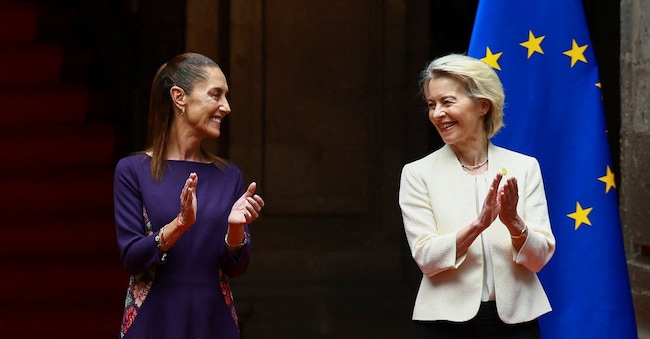
La presidente messicana Claudia Sheinbaum riceve la presidente della Commissione europea Ursula von der Leyen per un incontro finalizzato alla firma di accordi in materia di commercio, sicurezza e cooperazione, presso il Palazzo Nazionale, a Città del Messico REUTERS

3' min read

Translated by AI
Versione italiana

3' min read

Translated by AI
Versione italiana

For many decades, the EU and Mexico have been trusted partners. Now, in this era of increasing geopolitical tensions, we must seize every opportunity to deepen this partnership, and this week's EU-Mexico summit produced the results we need.

Our Global Agreement, signed in 1997, was one of the most ambitious ever concluded by the EU. This historic agreement - a pioneering advance for both sides - meant that trade between us quadrupled.

Loading...

Yesterday I had the honour to sign, together with President Claudia Sheinbaum, an update of this crucial agreement.

Europe is now Mexico's second largest export destination, while in turn, tens of thousands of European companies, the vast majority of them small businesses, export to Mexico. More than 11 000 European companies have offices in Mexico, directly or indirectly supporting 5 million jobs.

The world, however, has changed. We have entered a new and difficult phase. A time of tariffs and export controls, industrial rivalries and geopolitical fragmentation. Disruptions from the Middle East to the Indo-Pacific region clearly demonstrate how interconnected and vulnerable the global economy is. That is why our renewed EU-Mexico Global Agreement is so important: it binds us to each other for the long term, with the promise of achieving even greater benefits for our citizens.

The fundamentals remain the same: our common values, the desire to diversify our economies and the commitment to regulated cooperation. What is new is the urgency that characterises this moment. By modernising our Agreement we create a basic trust to deepen cooperation in a number of areas: risk reduction in strategic sectors, sustainable development and climate action, human rights and gender equality, and more.

In a world dominated by uncertainty, what really matters is our commitment to work closely together to promote international peace and security and reform global institutions, a signal that will be felt around the world.

Our commitment to growing trade and investment also counts. The elimination of tariffs in a number of areas will benefit exporters on both sides.

For example, in the agri-food sector, Mexico is a large and fast-growing market with over 130 million consumers and is a major importer. By eliminating 99 % of tariffs, the agreement will save the European agri-food sector around € 100 million per year and offer Mexican consumers a wider choice. It will open new markets for producers in both regions, while maintaining the highest standards of health and food safety and promoting environmentally friendly practices. Importantly, the agreement will protect hundreds of traditional products from imitation, products that encapsulate generations of tradition and craftsmanship. The agreement will protect this heritage while providing room for growth.

We are equally ambitious when it comes to investment: Europe is already one of the biggest sources of foreign investment in Mexico. Now we are investing another €5 billion in key areas: clean energy and the necessary infrastructure to bring it to all corners of the country; modern rail links and decarbonised ports; local pharmaceutical production and circular value chains. These changes benefit both sides: for Mexico, they mean high-quality jobs and increased domestic capacity; for Europe, the opening of new markets and the stabilisation of value chains. Overall, they mean greater economic security and competitiveness in the coming decades.

Another area of enhanced cooperation is that of critical raw minerals. Both the EU and Mexico need a reliable supply of these minerals to drive their green and digital economic transformation. Mexico is already a major supplier of fluorspar, used in chemicals, steel production and the ceramics industry. It is a major exporter of zinc and copper, the minerals that underpin power grids, batteries and clean technologies. Our modernised agreement eliminates all tariffs and restrictions on these minerals. At a time when critical resources are increasingly being weaponised, this will help ensure stable and reliable supply chains.

Europe and Mexico see the world through the same eyes. At a time of increasing fragmentation, we choose openness and partnership. A choice that will make both stronger.

2026 was a decisive year for Europe's ambitious trade agenda, and we are still only in May. We have made strong and ambitious new agreements with India, Australia and now Mexico, while our agreement with the Mercosur region is already provisionally applied.

The economic benefits of these agreements are undeniable, but their value goes far beyond that. We are linking up with like-minded partners, demonstrating the lasting value of win-win cooperation.

We are making Europe safer, stronger, more prosperous and more influential on the world stage. And we will achieve much more by the end of 2026.

President of the European Commission

Copyright reserved ©
Loading...

Brand connect

Loading...

Newsletter

Notizie e approfondimenti sugli avvenimenti politici, economici e finanziari.

Iscriviti