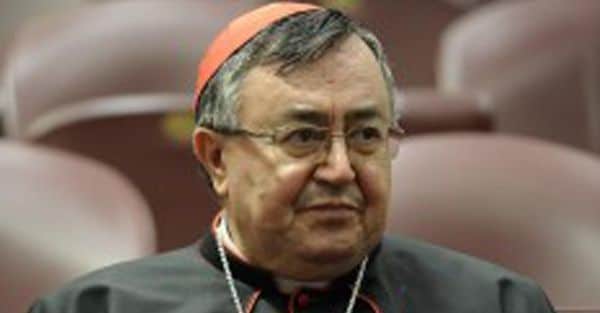
Conclave, Cardinal Vinko Puljic and the remote vote hypothesis
The Archbishop Emeritus of Sarajevo, 80 years old in September, is very ill. The prelate has nevertheless arrived in Rome, and intends to enter the Sistine Chapel. But it cannot be ruled out that, should his condition worsen, he will be forced to remain in Santa Marta

2' min read
2' min read
In the age of smart working, voting by mail or online, even the Conclave could experience remote voting for the first time. This sounds like heresy, given that the meeting of the cardinals to elect the Pope is by definition "cum clave", closed to the outside world. But in fact, already Pope John Paul II in 1996 had foreseen the possibility for a sick prelate to vote outside the Sistine Chapel. The problem this time arises because Cardinal Vinko Puljic, Archbishop Emeritus of Sarajevo, 80 years old in September, is very ill. The prelate has nevertheless arrived in Rome, and intends to enter the Sistine Chapel ('With the help I'll come in,' he said yesterday). But it cannot be ruled out that, should his condition worsen, he will be forced to stay in Santa Marta, the residence of the cardinals during the Conclave.
What the rules provide for
From the hotel to the Sistine is more than a kilometre, on foot is twenty minutes. Cardinals travel the distance by shuttle. Cardinal Puljic, even in a wheelchair, would have no problem getting around and entering. Even John Paul II and Francis eventually did not walk, but still managed to fulfil their ministry. But what if the Bosnian prelate could not even move from his bed in Santa Marta? No problem. The Constitution 'Universi Dominici Gregis', promulgated in 1996 by Pope John Paul II, allows remote voting even at the Conclave. The document provides that three cardinal electors, known as 'infirmarii', leave the Sistine at each vote and go to their sick brother, to make him vote and bring his ballot back to the Conclave. It is not surprising that such a derogation was granted by Pope Wojtyla, who in the last years of his life knew the burden of illness and infirmity.
Monday 5 May double congregation for cardinals
Meanwhile, the cardinals on Monday 5 May will double the time for discussion, with two congregations, both in the morning at 9 a.m. and in the afternoon at 5 p.m. This was reported by the director of the Vatican press office, Matteo Bruni. At the exit of today's congregation several cardinals, conversing with journalists, had hinted that there is not yet a shared figure and that they need more time for discussion among themselves. As far as Tuesday 6 May is concerned, only the morning congregation at 9 a.m. is currently scheduled. It will be assessed later whether a second congregation is needed for the afternoon.
For Puljic an exemplary story
Cardinal Puljic however faced much greater difficulties than this. He was appointed archbishop of Sarajevo in 1991, and a few months later war broke out in Bosnia. The prelate spent years under bombardment, mobilising the resources of the local church to help refugees and people affected by the fighting. Puljic has vociferously defended freedom of religion and the right to live in one's own land, against all forms of ethnic cleansing. He has met with political leaders and leaders of all religions to promote dialogue and pacification between Christians and Muslims and between Catholics and Orthodox. This work has earned him great respect, but also harsh criticism. On one occasion, he was arrested for 12 hours by the Serbian military.