
Confindustria South Tyrol: 'Lowering the cost of energy'
President Rieper: 'The South Tyrolean export system reached a record figure of eight billion in the last year'
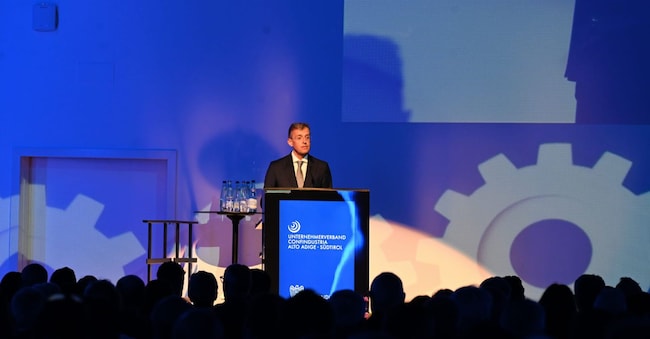
push for policies aimed at secure energy supplies at competitive prices as well as an industrial strategy for South Tyrol that reduces bureaucracy and guarantees the possibility for companies to grow and develop, while maintaining the area's industrial zones, starting with Bolzano, where the Valbruna steelworks are also located. These are the focal points of the report by the president of Confindustria Alto Adige, Alexander Rieper, illustrated during the general assembly of the association, held yesterday in the capital of the autonomous province. Rieper's appeal is addressed both to local institutions and to national and European ones.
The president of the region's entrepreneurs opened his speech by emphasising the ecological transition and rising energy costs, pointing out that local businesses pay up to 30 per cent more for energy than the European average: 'By 2040,' he said, 'the need for electricity will increase by 50 to 80 per cent. South Tyrol has the ideal prerequisites thanks to sun and water, but we need storage systems, grid investments and technology neutrality now, also considering wind and hydrogen'.
In the last 45 years, he added, 'the energy consumption of industry in South Tyrol has decreased by 40 per cent, but the output produced by our companies has increased significantly, thanks to technological development and their willingness to invest. The energy transition brings with it two big advantages: we protect the climate and, thanks to an energy mix based on renewable energies, we guarantee our independence. South Tyrol has the ideal conditions for this. We have plenty of water and sun. But this is not enough. We therefore absolutely need accumulation and storage systems'.
Alert for Brenner road blockade
One passage was devoted to mobility and the Brenner corridor, on the eve of the planned road blockade for protest on the Austrian side on 30 May. 'The free movement of people and goods is a pillar of the EU, blockades do not help, cooperation does,' warned Rieper. He also recalled that despite the geopolitical difficulties and the slowdown of the main trading partners (Germany and Austria), South Tyrolean industry recorded an all-time record of EUR 8 billion in exports last year. But holding back development, he recalled, is 'unnecessary bureaucracy'.
As for the Bolzano industrial zone, 'it is a strategic area,' emphasised Rieper, 'as are the other production areas in our territory, and its productive destination must be protected. In this sense, the step forward taken a few days ago regarding the future of the steelworks (with the Autonomous Province's openness to direct negotiations with the company, ndr) is important'. Finally, Rieper touched on the issues of employment and demographics: in 10 years' time, he said, there will be a shortage of 30,000 workers in South Tyrol and, in order to attract and retain talent, the implementation of the housing reform aimed at lowering land and house prices is needed, as well as, he emphasised, greater support for female employment and the activation of a one-stop shop for the integration of qualified workers from abroad.


