
Confitarma: ‘We need a transition pact and green credit for fleet renewal’
Mattarella: ‘When it comes to shipping, there are those who disregard agreed rules in order to impose their own. We must commit ourselves to thwarting these tendencies.’

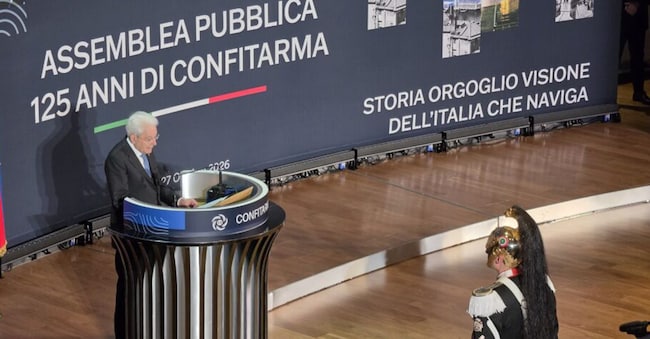
A national pact for the maritime energy transition which, as well as bringing together ‘institutions, shipowners, energy producers, the engine and shipbuilding industries to define a shared strategy’, also provides for “a new green shipbuilding loan scheme, drawing on the experience of the 1980s, to support fleet renewal and revitalise the entire industrial supply chain centred on the ship: the transition must translate into investments that reduce emissions and strengthen our competitive capacity”. This was the call made by the president of Confitarma, Mario Zanetti, during Confitarma’s public meeting, at which the 125th anniversary of the Confindustria-affiliated association of Italian shipowners was celebrated in the presence of the President of the Republic, Sergio Mattarella.
Zanetti’s appeal comes, moreover, at a difficult time for the global shipping industry. This was highlighted by the President of the Republic himself: ‘The repercussions of the current geo-economic and geopolitical crises,’ stated Mattarella in his address, ‘are having a significant impact on freedom of navigation, whilst this, by its very nature, requires – and depends on – rules. If we consider that, well before the International Maritime Organisation (IMO) was established in 1948, the rules governing free navigation through the Suez Canal originated in the 1888 Convention of Constantinople, we might conclude that, in the current international climate, there are those who disregard shared rules in order to impose their own, adopting a proprietary attitude, with the aim of turning the clock back significantly in the history of civilisation. We are therefore called upon to commit ourselves to thwarting these impulses.
‘Crises,’ he continued, ‘are multiplying: the Black Sea, the Red Sea, the Strait of Hormuz, piracy in the Horn of Africa and the Gulf of Guinea, to name but a few. Unconventional actors are joining state actors. Extensive international cooperation is tackling the issue of piracy, starting with the European Union’s effective Aspides mission, which is currently in full swing.”
On the geopolitical issues highlighted by Mattarella, Zanetti, for his part, stated that shipowners cannot ‘tolerate attacks on ships and crews, nor arbitrary restrictions or tolls in international straits’. For this reason, he added, ‘we are calling on the Government to champion, within Europe, an alliance for security and freedom of navigation’. And it is precisely this freedom of navigation that represents one of the four priorities Zanetti has identified as paramount for Confitarma.
The other three are the energy transition (on which the application for the shipbuilding loan focused); the competitiveness of the shipping industry (for which, he said, it is important to ‘maintain certainty in the tax framework’ and ‘ensure the full effectiveness of the International Register and the tonnage tax, with clear rules on the activities eligible for the two schemes. The budget is the main instrument for this, but parliamentary work is essential to continue on the path towards simplification’); and finally, employment and training (‘For our young people,’ explained the president of Confitarma, ‘we are working to make maritime professions more accessible and attractive, by overcoming regulations that are sometimes anachronistic’).


