Locarno

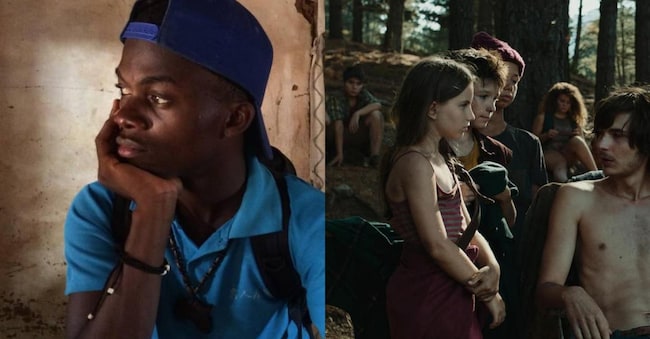
“Congo Boy”, a gripping musical drama

Rafiki Fariala’s autobiographical film was screened in Piazza Grande in Locarno

3' min read

Translated by AI
Versione italiana

3' min read

Translated by AI
Versione italiana

‘I am a Congolese refugee who arrived in the Central African Republic as a child. ‘Congo Boy’ is my story told through the character of Robert. Everything that happens in the film really happened to me’: this is how director Rafiki Fariala chose to introduce ‘Congo Boy’, a film featured in the Piazza Grande section of this year’s Locarno Film Festival.

Born in 1997, Rafiki Fariala made his feature film debut with *We, Students!* (2022), a documentary in which he featured himself and his friends, capturing their daily lives within the university setting and listening to their thoughts on the future of the Central African Republic: the film was screened in the Panorama section at the Berlin Film Festival and went on to win several awards at various international film festivals.

Loading...

“Congo Boy” is thus his debut in fiction cinema but, as the director points out, it is an equally autobiographical work that shares several characteristics with his previous film in terms of its socio-political reflection on the country to which Fariala arrived as a child, and in its aim to offer the perspective of a young man trying to find his place in an environment that is far from easy to live in.

Set in Bangui, the capital of the Central African Republic, the film centres on 17-year-old Robert, a young man who dreams of making music in a country torn apart by civil war. When his parents end up in prison, he is left on his own to look after his four younger siblings, juggling daily chores, odd jobs, school exams and concerts, determined to make his dream come true.

Through an extremely realistic style, Fariala succeeds in making his personal story, brought to the big screen, entirely credible, aided also by the film’s short running time (around 90 minutes), which avoids any potential verbosity or redundancy.


Art as a redemptive force


Music (and, consequently, art) becomes the only hope of salvation for the protagonist, Robert, just as cinema seems to have been for its young director, who does fall into a few narrative naiveties and some sequences that are a little too didactic, but who nevertheless manages to convey all the intensity of the life his protagonist must face on a daily basis.

Despite the harrowing backdrop of civil war and the devastation of a country ravaged by conflict, the film manages to offer more than just a glimmer of hope, thanks to its poetic touches which, for a few moments, soften the chaos of war and the impact it can have on young people.

The result is a deeply humanistic feature film, capable of striking a deep chord and, despite a few passages that are less successful than others, of moving the audience. Having already been screened in the Un Certain Regard section at the Cannes Film Festival, *Congo Boy* found its perfect setting at Piazza Grande; it is also worth noting how the director’s semi-documentary style has helped to make the cast’s performances very convincing.

Loading...


Wandering Trees


Meanwhile, Salvatore Mereu’s *Alberi erranti* was screened as part of the competition; it is the second Italian film in the running for the Pardo d’oro after Giovanni Tortorici’s *Ketticè*.

A filmmaker who has long been a regular on the stages of major festivals – from the Venice Film Festival to the Berlin Film Festival – Mereu has adapted Alberto Capitta’s novel *Alberi erranti e naufraghi* to create a truly ambitious film.

The story begins by telling of Piero and his son Giuliano, who live on their own on the outskirts of the town, in a cottage crammed with injured animals that they take in and nurse back to health. The Nonne, local dignitaries, want to drive them out because they live like vagabonds. During a heavy snowfall, Piero goes missing and the animals are killed. Giuliano sets out in search of his father. On his journey, he meets Maddalena and it is love at first sight.

Perhaps even more than the characters, however, it is the setting that is the true protagonist of the story: an unusual Sardinia, frozen in time, the perfect backdrop for a film in which fiction and reality intertwine to create an unconventional fairy tale.

“Alberi erranti” is an unconventional film, much like the journey Giuliano undertakes throughout the narrative; it is full of fascinating imagery, but also suffers from a truly excessive running time (180 minutes) that is not entirely justified by the film’s narrative structure.

Mereu once again proves himself to be a writer with an extremely personal and interesting style, but the messages he conveys could have been more incisive.

Copyright reserved ©
Loading...

Brand connect

Loading...

Newsletter

Notizie e approfondimenti sugli avvenimenti politici, economici e finanziari.

Iscriviti