
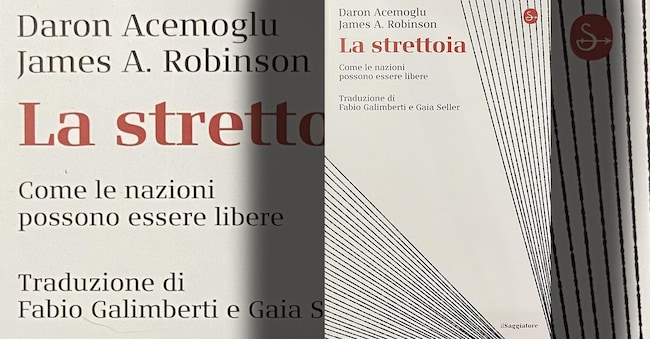
'The Bottleneck', review of the latest book by Nobel laureates Acemoglu and Robinson
The study by the two economists explains how a state that is efficient but not oppressive implies pressing action by society: only civic participation in institutional life legitimises public power
5' min read
5' min read
There is a civil pedagogy, to which we are accustomed, according to which the state exercises control over society, with rules and regulations that become institutions and gradually become culture. Acme - and at the same time the foundation of this construction - is the legitimate and exclusive use of force as the last resort guaranteed to the state to prevent forms of deviance or abuse.
Daron Acemoglu and James A. Robinson , winners of the 2024 Nobel Prize in Economics, do not like this state primacy. And they turn the paradigm upside down with the 800 pages of The Strait to demonstrate just the opposite: that it is the pressure of society, in the constant search for new articulations of power, that gives legitimacy and vitality to the idea of the state, in a perennial situation of competition. And the stronger the dialectic, the stronger the state. The stronger the awareness of the value of collective behaviour becomes, the more it avoids the supremacy of elites, to which the two authors do not attribute a useful guiding role. A contemporary theme if one looks, for example, at the growing weight of the Black lives matter movement and the influence it has had in the American presidential race. But also a theme of the 20th century, the century of the mystique of the opposition between movements and the state culminating in '68.
Civil pedagogy continues with 'the state is us'. But it is also true that 'society is us'. Here is the bottleneck, in this double identity. This is where the exercise of freedom is practised, the true object of the volume's analysis. Which answers a crucial question: why is freedom so rare in human history? An epoch-making question, just as epoch-making was the question Agemoglu and Robinson answered in their previous best seller Why Nations Fail.
The strong state is a bulwark against violence, an engine for the action of control and enforcement, an agency for the provision of essential services for its community. A strong society is one that exercises continuous checks and balances on power. Only thus does the system of checks and balances make the exercise of freedom worthwhile and prevent 'constitutions and guarantees from being worth more than the parchment on which they are written'.
The idea of the parchment takes us to the heart of Acemoglu and Robinson's narrative mode, which references myths and the culture of legends, ancient and contemporary, with an extraordinarily global palette, from the Greece of Solon the Archon to the India of the castes of the Arthashastra, the 324 BC treatise on the art of government, from the USA of Tocqueville to Trump's. And with bold twinnings such as that between Shevardnadze and Mohammed 'both called from outside' to resolve internal conflicts and cited as examples of the positive and irrepressible will to power.


