Science

Satellite constellations for computing and cloud systems

Leonardo's revolution started at davinci-1: the goal is computing systems that can also process data in orbit
by Leopoldo Benacchio

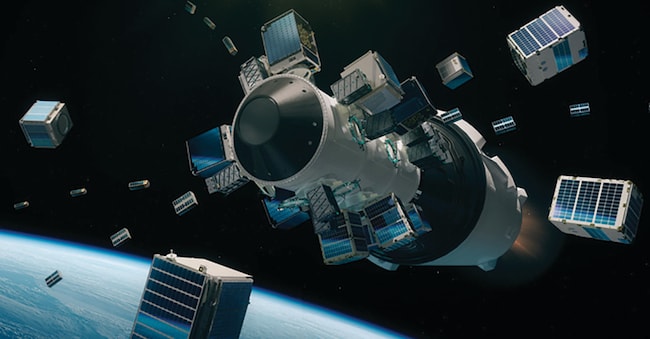
Operazioni nello spazio. Nell’illustrazione è raffigurato un vettore che  rilascia decine di satelliti piccoli e medi in orbita

4' min read

4' min read

High-performance computing, cloud, artificial intelligence, ultra-high-speed transmission: these are the ingredients of a revolution that Leonardo, together with its subsidiaries Telespazio and Thales Alenia Space, is taking from the ground to space.

The 200-server supercomputer

.

The story begins four years ago: Leonardo, at the suggestion of Roberto Cingolani, then not yet managing director and general manager, equips itself with one of the most powerful supercomputers in the aerospace defence and security sector. There are 200 servers, capable of five million billion operations per second, with a team of 20 researchers; the name is davinci-1 and, as Leonardo's own description goes, it 'combines flexibility and computing power, allowing the use of algorithms (from deep learning to Artificial Intelligence), customisation by technological platform and the calculation of the countless interactions between the data generated'.

Loading...

The first application on helicopters

Simone Ungaro, chief strategy & innovation officer at Leonardo, says that the first significant application was the analysis of the characteristics of one of Leonardo's most important products: helicopters. Thanks to the computational power acquired, 12 years of data recorded on the flights of various helicopter models were analysed to study the structural fatigue linked to the various uses, also thanks to a digital twin. This led to an understanding of how to handle the aircraft in different situations. 'Land, sea, water and even space can no longer be managed in a dichotomous way,' says Ungaro. And Leonardo applies this multi-domain to the military, with a system in which all technologies and platforms talk to each other and to space. Defence can therefore be approached in an integrated manner and already functions as a digital simulation model, a system in which the helicopter integrates with, for example, the drone and the aircraft and finally with a soldier.

What will happen in space?

.

Space plays the key part, because it is the best possible vantage point, and from this experience has come the conviction that the computational capability of a satellite is a fundamental element for any future system, and not only for defence, but also for agriculture, remote sensing and much more.

In space, avalanches of data are continually being generated, which are important for taking care of our planet. Think for instance of the European Copernicus system, whose satellites allow us to assess the sustainability of human activities: knowing exactly what the situation is like as seen and measured from space is increasingly indispensable. Having a good computational capacity on board the satellite also allows complex algorithms to be assembled. This makes the satellite more intelligent, let's say, but above all makes it possible to provide services that were not even possible to think of before, such as evaluating images, pre-processing them to evaluate them or to optimise transmission, and also making decisions according to what is observed.

"It is a kind of jigsaw puzzle that is starting to come together, whose pieces represent the work done over the past few years," says Massimo Comparini, Leonardo's managing director space business unit. So we are moving towards the realisation of a distributed computing system and a cloud, realised thanks to constellations of satellites.

From space missions to predictions

.

If we then think of the return programme to the Moon, Artemis, by NASA and 33 other countries, including our own, then by 2035 we will have some eighty Earth-Moon missions, and perhaps fifteen or so astronauts on the lunar ground. If we succeed in this, we will have an environment in which data streams are continuously generated that do not necessarily have to be transmitted or brought to earth, they can be processed and evaluated on the fly for local use. "It is also a commercial problem, if we consider the cyber security component: researchers on the Moon will make discoveries, develop products, register patents. They will have to be protected,' says Massimo Comparini again.

Until a few years ago, it was unthinkable to think of having this calculating and predictive capacity in orbit, and indeed there are still plenty of problems, for example those related to the usual cosmic rays, the real enemies of life in space, including that of computing systems. The CPUs that go into space are at least a couple of generations slower than those on earth, due to the need for engineering related to interference protection. This is a major problem that is supposed to be overcome with redundancy, which is the philosophy introduced by Starlink: if I have a lot of similar ones in orbit and one of them fails, I can still function perfectly. The costs of electronics, which have plummeted, and increasing miniaturisation allow us to think in these terms.

The other important point in forming a cloud is transmission: the satellites must work in unison and talk at very high speed, a point on which there is a lot of work to be done, although Starlink claims to be able to have satellite-to-satellite communication at one hundred giga.

"On-board computing and artificial intelligence will also be important in missions to distant worlds, allowing us a kind of adaptive and intelligent on-site space exploration; a vision that seems like science fiction today, but could also become reality," Comparini concludes.

Copyright reserved ©
Loading...

Brand connect

Loading...

Newsletter

Notizie e approfondimenti sugli avvenimenti politici, economici e finanziari.

Iscriviti