
Constituent Assembly, the women and men who made Italia
The exhibition at the Chamber recounts the recognition of women's right to vote, the referendum of 2 June and the extraordinary two years of the Constituent Assembly that led to the drafting of the Charter

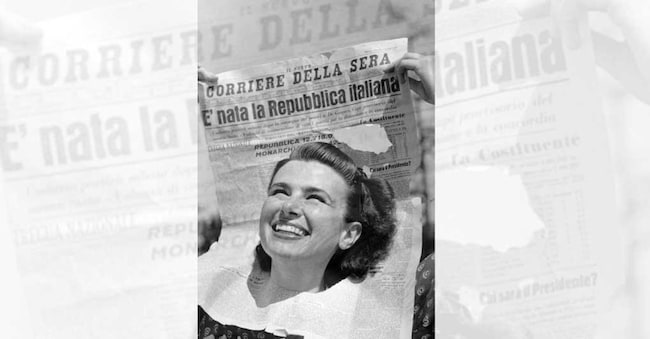
The choice of location alone is significant and transports those who arrive to those years of ferment and change: we are in the solemnity of the Sala della Lupa, in Montecitorio. It was here that the result of the referendum on the monarchy and the Republic was announced, and to see the outcome written on a typewritten protocol sheet - the original document - is moving. It is one of the many papers and various objects on display in the exhibition set up in the Chamber of Deputies to celebrate the vote for women, the twenty-one elected to the Constituent Assembly and the work of the Assembly, with the arrival of the Charter (one of the three original copies, the one given to Umberto Terracini, is kept in a display case; the others were given to Alcide De Gasperi and Giuseppe Grassi, Minister of Justice).
An immersion in the two-year period that decided the fate of Italy - on the 80th anniversary of the Republic - with the faces and words of the protagonists, films from the Istituto Luce, photographs, reproductions of posters, flyers, pages of newspapers. At the beginning of the itinerary, the proud face of Angela Maria Guidi Cingolani takes us to the (transitional) phase of the National Council, in the aftermath of the Liberation, which ferried the country towards 2 June 1946. There the Christian Democrat, a veteran of politics, delivered the first speech by a woman in a national public context, emphasising the exceptional nature of that moment which concerned not only her but all Italians. They would be called upon to vote (the exchange of letters between De Gasperi and Togliatti, on 20 January 1945, demonstrates the inalienability of this right) but could not yet be elected. They would have to wait until January '46 for the decree allowing them to stand as candidates in the spring administrative elections: a dress rehearsal for the following 2 June in which the first mayors and town councillors were appointed. From the columns of "Noi donne" and from the posters of the Udi, Cif and Azione femminile, appeals to vote and useful explanations ("How to vote", "What is the Constituent Assembly") proliferated, as well as motivating slogans ("Unite yourselves", "What we will ask for Italian women workers"): it was not to be taken for granted that - given the opportunity and the responsibility - women would answer the call. Instead they surprised everyone, already in the March/April vote, with mass participation. The polling booth, recreated in the exhibition itinerary together with the wooden ballot box in which to put the ballot paper, and the (original) ballot papers with all the party symbols hint at the enthusiasm of that day: pluralism and democratic representation stifled by fascism came back to life. Voting was by pure proportional representation and there were three lines to express preferences (there were plenty of surprises: the socialist Bianca Bianchi, in her own constituency of Florence-Pistoia, took almost twice as many votes as Pertini).
Already the partial results of the referendum - the differences between the republican North and the monarchy-ridden South are exposed and documented - show a country split. The confirmation comes from the 12,717,923 final votes for the Republic against the 10,719,284 consensus for the monarchy. Looming, moreover, is the thorn in the side of one and a half million void ballots. We were embarking on the construction of democracy with the need - not to say the obligation - for a spirit that would reconcile the various souls of a wounded Italia. The Constituent Assembly, which took office on 25 June, responded admirably, drafting a Charter that was the result of meticulous weaving: the documents reveal the long process that led to the final drafting of the key articles, which words appeared and which were eliminated or re-proposed in another way, in an effort to bring different sensibilities closer together. The stages in the approval of the Charter are followed, with the Charter coming into force on 1 January 1948, while a large photo shows the scene of the handing over of the approved text to the provisional Head of State, Enrico De Nicola: Teresa Mattei (the youngest of the twenty-one and secretary of the Assembly's presidential office) is next to him and, behind him, Bernardo Mattarella, Quaestor of the Constituent Assembly. A section of the exhibition presents the protagonists of that two-year period who later went on to rise institutionally in the Republic (the seven heads of state, the presidents of the Chamber of Deputies and the Senate), as if to consolidate in those roles the values they had helped to define in the Assembly.
A wall covered in writings, with cartoons and colourful phrases highlighting certain passages, catches the eye: it reproposes part of the 1,700 letters sent by citizens from all over Italia to their newly elected representatives, to remind them that there is a people bent over by war, waiting for answers on the rising price of food on the black market, on diseases they do not know how to cure, on the lack of work. Nor is there anyone who tries to send a score by proposing a new national anthem. The Peace Treaty signed in Paris (where Italia sits as a defeated country) calls into question the complex international situation in which the Republic will have to move and gain credibility. The Assembly ratified the Treaty, under De Gasperi's impetus, on 31 July 1947, after 300 Constituents had written an appeal to the French so that Italia would not be humiliated and punished by heavy territorial mutilation.
Documents from the Chamber's precious historical archive are central to the story and substantiate its accuracy. But the presentation of that season is moving, full of curiosity, and resorts to mechanisms that can bring young people closer, such as the touch screen (which activates access to press reviews, maps, audio of epoch-making speeches), or the life-size figures of Terracini and Nilde Iotti between which to take a selfie. It is an initiative addressed to all, but especially to them, so that they may realise, in the words of Piero Calamandrei, what the birth of the Republic was: a 'miracle of reason' in which they can recognise themselves deeply and with gratitude.


