
The 21st edition of “Contemporary Istanbul”
The art fair, which runs until 27 September, is being held in the new premises of Tersane Istanbul

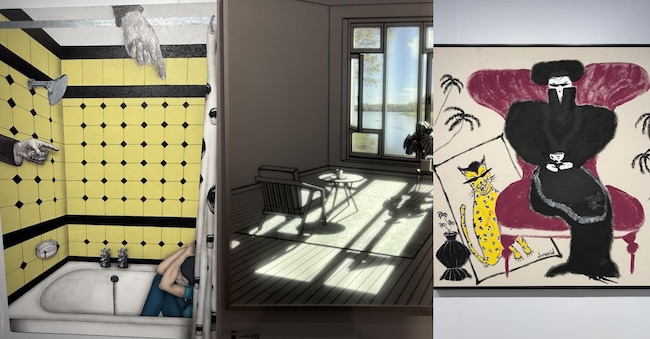
In Istanbul, the East is a presence that can be seen and heard. Perhaps this is also why Contemporary Istanbul, the contemporary art fair now in its twenty-first edition, has chosen to look precisely there, towards Asia, ‘not to add a new provenance to the catalogue of international galleries, but precisely to try to change the perspective’, explains Ali Güreli, founder and president of this fair, which every year welcomes thousands of visitors and achieves attendance and sales figures that would be the envy of any other fair of its kind in Europe – at least in Italia. The 2026 edition, running until 27 September, is being held in the new premises of Tersane Istanbul – a haven of true, classy luxury featuring shops, hotels and restaurants – is dedicating a comprehensive programme to the Asian art scene for the first time, “set to develop over the course of two years”, Güreli assures us.
‘A project involving galleries, artists, collectors and institutions that seeks to bring together art worlds which, until now, have often viewed one another from a distance.’ “It wasn’t easy, given the geopolitical situation and the cost of transport, insurance and logistics, but we’ve managed it,” he adds. A decision that says a great deal about the fair and perhaps even more about the city hosting it.
Istanbul
Istanbul, in fact, does not need to artificially build a bridge to Asia, because it is already situated within it. Yet it is precisely this proximity that now takes on a new meaning. The contemporary art market has become more complex, its centres have multiplied, and its trajectories no longer follow only the old routes between New York, London, Paris and Berlin. Tokyo, Seoul, Hong Kong, Singapore and New Delhi are now nodes in a network through which artists, capital, ideas, collectors and institutions circulate. Consequently, Contemporary Istanbul seeks to position itself within this network, viewing its place not as a historical given, but as a possibility. The scale of this edition clearly reflects this ambition, with more than 70 galleries taking part, hailing from 24 countries and including numerous newcomers. Among the Italian participants are Francesca Leone with JD Malat Gallery, Matteo Massagrande and Massimo Giannoni with Pontone. The Asian participants making their debut are Pearl Lam Projects, Takato Kano Gallery and Whitestone Gallery – all of which, by virtue of their geographical spread, already reflect a scene that is anything but homogeneous. Whitestone, for example, operates across Hong Kong, Taipei, Beijing, Tokyo, Singapore and Seoul. The Asian presence arriving in Istanbul is therefore not a uniform category, but a collection of different art ecosystems with histories, markets and sensibilities that cannot be reduced to a single definition. “We want to be more curious, more flexible and more open to what is happening in the world,” the president explained. ‘We don’t want to keep doing the same thing in the same way just because we’ve been doing it for years.’ What can an art fair become once it has moved beyond the stage of establishing itself and must now imagine its own future? One cannot help but wonder. In Istanbul, the answer lies not only within the exhibition halls, because Tersane – the historic shipyard on the Golden Horn, transformed into one of the city’s major new cultural hubs – is the centrepiece of a week in which the fair tends to spill out into the urban landscape. There is the Istanbul Biennial, the galleries of Beyoğlu and Karaköy, the museums – foremost among them, the spectacular Istanbul Modern, designed by Renzo Piano – and the more recent cultural spaces such as Zeyrek Çinili Hamam, which, within its ancient cisterns, hosts *Atlas of Encounters*, Alex Červený’s new exhibition, which is nothing short of astonishing. The city thus becomes part of the programme, and Contemporary Istanbul seeks its purpose even beyond the fair itself, in the opportunity to connect places and communities that, for the rest of the year, follow separate paths. And this is how ‘Focus: Asia’ takes on a broader significance, because it is not merely a matter of bringing new galleries to Istanbul, but of using the city’s location as a means of fostering connections. The CIF Dialogues series and *The Long and Winding Road* explore the transformations of contemporary art through the historical and cultural relationships between East and West. Guests include Akiko Miki, director of the Naoshima New Museum of Art; Naz Cuguoğlu of the Asian Art Museum; Felix Kwok, former head of Asian modern art at Sotheby’s; and the architect who loves the colour orange more than any other, Kulapat Yantrasast. CIF Bridges, the Contemporary Istanbul Foundation’s digital platform, is also following the same direction this year. The first event, ‘Art in Asia Today’, brought together Sarp Kerem Yavuz, the foundation’s artistic director, and Nick Buckley Wood, head of private sales for Asia at Sotheby’s.
Among the most recognisable names is Yayoi Kusama, with works presented by Whitestone Gallery and Takato Kano Gallery; however, alongside names now familiar to an international audience, there are also artists and artistic approaches less well known in the West. The same logic underlies ‘New Grounds’, the new section dedicated to young galleries and emerging artists. New York, Ankara, Prague, New Delhi, Istanbul and Tehran coexist in a space where geographical categories inevitably become blurred. Asia meets Europe, the Middle East meets the Americas, and established scenes meet those still taking shape. ‘After twenty years, Contemporary Istanbul does not seem content merely to grow, but appears to be redefining its role,’ concludes the president. Güreli describes the fair as a ‘cultural translator’, because at Tersane, overlooking the Golden Horn, the fair occupies a site that is part of the city’s industrial and maritime history and which is now being reclaimed for culture. Ships, people, goods, tourists, artists and collectors pass by all around, and Contemporary Istanbul seems to have realised that the most natural way to shape its future is not to choose a single direction, but to create new avenues for connection.
Contemporary Istanbul, until 27 September 2026

