
'We are the content': platforms, publishers and the new media marketplace
Massimo Scaglioni's book, 'Economics of the Media Industries', becomes the starting point to discuss the new media balance with Federico Silvestri, CEO of the Il Sole 24 Ore Group, Massimo Beduschi, ceo and chairman of WPP Media, Andrea Imperiali, professor at the Università Cattolica and member of the AgCom IA Committee, and Linus, editorial director of Radio Gedi

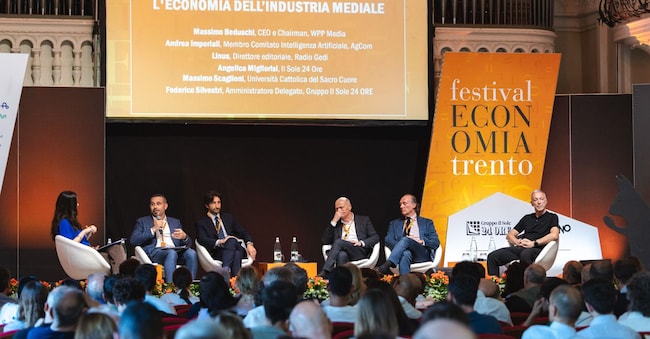
"We have moved from proprietary concentration to algorithmic concentration". The words of Andrea Imperiali, professor at the Università Cattolica and member of the IA Committee of AgCom, were one of the keys to the discussion at the Trenton Festival of Economics built around the book "Economics of Media Industries", edited by Massimo Scaglioni and published by Vita e Pensiero. A dialogue on the changes that in the last twenty years have affected the media, today economic, algorithmic and cultural infrastructures capable of affecting attention, reputation, advertising, consumption and perception of reality. Also on stage were Federico Silvestri, CEO of Il Sole 24 Ore Group, Massimo Beduschi, ceo and chairman of WPP Media, and Linus, editorial director of Radio Gedi.
In the book, and in the Trento discussion, the focus is on the shift of resources and attention from traditional publishing media to global platforms. "The economic-industrial theme and the democratic theme are not separable," Scaglioni explained. Digital advertising, programmatic advertising and concentration of resources affect the sustainability of media, the quality of content and the possibility of building a shared reality.
It is precisely in the advertising market that Beduschi sees the clearest shift. "Content is us", he said, referring to the users who feed the platforms with data and behaviour. "We have moved beyond attention and visibility, we are in the proximity of the decision," he continued. If the machine offers answers, for companies the challenge is no longer to be found: 'We need to be mentioned'.
And meanwhile, if value increasingly passes through platforms and algorithms, the issue also becomes who dictates the rules. In the past, Imperiali recalled, pluralism was measured by limiting the proprietary concentration of media. Today, the issue concerns a few global platforms capable of choosing which content to amplify. "It is not we who navigate Netflix's catalogue, it is Netflix's catalogue that navigates to us", he said. The risk also concerns 'addiction design', with effects on polarisation, information bubbles and young users.
For Silvestri, the transformation requires publishers to clarify their mission. "Netflix is not a publisher," he said. The challenge is to 'protect content' because producing quality information remains expensive and costs cannot be cut without reducing the editorial standard. Not to mention the problem of content provided 'most often for free' to platforms and piracy.A publisher will increasingly have to be a content producer with an authoritative brand.


