
Cali Cop seeks momentum on nature strategies
21 October in Colombia will take stock of country policies and the issue of financing. Focus on the role of business

4' min read
4' min read
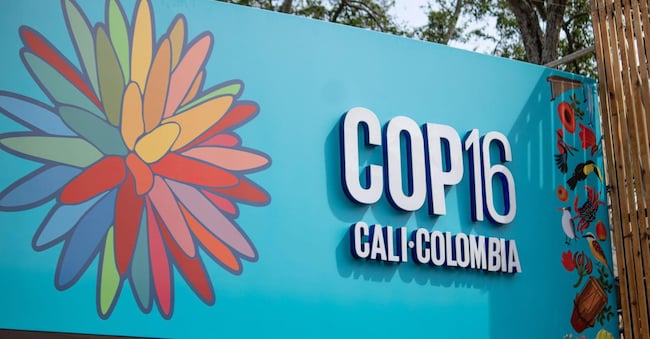
A flower in changing colours and the words 'Paz con la naturaleza', peace with nature. The logo of UN Cop 16, the Conference of the Parties on Biodiversity to be held from 21 October to 1 November, goes straight to the heart of the problem. Representatives of more than 190 states (including Italy) will gather in Cali, Colombia, for the first environmental summit in Latin America. The setting is a country with 98 general ecosystems and the largest number of butterflies in the world, the largest range of bird families and the second largest for amphibians and freshwater fish. Treasures to be protected, even at the cost of one's life, as shown by the latest Global Witness report with a still image to 2022 that assigns Colombia the sad world record with 60 activists killed for their battles.
During the meetings, delegations will be called upon to implement targeted strategies two years after the approval of the Global Biodiversity Framework at Cop 15 in Kunming-Montreal. An agreement that is considered historic because it filled the regulatory gap at the expiry of the previous 2010-2020 strategic plan and outlined an ambitious pathway, the so-called '30x3': recover 30% of degraded ecosystems, conserve and protect 30% of land and sea areas to restore biodiversity almost entirely by 2050.
The meeting is less well-known to the general public than the Conference of the Parties on Climate Change that is held annually (the last in Dubai and the next in Baku in November) to take stock of the reduction of carbon dioxide emissions and compliance with the Paris Agreements, but just as crucial because the two topics are intertwined. Marking the turning point was the joint declaration of Cop 28 in Dubai, which emphasised the vital importance of nature and ecosystems for effective and sustainable climate action. "There is now a clear understanding that biodiversity plays a key role in climate change mitigation and adaptation actions, and thus in our survival. The ambition of the Cali summit is to continue along this path and seek the point of convergence between climate and nature,' stresses Alessandro Leonardi, co-founder and CEO of Etifor. The environmental consulting firm is the Italian hub of the Capitals Coalition and a member of Sbtn (Science-Based Targets Network), both part of the Business for Nature initiative, which aims to encourage companies to make concrete commitments to a nature-positive economy, protecting biodiversity.
The first topic on the agenda in Cali will be the monitoring of countries' efforts to implement the global framework on biodiversity, composed of four macro objectives and 23 targets to be achieved by 2030, with national plans and strategies to be updated by the start of the conference. The EU countries will bring as a dowry the approval of the regulation on nature restoration that came into force last month, the first global law on the subject that has adopted the principles sanctioned in Kunming-Montreal.
The conference will also closely involve businesses with several events dedicated to exchanging best practices on how to reach the targets. "Businesses and financial institutions," says Leonardi, "are under increasing pressure to measure risks, dependencies and impacts on nature, having to integrate biodiversity into their governance and throughout the supply chain to contribute to global conservation efforts. In particular, Target 15 of the Global Biodiversity Framework calls on states to take measures to enable companies to do this. It is also referred to in the CSRD directive on new sustainability reporting, which has been implemented in our country since the beginning of September, making biodiversity reporting mandatory for more than 4,000 companies.


