The Antalya Summit

COP31 derails over fossil fuels: the framework decision is scrapped. The EU leads the opposition, against Saudi Arabia, Russia and India

For Europe, the red line was the confirmation of the gradual phase-out of oil, gas and coal. Another blow to multilateralism. The two-day extension of the negotiations proved futile.

by Gianluca Di Donfrancesco

Aggiornato il 22 novembre 2026, ore 13:32

Aggiungi Il Sole 24 Ore
ai preferiti su Google
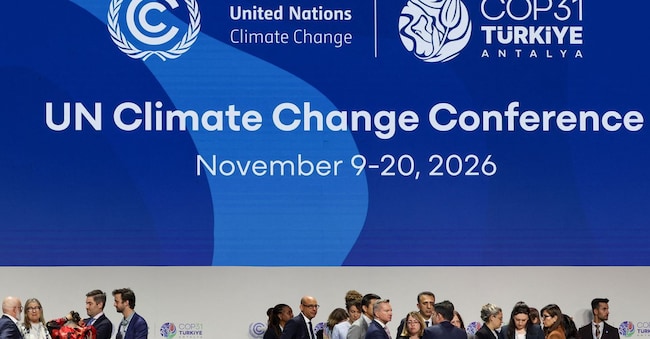
La plenaria della Cop31) ad Antalya in Turchia (REUTERS) REUTERS

4' min read

Translated by AI
Versione italiana

4' min read

Translated by AI
Versione italiana

The European Union has confirmed its rejection of the COP31 framework decision, which makes no mention whatsoever of fossil fuels. During the current plenary session, Darragh O’Brien, the Irish Minister for Climate, signalled this rejection by speaking even before the document was put up for debate. Ireland currently holds the rotating presidency of the Council of the EU.

The plenary session convened shortly before 1 pm (which is 11 am in Italia).

Loading...

The Turkish COP President, Murat Kurum, stated that ‘no one got everything they wanted, yet everyone was able to find something for themselves’. But this is clearly not the case. Saudi Arabia, Russia and the oil-producing states managed to block any explicit reference to phasing out fossil fuels, the main cause of global warming. Over a hundred countries were calling for this and refused to back down.

A resounding ‘no’

O’Brien stated that “we will not accept a decision that fails to take scientific evidence into account, that ignores the implementation gap, and that risks, in effect, widening the gap between global commitments and the actions needed to correct the overshoot and bring the 1.5-degree target back within our reach”. For these reasons, “we will not endorse a token decision or an Antalya agreement that does not even mention fossil fuels, which are the key driver of climate change. Nor will we agree to negotiate a return to the past. Nor will we accept a COP that engages in greenwashing”. And furthermore: “The drafts – and I mean drafts in the plural – that have been presented to us do not in any way address the climate emergency we are facing and, therefore, the European Union cannot accept them.”

These points were reiterated by Commissioner Wopke Hoekstra when the debate on the framework decision began.

Panama’s statement was extremely harsh; in recent days, it had denounced the ‘oil mafia’. Meanwhile, the Marshall Islands ask: ‘Are we so out of touch with reality that we are taking steps backwards, just as the climate crisis threatens to overwhelm us?’

The group of least developed countries (the 44 countries known by the acronym LDCs) also rejected it.

On the opposite side

Russia has criticised the EU’s CBAM, which other countries also regard as a full-fledged tariff. It serves to level the playing field for European companies subject to the ETS.

Saudi Arabia and India have used their historical greenhouse gas emissions as a defence, shifting the blame for global warming – which is pushing average global temperatures above the 1.5-degree threshold compared with pre-industrial levels – onto developed countries. This is the threshold set out in the Paris Agreement and, above all, by science. Yet Riyadh continues to dispute and attack it.

Saudi Arabia has once again defended the potential (though, for now, science-fiction-like) technologies for CO₂ capture and storage, a solution that has always been backed by the major oil and gas companies. And it has levelled the accusation at Europe that it is cherry-picking the solutions it prefers from among those analysed by science to reduce polluting emissions to zero. Carbon capture and storage will play a role – albeit a marginal one – in offsetting precisely those emissions that cannot be avoided (hard-to-abate sectors). According to the IEA, this would account for around 5 per cent of the total.

Loading...

China’s response was brief: it has already decided on its transition, driven by a desire for power, to reduce its dependence on energy imports and dominate green technologies.

The Turkish COP President, Kurum – who had already cut off a couple of delegates whilst they were speaking – acknowledged that it was impossible to reach unanimous consensus on the document and attempted to bring the discussion to a premature close in order to put an end to the heated exchange of accusations. He was unsuccessful in this too, of course.

The Byzantine Problem

The COP Presidency has divided the Antalya Pact into two separate but related decisions: one under the UN Framework Convention on Climate Change (the UNFCCC, for which the COP serves as the decision-making body), and one under the Paris Agreement, which covers the most contentious issues.

The first text covers only mountains, the replenishment of climate funds, science from the IPCC (the Intergovernmental Panel on Climate Change) and a proposal on reforming the UNFCCC process.

COP31 in Antalya has gone down in the records as the longest UN climate conference. It dragged on for almost 50 hours beyond its scheduled end.

Negotiation and reality

The failure to reach an agreement is yet another blow to multilateralism, which is being undermined by the corrosive influence of sovereignty at every level. It is also a betrayal of the expectations of the younger generations.

The energy transition challenges economies’ models of production and consumption, people’s ways of life and their mindsets. It is an epoch-making shift, necessitated by the severity of the climate crisis. What is needed is awareness, cooperation and a fair process that cushions the impact of the transformation, without leaving any countries, industrial sectors or people behind.

Low-income countries are already heavily in debt and struggle to find the resources needed for mitigation (cutting greenhouse gas emissions) and adaptation (prevention and response to extreme weather events). This is where aid and climate finance should come into play. Yet here too, efforts fall short of the challenge. For developing countries, this was supposed to be the COP at which commitments made would be implemented. This aspect, in particular, has instead been pushed into the background, overshadowed by the clash over oil, gas and coal.

Renewables are growing within the global energy mix. Not enough, however, to drastically cut global greenhouse gas emissions, which are in fact driving the rise in average global temperatures well above two degrees by the end of the century. The 1.5-degree threshold is effectively out of reach. But, as Carlo Buontempo, director of the European Climate Change Service Copernicus (C3S), every decimal point counts.

Copyright reserved ©
Loading...

Brand connect

Loading...

Newsletter

Notizie e approfondimenti sugli avvenimenti politici, economici e finanziari.

Iscriviti