
Cortina '26, after the bobsleigh, it is the Olympic village on the river that is causing discussion
from our correspondent Luca Benecchi
 Aggiungi Il Sole 24 Ore
ai preferiti su Google
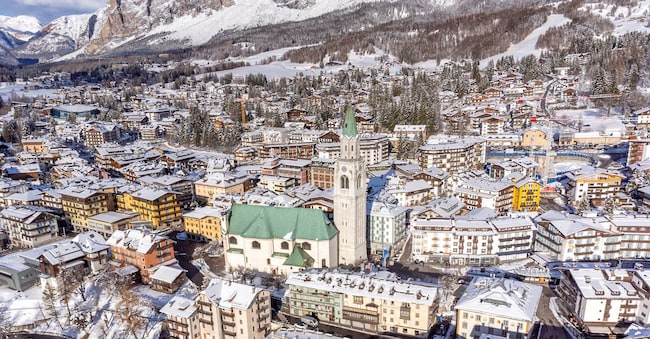
CORTINA - Looking at Cortina from the road leading to the Giau Pass, just above the large bobsleigh track construction site, it is the number of cranes that catches the eye. Some fifteen of them, dominating the valley far and wide. As for a large road construction, a bridge or a high-speed train yard. The 2026 Olympics are profoundly changing the city both from an urban and cultural point of view, but the five-ring revolution will also have social implications. Everything is for sale, from the large, somewhat decaying hotels that tell of the first great urbanistic change following the real estate boom of the 1960s, to the small shops, which by now there are almost no more in the centre, to the advantage of the usual big brands found in all the airports of the world. Prices per square metre are very high (around EUR 10,500) and for many families selling at this time can represent the opportunity of a lifetime. So there are those who prefer to come down to the valley and rebuild their lives thanks to offers that are hard to say no to. As is the case everywhere in the mountains, the birth rate is drastically decreasing and it is the owners of second, very expensive houses who, in order to avoid paying the Imu tax, are increasing the historical group of residents, which by now number no more than 5,000. So autumn leaves many hotels closed for the end of the summer season and many undergoing renovation. Some have been demolished to the foundations. The tourists are almost all international, especially Asians who, dressed in technical clothing, are looking for the last remnants of Dolomite excursions before the refuges close. After the long and exhausting battle between politicians and environmentalists that marked the approach to the event more than anything else, it is difficult not to start with the construction site of what the mayor Gianluca Lorenzi proudly calls 'our sliding centre'. His idea is that it could become the beating heart of the new winter tourist attraction thanks to international competitions and amusement park-style use for tourists. Clearly, the entire credibility of the organisers, the company building it and the public administrators is at stake on this facility. Making a mistake and turning Cortina into a new Cesana (the ghost slope now abandoned and used only for the 2006 Turin Games, which produced a great waste of public money and a considerable environmental wound) is not allowed. "By next March, the work will certainly be completed,' Lorenzi explains, 'and then a not-so-short testing period will begin. The mayor is also clear about what the impact on his administration's accounts will be. "Maintenance has a very high cost, we are talking about one million, one million and 200 thousand euro per year. We are aware that we will not break even. But with constant use, even for tourism, the deficit should be reduced to a few hundred thousand euro for the public coffers'. Climbing the mountain ridge among the workers, iron rods and cement, the impression is that there is still a lot of work to be done. The excavations began in February and in eight months only the first 200 metres of the structure out of a total of one kilometre and 200 metres seem to have been built at the moment. A major acceleration is needed in the next five months. Not least because otherwise there is a risk of a surge in costs, which for the moment amount to EUR 118.424 million from the public coffers. To which must be added another 3.812 million for preparatory work and 2.533 million for the recovery of part of the old track used for the 1956 Olympics. A reduced project compared to the initial one after the tender was abandoned several times. According to the mayor, the controversy over the cutting down of the larches was also misplaced because 'just look around us, we have trees coming in and when the project is completed, 10 thousand new ones will be planted'.
As far as the roads are concerned, the Anas works on the state road that climbs from Belluno with tunnels and small bypasses of the Cadore villages, the works seem to be proceeding even though they are works (as the signs indicate) that were planned for the 2021 Alpine Ski World Cup, and therefore rather late. In addition to the bobsled track, the other construction site that is currently visible and managed directly by the Società Infrastrutture Milano Cortina (Simico), and therefore by the ministries, is that of the Olympic stadium where the curling competitions and the final ceremony of the Paralympics will be held. Here the expenditure for the adaptation is around 20.4 million. For the rest, it is still a matter of waiting. The issue at the centre of the debate now is the Olympic village. Going up the Alemagna state road towards Toblach, there is Fiames. A large plateau used as an airfield and where there is now a helicopter landing pad. We are at the entrance to the Ampezzo Dolomites Nature Park, just before the Fanes, Sennes, Braies Park. Places of waterfalls and vie ferrate. The bed of the Boite torrent here is very wide with its white stones. Marina Menardi is president of the Cortina Civic Committee and recalls how 'it is precisely in Fiames that cross-country skiing has been banned for three years now because it is considered a high hydrogeological risk area. The torrent erodes the ground and in the event of a flood it could prove dangerous'. "Instead, it is right here," he continues, "that they have decided to build the village that should be able to accommodate 1,600 athletes and representatives of the sports teams
The module houses that will be built, plus urbanisation work in the area, will cost 39 million euro. An intervention that according to the government's Dpcm was supposed to be provisional, that is, at the end of the event everything should be dismantled and the area put back to its previous use. Until a few days ago, hoteliers and Tourism Minister Daniela Santanchè had pushed for the structure to become permanent. A neighbourhood, they argued, for all the workers in the sector who now have difficulty finding housing in Cortina. Instead, governor Luca Zaia closed the proposal, reiterating that it would be dismantled. Confindustria Belluno expressed interest in the housing modules to build a student residence in Belluno. In order to make the Olympic village definitive, however, new legislation would be needed on both the destination of the areas and the future of the village. The opposition councillor Roberta De Zanna was highly critical of this possibility, interpreting the proposal as 'the creation of a workers' ghetto, moreover in a hydrogeologically dangerous area'. Cortina debates and is divided over another super-project: that of the old station. In disuse since the train from Calalzo di Cadore ceased running, and with historical and public use constraints, it has attracted the interest of a private group that would like to use it for real estate investments. In all, 18,000 cubic metres of commercial space (excluding car parks), at a project cost of around 230 million euro. The approval of the variant by the Province of Belluno triggered a series of appeals to the TAR (Regional Administrative Court) by some groups of citizens. According to mayor Lorenzi, 'the Olympics and the new projects on the town will allow Cortina to be globally competitive from a tourism point of view for at least fifty years', while, concludes Roberta De Zanna of the opposition, 'going ahead in this way we are losing the cultural identity of our valleys, with an administration that refuses dialogue with citizens'.
© RESERVED REPRODUCTION


