
Cosmo-SkyMed, Italy's new Earth observation satellite launched
The new second-generation Cosmo-SkyMed satellite was successfully launched from the Vandenberg base, strengthening Italy's Earth observation capabilities thanks to advanced radar technologies and a unique dual civil-military system
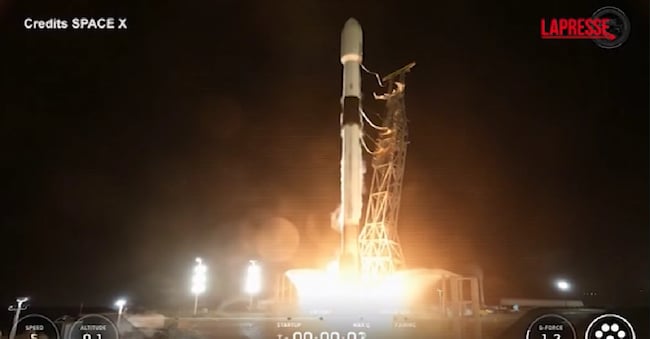
Italy strengthens its presence in space with the successful launch of a new Earth observation satellite, intended to enhance the Cosmo-SkyMed constellation, one of the most advanced space programmes at international level. The Cosmo-SkyMed CSG-FM3 satellite was put into orbit at 3.09 a.m. Italian time on 3 January from Vandenberg Space Force Base, California, thanks to a SpaceX Falcon 9 rocket. Liftoff came after a long wait: two postponements due to technical problems with the ground segment and a further stop imposed by adverse weather conditions.
The new satellite enhances the second generation of the Cosmo-SkyMed constellation, developed by the Italian Space Agency together with the Ministry of Defence. It is a unique system of its kind, conceived from the outset as a 'dual' platform, capable of responding to both civil and military needs. A feature that, in the global panorama of Earth observation, still represents a unicum in terms of performance level and integration between public institutions and industry.
In technological terms, Cosmo-SkyMed CSG-FM3 introduces significant innovations. The satellite is equipped with a new-generation radar antenna, which is lighter thanks to the use of components made using 3D printing techniques. This antenna is able to orient itself dynamically in space, allowing images of different areas to be acquired more quickly and with a higher level of detail than conventional synthetic aperture radar (Sar). The result is a more flexible and responsive monitoring capability that is particularly valuable in contexts such as emergency management, territorial control and support for security and defence activities.
Another distinctive feature of the satellite is the presence of the Laser Retroreflector Array (CORA-S), developed by the National Institute of Nuclear Physics. This device allows the position of the satellite in orbit to be determined with millimetre accuracy, a level of precision that is fundamental for advanced scientific applications and to further improve the reliability of the data collected.
According to the Italian Space Agency (Asi), the innovations introduced with CSG-FM3 significantly strengthen the national Earth observation capability, offering even more versatile and high-performance radar images. The data produced by the Cosmo-SkyMed constellation find application in numerous fields: from scientific research to environmental monitoring, from the prevention of natural hazards to maritime surveillance, and even strategic decision support in the field of national security.

