
Olympics, houses, cows and colonoscopies: here are the governments' benefits for medallists
While the IOC only admits cash prizes from the National Committees, in many countries medallists are awarded additional prizes of all kinds

3' min read
Key points
3' min read
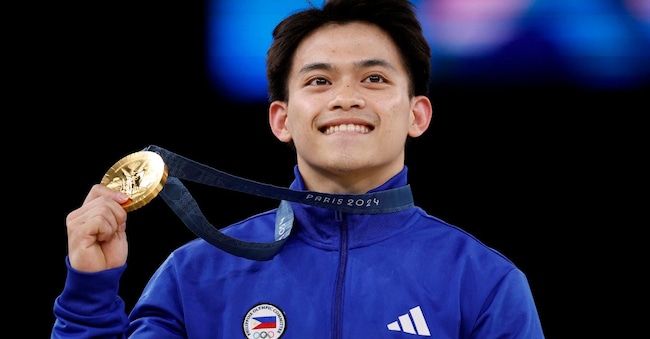
From the time he turns 45, Carlos Yulo, Filipino gymnast capable of winning Olympic gold in Paris in both floor exercise and vaulting, will be able to undergo medical examinations, such as colonoscopy and gastroscopy, free of charge. And this for the rest of his life. The Manila government for its national hero spared no expense. As a Sky TG24 report on government awards for Olympic medallists recounted, a cheque for 10 million Philippine pesos, about 160 thousand euro, will be transferred to Yulo's bank account, to which will be added a gift of another 6 million pesos, 95 thousand euro more or less, offered by the House of Representatives. Other material acknowledgements of appreciation for the Filipino star's sporting feats will come from public and private companies, from a furnished three-bedroom flat in Taguig City worth 380 thousand euros, to free meals for life in dozens of restaurants, as well as a free supply of ramen.
The official awards
.The International Olympic Committee has never looked favourably on monetary or other prizes to safeguard the purity of Olympic glory. A model still followed by Great Britain and other weights such as Norway and Sweden. However, with the rise of sport-business, the IOC had to be more flexible, leaving it up to the National Olympic Committees to reward the winners financially.
Coni, for example, awards cash prizes. In Paris for gold 180 thousand euro (gross), for silver 90 thousand and for bronze 60 thousand. The 80 medallists will 'cost' the CONI 9.8 million (5.5 for the golds, 2.6 for the silvers and 1.6 for the bronzes, while in Tokyo the total expenditure was around 7 million). The USA, on the other hand, will pay for a gold the equivalent of 35 thousand euros, for a silver 21 thousand, and for a bronze 14 thousand, while the Hong Kong committee awarded the gold medal winners in women's epee (Kong Vivian) and men's foil (Cheung Long) 768 thousand dollars each.
The one in Singapore awarded the Olympic gold medallists one million local dollars, equivalent to about USD 744,000, but will only have to shell out USD 186,000, having won just one bronze medal in the men's kite throughout the Olympics. In Paris, for the first time, a monetary prize was also established by an international federation, World Athletics: $50,000 but only for gold medallists.
Government Awards
.While in the first modern Olympic Games, in 1896, the winners received an olive branch and a silver medal to pin on their chests, with time even governments began to offer additional refreshments, financial or otherwise, to their national sporting heroes. In Paris they indulged. To the two gold medal winners in fencing Hong Kong donated free metro passes, while a chain of gyms offered lifetime memberships to other medallists.


