Film and Media

'Coward', emotional story of love between soldiers at the time of the Great War

A love story between two soldiers at the time of the First World War: the starting subject would be enough to give 'Coward', one of the latest films in competition, the right attention

by Andrea Chimento

3' min read

Translated by AI
Versione italiana

3' min read

Translated by AI
Versione italiana


Loading...

This is the third feature film by Lukas Dhont, a Belgian director and screenwriter born in 1991, who had already explored the theme of sexuality in non-simple contexts with his two previous films, 'Girl' and 'Close'.

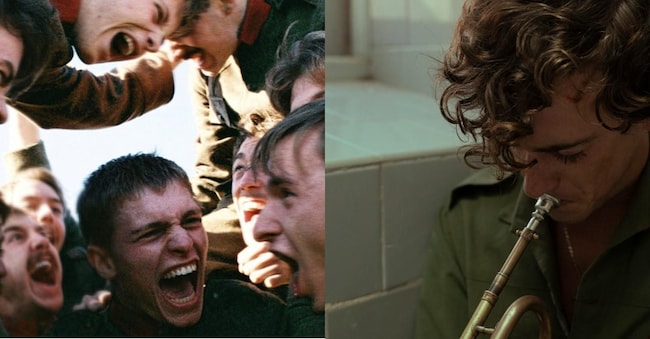
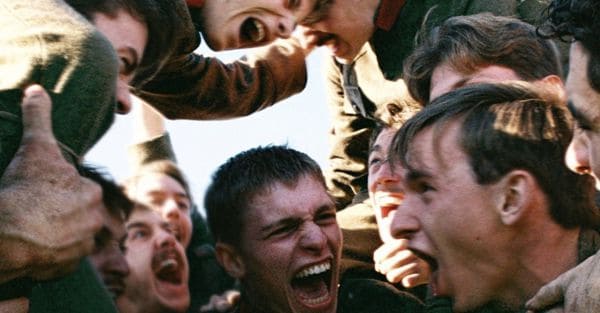
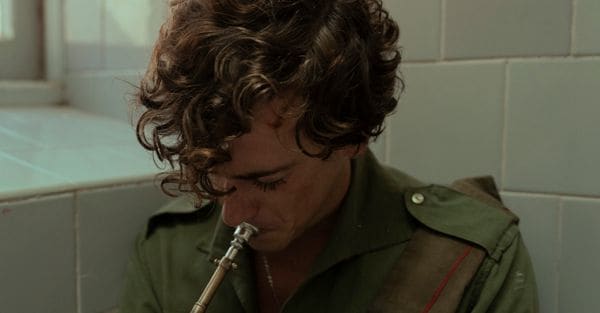
In the most difficult moments of the Great War, Pierre joins the Belgian militia at the front, trying to adapt to an extremely complicated situation. Here he meets Francis, a young man who tries to lift the spirits of his compatriots by putting on funny performances and plays in which he disguises himself as a woman and involves other fellow soldiers. As the violence becomes increasingly unbearable, both men try to escape the brutality of war by starting a forbidden but very passionate relationship.

More than a war film, "Coward" is above all a love film, a film that continually focuses on Pierre's gazes at the world around him: from his eyes, worried and frightened by the difficulties he is called upon to overcome, we pass to the point of view of a boy who gradually falls in love with a boy of his own age, coming to feel a sentiment that is perhaps unthinkable given the space-time context in which they find themselves.
 

The delicacy of style


Dhont has a delicate style even in telling very difficult themes, he had already demonstrated this with his previous works, but 'Coward' is perhaps the film of his maturity.

There are still a few overly contrived passages in its portrayal, but in this third feature there is an even greater ability to tell the story of the growth and development of such a strong feeling in a truly engaging and exciting manner.

It is not only love that succeeds in winning the war, but also art in this product, which also focuses heavily on how performances and theatre can act as a salvific key to overcoming the hardest of times.

The performances of the entire cast are absolutely natural and spontaneous, adding further value to a film that touches really deep chords, despite a few excessively melancholic passages.


La bola negra


Also in competition was 'La bola negra', directed by Los Javis, a Spanish duo composed of Javier Calvo and Javier Ambrossi, best known to date for having signed several successful television series.

Always great promoters and supporters of Spain's LGBTQIA+ community, Los Javis had already signed a feature film for the big screen in 2017, 'La llamada', but it is with this new film that they will come to make themselves known to an international cinephile audience.

The story intertwines the lives of three men from three different historical moments: 1932, 1937 and 2017. Their existences, although distant in time, mirror and recall each other, exploring what it means to be gay in historical contexts marked by repression, conflict and transformation. Against the backdrop of the Spanish Civil War and its consequences still alive in the present, the story highlights the weight of the emotional and cultural legacy that spans generations.

In addition to the starting idea of the two screenwriter-directors, 'La bola negra' was born from the meeting of different materials: on the one hand, an unfinished project explicitly referred to in the film related to Federico García Lorca, who started writing the novel 'La bola negra' in 1936, the year in which he was murdered; on the other hand, the theatrical text 'La piedra oscura' by Alberto Conejero.

The title of the film refers to an ancient mechanism of exclusion, made explicit in the 1933 part: the 'black ball' was the sign used to reject someone from a community and becomes in the course of the film a symbolic image linked to the theme of discrimination and marginalisation.

The narrative is about the passage of time, alternating editing rhythms and mixing different styles (the presence of musical sequences is very extensive) in an interesting way. For this reason too, it is really a pity that Los Javis put so much meat on the fire, seeming more concerned about being able to cover all the topics they have in mind than about giving each one its due.

A few cuts here and there, also in view of the ample and excessive length (155 minutes), would not have hurt, although one nevertheless comes out at the end of the credits satisfied with several well-crafted sequences (the beginning, first and foremost) and several stimuli capable of remaining imprinted for days after viewing. It should be noted that the cast includes Penélope Cruz and Glenn Close, both in supporting roles.

Copyright reserved ©
Loading...

Brand connect

Loading...

Newsletter

Notizie e approfondimenti sugli avvenimenti politici, economici e finanziari.

Iscriviti