Training

Creativity, adaptation, flexibility: how to govern the complexity of negotiation

Leonardo Caporarello's book explores negotiation as a widespread competence, fundamental in an interconnected and digital world

by Gianni Rusconi

4' min read

Translated by AI
Versione italiana

4' min read

Translated by AI
Versione italiana

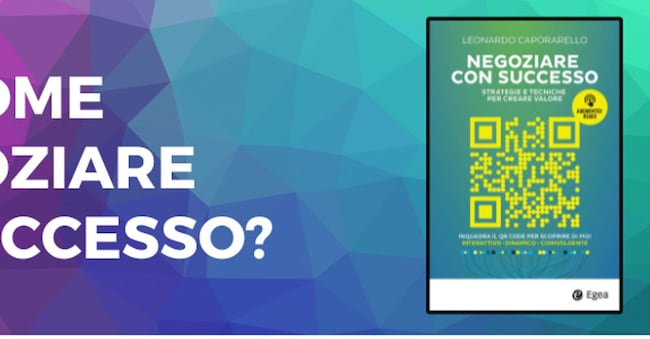
La negoziazione sul lavoro (e non solo) non è soltanto un’abilità: è un’arte capace di trasformare ogni aspetto delle nostre vite personali e professionali. È un assunto chiaro, forte, quello che emerge dal libro a firma di Leonardo Caporarello, Associate Dean for Online Learning e professore di Negoziazione in Sda Bocconi (oltre che direttore del Centro per l’Innovazione dell’apprendimento e dell’insegnamento dell’ateneo milanese). “Negoziare con successo”, edito da Egea, è un percorso che induce a riflettere e invita ad approcciarsi a questa arte da un nuovo punto di vista, accompagnandoci a scoprirne i segreti attraverso un’esperienza di lettura interattiva e “aumentata” grazie a contenuti accessibili online che comprendono videointerviste con manager esperti in materia di negoziazione, questionari, domande a risposta aperta con

In an increasingly complex and fragmented world, more and more people find themselves having to master negotiation and govern its complexity: whether it is about closing a deal, negotiating a salary or resolving a conflict, Caporarello offers pragmatic insights that go beyond traditional strategies (drawing on international literature and real case studies) and range from understanding cultural differences to managing emotions to using advanced digital tools, the author explores the varied dimensions of negotiation. This is why learning this art is so important in today's interconnected and digital society.

Loading...

The book invites us to rethink negotiation as a widespread skill, not just reserved for labour negotiations. What does this mean exactly?

Very often we associate the term 'negotiation' with 'business or salary negotiations', in reality negotiating is first and foremost a dialogue, at the basis of which there are different ideas, not necessarily in opposition, and through which we confront each other in order to find a point of synthesis shared by all parties. Now, let's try to ask ourselves: "who has never found themselves in a situation like the one just described?" or "how often do we find ourselves in situations like the one just described?" The answer to these questions is also the answer to the question "how often do I find myself negotiating?"

The attitude towards negotiation is often ambiguous or avoidant. What is the source of this distrust and how can it be overcome and/or corrected?

We do not negotiate for two main reasons: because we are not aware that we are facing a negotiation situation and because, as a consequence, we do not prepare ourselves by gathering the information that is essential for a 'robust' preparation. The mistrust, or rather the unawareness of being in a negotiation, can be traced back to earlier times when 'negotiating' somehow meant behaving in a particularly assertive manner, sometimes with the intention of prevailing over the other party. This way of negotiating, far from extinct, is not helpful in building long-term relationships and value for the negotiating actors.

There are seemingly 'lateral' elements to classic negotiation, such as emotions, psychology and the ever-present AI. How do these factors concretely affect the success of a negotiation?

If we put three people in a room who are very knowledgeable about the subject matter of the negotiation, what would create a competitive negotiating advantage? Exactly how much 'lateral' may seem to be absolutely central. Communicating - verbally and non-verbally, between artificial intelligence agents and/or between individuals - inevitably carries preconceptions and a narrative style that may be perceived in a completely different way by the listener: a message, for instance, may be perceived as 'aggressive' even though this was not the intention of the person who conveyed it. The history and background of each of us determines the 'lens' through which we interpret what is communicated to us, and some prefer direct communication while others prefer indirect communication. AI can significantly support negotiation dynamics, not only in terms of the

In an increasingly hybrid scenario, what is the most important competence to develop for those negotiating on behalf of an organisation? 

Negotiating in 'physical' environments, as they are defined in the book, requires special attention to the management of interactions between all negotiating actors. It is important, and even more so when communicating online than when in person, to manage timing, to have guidelines on how to intervene in the dialogue and how to facilitate verification of what is being said, to decide what language to use, whether very technical or high-level, multi-voiced or single-voiced. There are many aspects to consider.

Is there an anecdote about negotiation that particularly struck you in your academic or personal experience? 

One of the first 'lessons learned' that I have started to notice since I have been professionally involved in negotiations is how important it is to always verify underlying assumptions. We often think we have understood what the other party wanted to tell us but then, by verifying and deepening with the right questions, the gap between 'the perception of having understood' and 'the actual (or almost actual) understanding' of what the other negotiator meant becomes clearer. The second 'lesson learned' has to do with emotions: knowing how to manage them is as intangible as it is important for successful negotiations.

Final question: if you had to summarise the cornerstones of effective negotiation in three fundamental principles, which would you choose?

Understanding emotions, reading the social context and building trusting relationships: these are three principles inherent to human intelligence, which - precisely because of its capacity - must also learn to make appropriate use of artificial intelligence. Negotiation must be seen as a process of value co-creation on the assumption that negotiating implies creativity, adaptability and flexibility.

Copyright reserved ©
Loading...

Brand connect

Loading...

Newsletter

Notizie e approfondimenti sugli avvenimenti politici, economici e finanziari.

Iscriviti