Industry

Facilitated credit, Irca is born in Sicily

Today in Palermo the signing of the merger deed between Crias (artisans) and Ircac (cooperatives). The new regional institute starts with an expected annual production of over 19 million, 80 employees and the objective of becoming the reference centre


by Nino Amadore

4' min read

Translated by AI
Versione italiana

4' min read

Translated by AI
Versione italiana

Two stories, one home. The slogan chosen for the birth of the new Irca, the Regional Institute for Facilitated Credit, summarises the transition that will take place today in Palermo: the signing of the merger deed between Ircac and Crias, the two regional bodies that for decades have overseen two distinct worlds of the Sicilian production system, cooperation and craftsmanship.

With the deed of merger, the new economic public body of the Sicilian Region takes shape. The operation was envisaged by the regional law of 10 July 2018, which provided for the concentration of Sicilian financial entities and the amalgamation of Ircac and Crias with the aim of rationalising interventions in favour of companies based on the island. The 2025-2027 Business Plan defines Irca as an economic public body with legal personality under public law, with its registered and administrative office in Palermo and operational offices in Palermo and Catania.

Loading...

The acceleration in recent months

The process, which had been in the implementation phase for a long time, has accelerated in recent months with the appointment, by the regional government led by Renato Schifani, of extraordinary commissioner Roberto Rizzo, who has been called upon to accompany the decisive phase of the merger and the operational transition to the new single body for subsidised credit. "For the Sicilian Region, the birth of Irca represents a bet on industrial policy: to build a single entity of subsidised credit, closer to businesses and more capable of accompanying artisans, cooperatives and SMEs in the season of new funds and digital transition. The merger between Ircac and Crias is a concrete step to make the support system for Sicilian enterprises more efficient. It is a choice that had to be made a long time ago and that today finally becomes reality,' says the regional councillor for productive activities, Edy Tamajo.
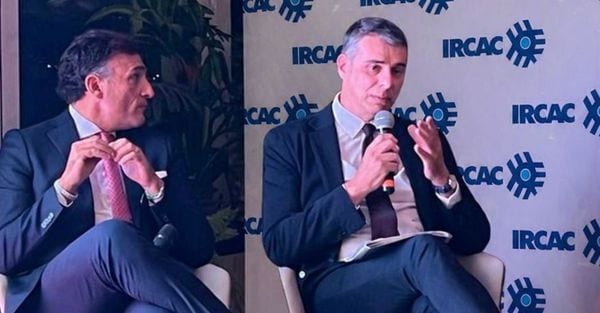
A sinistra l’assessore regoonale alle Attività produttive Edy Tamajo, a destra Roberto Rizzo

A single pole for subsidised credit and enterprises

The new Irca will take over the assets and liabilities of the merged entities and will operate mainly in favour of craft and cooperative enterprises. Supervision will be exercised by the Regional Department of Productive Activities and, for accounting profiles, by the Department of the Economy.

The sense of the operation is not only administrative. The Region aims to transform two separate structures into a single pole of subsidised credit, capable of managing revolving funds, regional measures, financing lines, credit recovery activities and, in the Plan's intentions, also instruments linked to European funds and the development of Sicilian entrepreneurship in the Euro-Mediterranean area.

The merger numbers

The economic dimension of the operation is significant. In 2024, Crias recorded a value of production of EUR 14.77 million, with a gross operating margin of EUR 5.39 million and a profit of EUR 1.51 million. Ircac, in the same year, recorded a value of production of EUR 5.02 million, with a gross operating margin of about EUR 1 million and a profit of EUR 745,000. The sum of the two entities therefore gives the new Irca a base close to 20 million euro of annual production. The 2025-2027 Business Plan predicts a stable operating production: 19.1 million in 2025, 19.4 million in 2026, and 19.2 million in 2027. The entity is expected to remain profitable throughout the three-year period, with gross operating margins of around 28%.

Craftsmen and cooperatives, two divisions in the same machine

The new organisational structure maintains the distinction between the two historical basins. The plan provides for a crafts division, a cooperation division and a common administrative management. This choice serves to preserve the specificities of the two production worlds, but within a single structure, with more homogeneous procedures, centralised data management and common control, administration and monitoring functions.

The Lever Plus Craftsmanship

One of the most significant items concerns the former Artigiancassa fund, linked to the Più Artigianato measure. The Plan recalls an initial endowment of about 38 million euro, increased by a further 75 million. Disbursements started in 2024 reached 21.04 million, generating fees for the institution of 1.52 million. The agreement also provides for an additional endowment of EUR 9 million every four months, with a duration of five years renewable for another five.

Personnel and generational turnover

The new Irca starts with 80 employees: 59 from Crias and 21 from Ircac. The plan provides for 18 new recruits in 2026, against planned retirements in the coming years. The issue is central because the document points to the need to strengthen skills, intermediate professionalism and operational capacities in various departments.

The merger, therefore, does not end with a change of name. It will have to be accompanied by a redesign of the administrative machine, IT investments and a new credit management model.

The Real Challenge: Data, Debt Collection and Governance

The Industrial Plan identifies some critical areas that emerged from the due diligence: information system and data governance, governance model, credit management, and remuneration system of the two merged entities. It is here that the real value of the operation will be measured. The new Irca will have to avoid being merely the sum of two old structures. It will have to become a single platform, capable of reducing duplication, better controlling credit risk, speeding up investigations, strengthening monitoring, and making relations with artisan companies, cooperatives, and SMEs more efficient.

'Eight years have passed since the law establishing Irca,' says President Schifani, 'a fact that raises many questions. This is why we are trying to overcome the bureaucratic obstacles that stand in the way of our objectives and to change a certain type of mentality that still exists in the administration. The amalgamation of Ircac and Crias follows a logic of simplification that, by avoiding duplications and streamlining procedures, allows us to be even closer to a productive world that, also at a national level, is looking at Sicily with increasing interest. Through Irca we overcome fragmentation and improve the quality of the credit offer to artisans and cooperatives. I renew my invitation to the productive categories to work as a team, all together, for the development of our island'.

Copyright reserved ©
Loading...

Brand connect

Loading...

Newsletter

Notizie e approfondimenti sugli avvenimenti politici, economici e finanziari.

Iscriviti