
Crispi and the first reform of the unitary state

3' min read
3' min read
One day I asked Crispi: Are you a Mazzinian? - No, he replied. - Are you a Garibaldino? - Neither, he replied. - And who are you then? - I am Crispi. And then: "I did not know this Crispi tout court, this unedited Crispi, who shines by himself and reflects neither Mazzini nor Garibaldi". It is 1862, and so writes Ferdinando Petruccelli della Gattina in his famous I moribondi del Palazzo Carignano. The 'Crispina age' is still a long way off, but Petruccelli already senses the energy of the Sicilian statesman, who would later become the first Prime Minister of the south: 'When he gets up to speak, one would say he is about to pull a pair of revolvers out of his pocket.
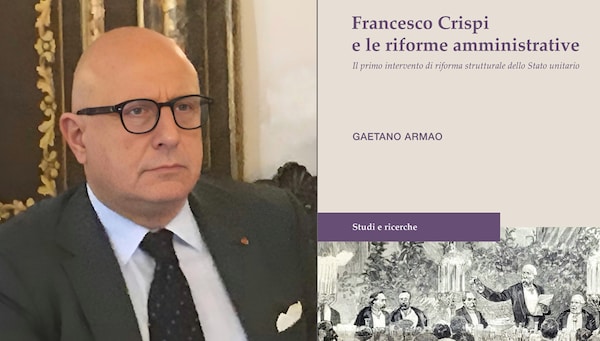
With his decisive ways (at Marsala he was the first to go ashore with the Thousand, and he entered Palermo with a pistol in his fist) Crispi endowed the country with a body of legislation - 'great monumental laws', as Guido Melis defines them - with which he succeeded in leading 'Piedmontese' Italy, which had been 'unified' by unification, into modernity. He thus realised his project aimed at an administrative 'discentralisation' that, by creating action, would at the same time strengthen the authority of the state. Conspirator and exile, enveloped by the 'mysterious charm of the Greats' (as Vittorio Emanuele Orlando wrote to him), his legal training would sustain him in the enormous reforming effort achieved through institutional paths of particular significance even in the current political scenario. This is precisely the line of Gaetano Armao's latest book, Francesco Crispi e le riforme amministrative. The first structural reform of the unitary state, which identifies in the Crispi decade (1887-1896), and even earlier in the extraordinary experience of Sicilian constitutionalism from the 'English decade' (1806-1815) to the uprisings of '48, the seminal themes of today's political-institutional architecture.
These include, first and foremost, the persistence of a 'party of the majority': theorised by Francesco Bonini as a shifting 'network of solidarity for the management of power', an 'organisation of interests' which acts as a 'deep structure of cohesion' that depowers the party model, replaced by personal relations between government representatives and parliamentarians, the bureaucracy and the notables clustered around the leader of the moment. Crispi is a symbol of this, which is reflected today in the precarious balance between premier, deep state and territorial instances. The Sicilian statesman was responsible for the first great structural reform in the Italian institutions, which,' Armao emphasises, 'was much more than a second unification: while the laws of 1860 had transfused the Savoy system into the legislation of the new state, the Crispi model wanted to 'open up new spaces for the intervention of the public administration starting with social policies', remaining however 'correlated to a clear and identifiable leadership': an arrangement 'that will profoundly affect the morphology of state and local administration and that, in some cases, will remain in force well beyond the political life of its creator'. Sensitive also to the theme of the jurisdictional protection of the citizen with regard to the public administration (he was responsible for the IV Section of the Council of State, which inaugurated the model that is still today the most successful among our apparatus of justice), Crispi introduced into the institutions the culture and "tradition" of the State in a country that - in its central-northern part - had historically known a structure on a municipal basis. One last innovative attempt, the most daring one, is inserted in this framework. It was 1894 when Crispi put his hand to the Italian territorial mosaic with a 'Circumscription Project' on a regional basis drawn up by Luigi Bodio, the great statistician. However, it was unsuccessful due to the too many vested interests that opposed it.
The statesman would shortly afterwards conclude his political history with the defeat at Adua and the fall of his fourth government. The knots that he tried in vain to untie, such as the eternal tension between centralism and autonomism, remain intact. Armao highlights its relevance very well, fifty years after that 1975 that gave rise to the regional experience and in the midst of a bitter conflict over the limits of differentiated regionalism.

