Australian GP

History-free (but critical) domination for Mercedes at the new F1 debut

The inaugural race sees Mercedes excel with Russell and Antonelli, while drivers and insiders discuss the impact of new technologies and regulations on driving and competition

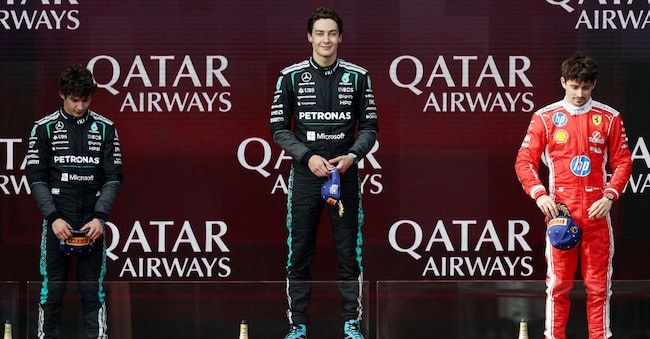
by Alex D'Agosta

Formula Uno F1 - Gran Premio d'Australia - Circuito Albert Park Grand Prix, Melbourne, Australia - 8 marzo 2026 George Russell della Mercedes festeggia sul podio dopo aver vinto il Gran Premio d'Australia insieme al secondo classificato Andrea Kimi Antonelli della Mercedes e al terzo classificato Charles Leclerc della Ferrari REUTERS/Hollie Adams

6' min read

Translated by AI
Versione italiana

6' min read

Translated by AI
Versione italiana

The 2026 Formula 1 season at Melbourne's Albert Park decrees victory number six for Russell: a Mercedes one-two with Leclerc third and Ferrari's Hamilton fourth. An important relief for Antonelli: it is the second time for him in second place in a grand prix after Brazil in 2025, and he is the first Italian to return to the podium at the classic Australian track since Jarno Trulli in 2009 in a Toyota. It is also the first one-two for Mercedes without Lewis Hamilton since Fangio and Taruffi back in 1955.

Russell and Antonelli have shown since practice that they have the best car of the lot with a clear advantage: first and second without question, with a clearly superior pace such as to appear 'managed' to the naked eye (just think of the 'recovery' of the gap of Antonelli); all this after a first fifteen laps that were very illusory, where Leclerc was seen for a while in front with Hamilton right behind Russell, literally fighting, as on lap nine, where there was also the risk of contact due to a blockage of the Mercedes driver. It almost seemed as if Wolff's squires had to 'hide' or, more prudently, not overdo it, so as not to upset their rivals too much. And so there were about ten laps of tussle. The important thing, however, was to be able to show a bit of spectacle at the debut of such new and impactful regulations, and indeed there was some spectacle, without the heavy conditioning of accidents, rain chaos or pit disasters that have defined many editions of the last decade.

Loading...

Then, to be optimistic, partly the fault of the second safety car that closed the pit lane when the protagonists (with the exception of the reds) had entered, partly a delay that from the middle onwards seemed insurmountable, except for a few chronometric glimpses from Leclerc on fresh tyres, and Ferrari dissolved. Nor did it help the recent decision to increase the pit lane to 60 km/h because of the eleventh team, a fact already seen at Monaco, Singapore, Zandvoort, despite the fact that only a few years ago the entire track had been resurfaced, with several widenings both of the corners, up to 2.5 metres, and of the pit lane itself to raise the limit to the 80 envisaged in most other races.

Norris fifth, able to overtake a Verstappen who up to that point had risen with great merit, starting last due to an accident in Q1 on Saturday resulting in an in-depth medical examination for a suspected hand fracture. Despite the neutralisation, from seventh the lapped drivers were already starting: Bearman surprisingly kept behind Lindblad, the Racing Bulls rookie who promised to become the new Hamilton and, in fact, in the early stages of the race, had darted well ahead. Gasly and Ocon also scored points. Sainz's Williams finished as high as fifteenth and second to last with two laps to go, while Perez was three laps down. Apart from the 'justified' Aston Martins, with serious and announced problems of congenital unreliability between power unit and batteries, excellent retirements include Piastri, who went to the wall on the installation lap, the very good Hadjar, while he was fourth in the very early stages of the race, and Hulkemberg, who was unable to start the new Audi.

Sustainability flag or historical mistake?

In a predictable first race marred by reliability problems, the Cadillacs and Audis nonetheless brought a car to the end against the most ominous predictions, but they were certainly not the most 'troublemakers' in terms of image: the first Aston Martin signed by the most successful engineer of all time, Adrian Newey, had already announced on Saturday that due to serious problems they would retire their cars at the first opportunity. And then, with both drivers, exploit a few more laps of the second half of the grand prix as if they were free practice: something unwatchable when there is a former champion like Alonso pawing the field.

It will, however, be a matter of time to see the effects of this new power unit, which exploits equally, fifty-fifty they say, the two thermal and electric engines, in a ratio unheard of in racing. It is too early to say whether it is a gamble or an apt choice: certainly putting the foot down 50 or 100 metres earlier may seem an unforgivable anomaly in the planet of racing, which has always been the fastest and most daring in all of motorsport.

However, on closer inspection there is one of the most advanced technological innovations on the world motorsport scene. It is the most sophisticated energy recovery system ever seen on track and road: up to 350 kW in braking and about 8.5 MJ on average per lap, roughly 2.5 kWh.

Translated into concrete terms, the real-time regeneration of a single race lap can be worth the equivalent energy required to fully recharge 5 e-bikes or to power a high-end electric SUV for more than 10 km, at a speed even 40-50% higher than the best fast-charging stations currently installed in Europe.

The real question, then, is another: will we suffer less exciting races, or will we end up thanking the manufacturers for having accelerated technologies destined, in the short and medium term, to be transferred - in terms of efficiency, industrial scale and progressive cost reduction - to cars, motorbikes, bicycles, boats and perhaps even aeronautics?

A debate born already in qualification

After the perplexities already seen in the increasingly contracted winter tests, it was enough to see the first official qualifying laps of the Qatar Airways Australian Grand Prix 2026 to open the new technical chapter of Formula 1 with a feeling that from fear has become certainty. The first to say it openly was Lando Norris, the reigning champion with the dominant Mclaren of 2025. He is not convinced by the fact that energy management has become a dominant part of driving: it is no longer just a matter of pushing to the max but of constantly controlling how and when to use the battery, when to recover energy and how much to brake regeneratively.

Since the energy recovery in the new cars is much more aggressive than in the past, the feeling for the driver changes from corner to corner. Norris made it clear that this makes driving less natural and much more dependent on the way the electric system goes in and out during braking.

And he was not the only one to say so. Lewis Hamilton pointed out that the new balance between the heat engine and electric power has profoundly changed the way performance is built. According to the seven-time world champion, the difference between a competitive car and one that struggles can depend on how well the system manages the release of energy and how well the electronics manage to coordinate the work between the engine and battery.

In other words, performance no longer stems only from aerodynamics and the engine, but increasingly from the way energy is distributed along the lap.

Max Verstappen spoke mainly about the stability of the car. The transition between regenerative braking and conventional braking can create difficult situations to manage, especially when the system is not perfectly balanced. The rear end can become nervous precisely in the most delicate phases, i.e. when the driver enters a corner and is still recovering energy.

Fernando Alonso offered a broader reading. Every major technical revolution, he recalled, inevitably produces an initial phase in which some teams find the right way straight away while others take longer to understand the car. But this time the complexity seems higher than usual because the energy system has become an integral part of the car's set-up.

It is not just a question of engine power or aerodynamic load. Today, it is also about how the power unit works together with the software, battery management and energy recovery strategy.

At the bottom of these discussions remains the question of the compression ratio of the engines. The regulations set a precise limit, but in the paddock there has been discussion for days about how this value is verified. Some engineers argue that measurements taken at room temperature may not accurately reflect what happens when the engine is running at full temperature on the track.

It is a regulatory grey area that is much talked about among engineers, because it could affect engine efficiency and thus available power.

For this reason, the federation is already considering stricter controls in the next races.Beyond the technical details, the point that emerges from the Melbourne weekend is another. It was not just any drivers who expressed doubts, but some of the most important names in contemporary Formula 1.

Hamilton, Verstappen and Alonso have been through different technical eras of the category. If drivers with this experience independently arrive at similar observations, the message in the paddock is quite clear.

Brand connect

Loading...

Newsletter

Notizie e approfondimenti sugli avvenimenti politici, economici e finanziari.

Iscriviti

Tutto mercato WEB