
Critical minerals and semiconductors, Meloni signs alliance with Korea's Lee
The PM: 'Exploring the unexpressed potential of our relations'. Cooperation strengthened, maximum focus on SMEs. Homage to 'pragmatic and constructive' leaders
From our correspondent in Seoul Manuela Perrone
 Aggiungi Il Sole 24 Ore
ai preferiti su Google
Key points
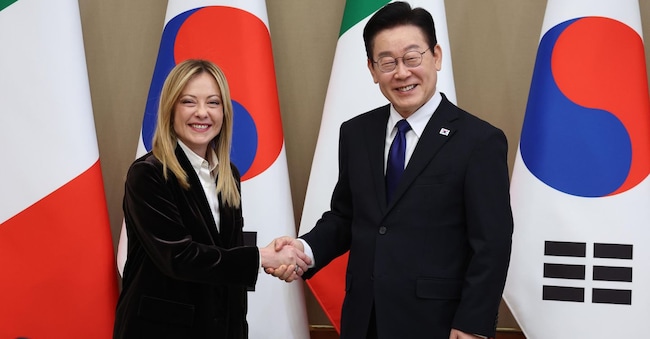
Strengthening economic and industrial partnerships, from artificial intelligence to aerospace, from semiconductors to critical raw materials. Making value chains 'increasingly strong and secure'. "Making policy coordination on major international issues more systematic", starting with security in the Indo-Pacific. These are the three priority objectives shared by Giorgia Meloni with the President of South Korea, Lee Jae-myung, during the bilateral meeting in Seoul that took place at 11 a.m. local time (in the Italian night) in the presidential Blue House dusted with snow.
More generally, the purpose of the face-to-face meeting was to 'explore the extraordinary untapped potential' of the bilateral relationship. "Unlimited" potential, according to Lee: "By combining Italy's tradition of scientific strength with Korea's DNA of innovation, we will be able to create an extraordinary synergy and results of great value".
The bilateral in Seoul, then the return to Rome
Meloni is the first Italian premier to make an official visit to Korea in 19 years (the last had been Romano Prodi) and the first European since Lee took office. It was necessary to "fill a gap that had been too long", she said in joint statements to the press. "Italy and Korea are old friends," Lee echoed her, "two years ago was the 140th anniversary of our diplomatic relations, elevated in 2018 to strategic partnership. The bilateral is the last stop of the Asian mission of the premier, who is ready to return to Rome. With bated breath, on the external front, to understand the evolution of relations between the United States and Europe, precipitated over the Greenland case. And determined to tackle with the allies, domestically, the node of the security package, in view of the Council of Ministers tomorrow. Certainly, on Meloni's agenda, there is for now only the extraordinary European Council convened by Antonio Costa in Brussels for Thursday. On the other hand, the hypothesis of making a stop in Davos for the meeting of the Board of peace for Gaza and the conference on Ukraine is receding: too many tensions with Trump, too many unknowns.
Strategic autonomy, agreement on semiconductors
'Strategic' is the adjective most frequently used by Meloni at the start of the conversation. She mentions the desire to launch joint research projects in the field of critical minerals, given the need to 'rethink our supply chains to make them more solid, stronger, more controllable'. She says she is 'particularly proud' of the memorandum of understanding on semiconductors signed between Ksia, the Korean semiconductor industry association, and Anie-Ce, the Italian federation of electrotechnical and electronic companies. A fundamental step,' Meloni comments, 'to reduce external dependencies and support innovation in sectors such as electronics, automotive, and telecommunications. The collaboration will also cover scientific research, with the exchange of researchers and expertise. The other two MoUs signed concern the prevention and management of natural disasters (our Civil Protection is in the field) and the protection of cultural heritage.
Investments, 'Italy works to foster them'
Cooperation with Korea, according to the premier, can also improve in transport and infrastructure, because Italian companies 'can offer innovative solutions that are already competitive in international markets'. But it is on investments that there are wide margins for growth. "For Italy," says Meloni, "the presence of large Korean industrial groups in Italy is certainly very important. We are working with this government to create an increasingly favourable environment for foreign investment, especially in highly innovative sectors: I am thinking about robotics, microelectronics, and automotive'. Both Meloni and Lee mention small and medium-sized enterprises, and their internationalisation, as recipients of special attention. The consolidation of the partnership will also result in overcoming 'some non-tariff barriers to entry for our products', especially for meat and fruit.


