
Croatian shipping company Jadrolinija is investing 200 million in fleet renewal
CEO Blažinović: “We plan to acquire up to 10 ships.” The company has just launched the high-speed service between Zadar and Ancona

Having launched the fastest connection between Italia and Croatia (4 hours) at the start of July, with the route between Zadar and Ancona, Jadrolinija, Croatia’s largest passenger shipping company, is aiming to expand its fleet. Robert Blažinović, CEO of the group, which is controlled by the Republic of Croatia, explains the company’s plans. “Fleet renewal,” he emphasises, “is one of Jadrolinija’s strategic priorities. “Our long-term plans include significant investments, including the potential acquisition of up to 10 vessels, with an estimated total value of around 200 million euros. These plans will be implemented gradually, in line with the company’s needs and changing market conditions.”
The company currently operates a fleet comprising 57 vessels: 39 ferries serving domestic routes, 13 high-speed catamarans for passenger transport (including the one operating on the Zadar–Ancona route), four conventional passenger ships and one ferry used primarily for international services. “In 2024,” recalls Blažinović, “Jadrolinija introduced the Dalmacija, the largest vessel in its fleet, which is now deployed on international routes between Split and Ancona, Split and Bari, and Dubrovnik and Bari. At the same time, the Marko Polo ferry, traditionally used on international routes, was redeployed to strengthen domestic connections with the most remote Croatian islands, where greater transport capacity was required.”
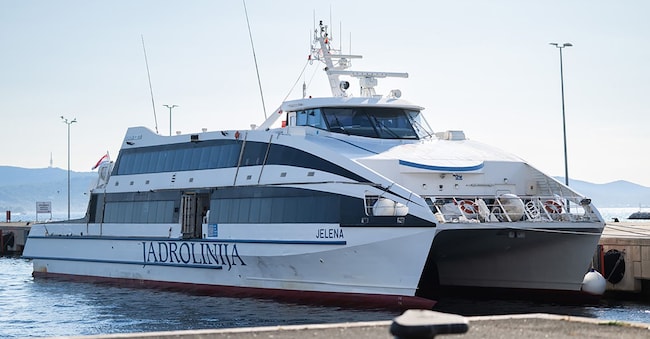
Jelena, a catamaran carrying 400 passengers
This, he continues, “has given us the opportunity to rethink the most effective way of connecting the Zadar region with Italia. We firmly believe that this route is of strategic importance, not only for tourism, but also for trade, economic relations and, more generally, for connectivity between the two shores of the Adriatic’. The Ancona–Zadar express service is operated by the catamaran Jalena (launched in 2018), which has a capacity of around 400 passengers; the service runs five times a week and will operate until 30 August. The route “offers Italian travellers direct access to Zadar, Central Dalmatia and the Croatian islands, whilst at the same time enabling Croatian passengers to reach the Marche region and central Italia with ease”.
Jelena, the CEO continues, “is a modern and reliable vessel, particularly well-suited to operating on that route. However, our long-term vision extends far beyond this single route: the company’s development plan envisages a broader programme to modernise the fleet, which will involve various types of vessels. We are working with international financial institutions to identify funding opportunities, whilst some of the planned projects will be carried out using our own resources. At the same time, international routes continue to represent an important part of our commercial development: the introduction of the Dalmacija, now the fleet’s flagship, has helped to raise the quality of service on international routes. Our short-term investment priority remains the renewal of the fleet deployed on domestic routes. However, the growing demand on international routes certainly makes us keen to seize new opportunities to strengthen this segment.’
Almost 2,000 employees
At the end of 2025, Jadrolinija had 1,995 employees, nearly three-quarters of whom were seafaring personnel. As mentioned, the company is wholly owned by the Republic of Croatia but, as Blažinović points out, despite being publicly owned, it operates within a maritime transport market that was fully liberalised in 2013, in line with European Union legislation. Although commercial routes are open to competition, many domestic passenger and ferry services operate under public service obligation contracts. These routes are awarded through public tenders and aim to guarantee island communities regular, safe and accessible connections throughout the year, regardless of seasonal fluctuations in demand.”


