Letter to savers

Cucinelli is ahead of the curve with its new factories. The push into China

Exclusive luxury. The cashmere brand plans to complete work on its production facilities by the end of the year. The risk of tariffs on the US market

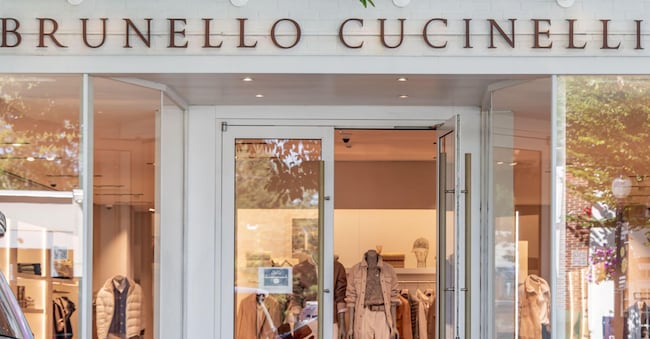
Brunello Cucinelli boutique Alamy Stock Photo

6' min read

Translated by AI
Versione italiana

6' min read

Translated by AI
Versione italiana

On the one hand, the acceleration in the construction of the new production facilities, which will be ready by the end of 2025. On the other, the focus on the Chinese market. These are among the priorities of Brunello Cucinelli, whose senior management spoke to *Lettera al risparmiatore* in support of the business.

Yes, business. The cashmere brand recently published its sales figures for the first quarter of 2025. Turnover stood at 341.5 million, up 10.5 per cent compared with the same period in 2024 (+10 per cent at constant exchange rates). As for sales channels, the retail sector (company-owned stores) grew by 11.9%, whilst the wholesale sector (multi-brand) increased by 8.2%. Finally, looking at the geographical breakdown: the Americas and Europe grew by 10.3 per cent and 10.2 per cent respectively. Asia, for its part, recorded an increase of 11.3 per cent.

Loading...

CONTI A CONFRONTO

Loading...


Focus on China

With regard specifically to the geographical breakdown, it is worth noting that the distribution of sales – again at the end of the first quarter – is as follows: Europe and the Americas account for 35.1 per cent and 36.9 per cent of the total respectively. Asia’s share, on the other hand, stands at 28 per cent. Is this breakdown set to change? The answer is yes. The group aims to increase China’s relative share. The former Middle Kingdom currently accounts for around 13 per cent of turnover. This percentage is considered low, and the aim is to reach a share of around 16 per cent within three or four years. In doing so, the whole of Asia – with the obvious contribution of other countries in the region – could account for around a third of global sales. In such a scenario, moreover, a more balanced distribution of turnover would be facilitated. In other words: ensuring that all three regions account for around 33 per cent of revenue. Beyond the percentages, expansion in China must not compromise the exclusive luxury character typical of Cucinelli. This, in a country such as the former Middle Kingdom, is no simple matter. Beijing is characterised by the hyper-connectivity of its inhabitants. A situation which, on the one hand, allows for a more than proportional level of brand awareness and reach; but which, on the other hand – precisely because of this characteristic – risks diluting the brand. In light of this, the strategy is to proceed gradually. An example? Opening just one shop a year, whilst ensuring the exclusivity and quality of the offering.

RICAVI E AREE GEOGRAFICHE

Loading...


The US-Beijing clash

So, is it as easy as drinking a glass of water? The reality is more complicated. The increasingly fierce tensions between China and the United States, following Washington’s policy on tariffs, could penalise Western companies, including Cucinelli. The cashmere fashion house does not share this concern. The group, it is said, in the countries where it operates – including the former Middle Kingdom – studies and engages with the cultures it encounters. This understanding facilitates integration and mutual respect with the local community. But that’s not all. The Chinese, Cucinelli adds, appreciate the group’s high-quality products and craftsmanship, as well as its ability to stand out in the lifestyle sector. Consequently, the company does not face any specific issues on this front.

The suspension of production capacity

But it is not just a question of Asia and China. Another important aspect – precisely – is the strategy for expanding the production base. For the three-year period 2024–2025–2026, annual capital expenditure was projected to be around 9 per cent of turnover. This is higher than the historical average, which stands at 7–7.5 per cent of revenue. As is well known, this increase is aimed at building new factories to support the group’s future growth. Indeed, Cucinelli has confirmed that capital expenditure will be accelerated to bring the project forward to the end of 2025. So much so that, in the current financial year, capitalised expenditure is estimated to reach 10.5 per cent of turnover, before returning to the level historically typical of the luxury house in the following year. In particular, by the end of the current financial year, the extension of the factory in Solomeo is expected to be completed (reaching a total area of around 75,000 mt2). Then, also by the end of the year, the facility in Penne (4,000 square metres) is expected to be operational, which has the potential to accommodate up to 400 tailors; and, on the other hand, the factory in Gubbio (3,000 square metres) with the potential to accommodate up to 250 tailors (there are currently 80).

RICAVI E CANALI DI VENDITA

Loading...


The tariff war

In such a context, and given that the US is a major export market for Cucinelli, investors are expressing concerns. The concern is that the new tariffs – launched on 2 April with ‘Liberation Day’ – will affect the luxury sector itself, including Cucinelli’s business. The fashion house – whilst fully aware of the situation and strongly reiterating that it has no intention of moving production outside Italia – calls for a more nuanced analysis. It is pointed out that exclusive luxury goods are resilient to developments such as these new tariffs. In this regard, the group will implement a ‘pass-through’ policy in the American market. From 1 July – as things stand – a 3–4 per cent price increase is expected for the autumn–winter collection alone. A move – Cucinelli adds – which is not expected to have any negative impact on sales. That said, however, it may be further argued that geopolitical and macroeconomic instability creates uncertainty. This context is fuelled by what the sociologist Zygmunt Bauman has termed ‘the economic politics of uncertainty’, in which the very propensity to spend on discretionary goods – such as luxury items – may be undermined. True, says Cucinelli, who nevertheless counters: first and foremost, in April and May, the group observed no change in its customers’ behaviour. Furthermore, the company – much as it did during the Covid crisis – issued various guidelines to reassure its employees about their jobs. These included: being increasingly kind, welcoming and courteous towards customers. An approach that – clearly – is paying off. So much so that Cucinelli confirms its revenue growth forecasts of around 10 per cent for both 2025 and 2026.

FLUSSI DI CASSA

Loading...


Loading...

Sales channels

So far, we have looked at some insights regarding the development of the production base and Asian markets, particularly China. But what are the trends within the distribution channels? At the end of 2024 – and therefore net of any seasonal fluctuations – revenue broken down by sales channel was distributed as follows: 66.6 per cent was attributable to retail and 33.4 per cent to wholesale. The group considers this breakdown to be appropriate. Among other things, the company emphasises that multi-brand retail remains important, not least because it acts as a ‘guardian’ of the brand. Put another way: the presence of ‘Made in Cucinelli’ products – alongside other brands – in high-end department stores allows customers to assess the freshness and contemporary appeal of the group’s products.

Digital, but not too much

That group which – with regard to directly managed stores (DOS) – generally confirms, on the one hand, 4–5 expansions of existing outlets per year; and, on the other hand, the opening – again each financial year – of 3–4 DOS. With regard to the digital sphere, however, it should be noted that e-commerce attributable directly to the online boutique accounts for around 7 per cent of total turnover. When purchases via multi-brand websites are also taken into account, the percentage rises to 13–14 per cent. Are these figures set to increase? The answer is no. Although the digital world – particularly given the role that online platforms play in presenting garments and offering potential customers their first glimpse of them – is considered important. The proof? It is provided – amongst other things – by the development of artificial intelligence, which is gradually complementing the traditional online boutique.

So, for example, within three months, a service is expected to be launched whereby artificial intelligence – when asked – will be able to suggest the best combination of garments (from a jacket and trousers to a shirt) for attending a gala dinner or a ceremony. In short: the real world of retail remains at the heart of it all, supported by new technologies.

Share price performance

Technical analysis

Finlabo research

Copyright reserved ©
Loading...

Brand connect

Loading...

Newsletter

Notizie e approfondimenti sugli avvenimenti politici, economici e finanziari.

Iscriviti