
Culture: an industry worth 310 million. A driving force behind ‘Made in Italy’
Conference of Italian Cultural Institutes Abroad held in Verona. Tajani: ‘Ambassadors of the country’

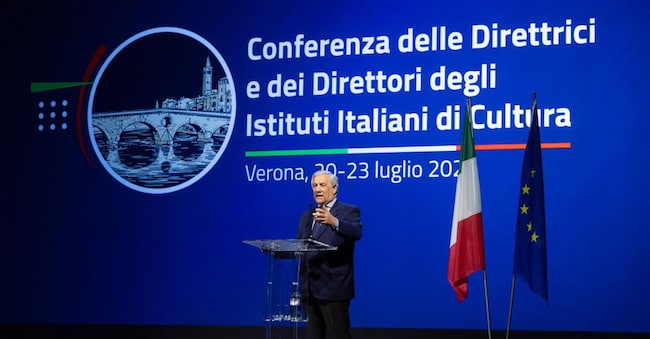
Italia is a small country: it accounts for just 0.2 per cent of the world’s land area and less than 1 per cent of the global population, yet it is home to 5 per cent of UNESCO World Heritage Sites, generates 3.1 per cent of global exports and 2.1 per cent of the world’s gross domestic product.
“We are a cultural superpower,” remarked Antonio Tajani, Minister for Foreign Affairs and International Cooperation, speaking at the Conference of Directors of the Italian Cultural Institutes (IIC), which took place in Verona from 20 to 23 July. A network of 88 organisations across 63 countries, which organise over 5,000 promotional events each year, thanks to public funding of around 24 million per year. “Culture is an extraordinary asset for promoting our identity and our economy around the world, and the cultural institutes are ambassadors for an Italia that is a giant in the field of culture,” said Tajani.
Culture is identity, values and a way of life. But it is also a driver of wealth and employment, as Federico Silvestri, CEO of the Il Sole 24 Ore Group, who began collaborating with the Ministry of Foreign Affairs and International Cooperation (MAECI) in 2023 on the ‘Laboratorio Farnesina’ project, which became the ‘Laboratorio della Crescita’ in 2026. The aim is to map out Italian initiatives and organisations to be supported and promoted abroad through the network of embassies, consulates and Italian cultural institutes. So far, 11 Italian cities have been involved, through one-to-one meetings organised between Ministry officials and local cultural operators, and three projects have been implemented. ‘The Italian cultural institutes and the system of cultural diplomacy constitute a strategic infrastructure for the country, generating not only knowledge and expertise, but also competitiveness and growth,’ said Silvestri. The €170 billion in exports of beautiful, well-made products, as estimated by Confindustria, “remind us that cultural reputation is not a mere accessory to the economy, but one of the foundations of its value”, he added, emphasising that culture directly generates nearly 116 billion euros in added value and contributes around 49 billion to sectors that benefit from culture, ranging from fashion to design, and from hospitality to services.
Minister Tajani also cited some figures that highlight the importance of culture, not only in terms of identity but also economically. “The cultural sector is worth 310 billion, equivalent to 15.4 per cent of national wealth,” said Tajani, citing figures from the Symbola Foundation’s ‘Io sono cultura’ report, presented last week, “and employs one and a half million people, 5.7 per cent of the Italian workforce.”
The cultural industry encompasses not only the sectors traditionally regarded as such, but also production sectors that play a full part in shaping Italian identity and way of life. Matteo Zoppas, president of the ICE Agency, emphasised this, noting that ‘we Italians are famous throughout the world not only for our artistic culture, but also for our craftsmanship and industrial heritage, which cuts across various sectors, including design, fashion, cuisine and wine, technology and traditional crafts’. Zoppas highlighted the collaborative work between the 90 ICE offices worldwide and the Italian cultural institutes, under the direction of the Ministry of Foreign Affairs and International Cooperation (MAECI). ‘Culture is an ambassador for dialogue and peace, but it is also diplomacy for growth, supporting the government’s target of reaching €700 billion in exports by 2027.’

