Federculture Report

Culture is out of the crisis

The 20th Report records growth in public investment, the Art Bonus, cultural consumption and partly employment. The North-South gap remains

5' min read

5' min read

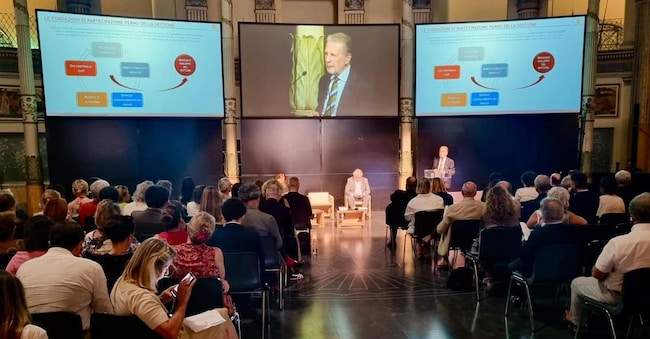
Last Thursday 11 July, in the setting of the Roman Aquarium, the 20th Federculture Annual Report 2024 was presented. From the data presented, the cultural sector now seems to have left its darkest years behind it, with indicators on cultural consumption and participation, but also employment, returning almost completely to the levels of 2019, in some cases exceeding them. If 2022 represented the year of recovery after the dark years of the Covid-related crisis (2020-2021), 2023 consolidated the growth trend with +12% on cultural participation and +10% on household spending on culture.

During the presentation, in the presence of Andrea Cancellato and Daniela Picconi, respectively president and vice-president of the trade association, Alessandro Panci, president of the Order of Architects of Rome and province, Remo Tagliacozzo, sole director of Acquario Romano srl, and Miguel Gotor, Councillor for Culture at Roma Capitale, a message was read out by the Minister of CultureGennaro Sangiuliano, who emphasised how certain measures implemented by the government had been the driving force behind this recovery: "the launch of the great project of the Albergo dei Poveri, the largest cultural infrastructure in Europe, and the great public successes in the extraordinary openings of museums, archaeological parks, and cultural sites of the State," the minister went on to emphasise, "the importance of the new law against eco-vandals and all forms of violence against Italy's artistic and cultural heritage.

Loading...

Consumption and participation

The first sign of recovery is that citizens' demand for culture is growing again: the average monthly expenditure on culture, recreation and sport of families resident in Italy is 101.27 euro compared to 91.94 in 2022; the increase recorded is therefore +10.1%. If we also deduct the inflation figure for spending on culture, the increase would be reduced to about +4%, a figure that is clearly more positive than that of overall spending. On the other hand, the value relative to the increase in the incidence of expenditure on recreation, sport and culture on the total average monthly family expenditure remains constant, rising from 3.2% in 2021 to 3.7% in 2023, as in the case of absolute values the value of 2019 is not completely recovered.

SPESA MEDIA MENSILE DELLE FAMIGLIE

Loading...

Although the estimates are still preliminary, the usual regional gap seems to be confirmed for 2023, with the North having an average expenditure of EUR 122.8 and the Centre of EUR 117.8, a value that almost halves in the regions of Southern Italy with about EUR 58.7, a growth of 3.5%.

The appetite for culture has also returned in terms of participation: compared to 2022, the enjoyment of all cultural activities outside the home increased on average by about one and a half times and, in some areas, such as concerts, almost doubled. In addition to concerts, the biggest increases were recorded in theatre (+63%), classical concerts (+50%), visits to museums and exhibitions (+44%), and to archaeological sites and monuments (+43%). As in the case of expenditure, the gap between North and South is considerable. In fact, in the first places of consumption we find regions in Northern Italy and Lazio, while Sicily, Calabria and Basilicata, as well as Sardinia, are among the Cinderellas.

FRUIZIONE CULTURALE, UN’ITALIA A DUE VELOCITÀ

Loading...

The report guiltily does not indicate, in our opinion, the level of consumption related to the video game industry and on-demand streaming platforms, new forms of cultural enjoyment that have replaced the classical consumption of cinema, theatre and TV.

In 2023, the cultural participation indicator stands at 35.2%, a sharp increase from 2022 (+12%), bringing it back to pre-pandemic levels for the first time (in 2019 it stood at 35.1%). Compared to the pre-pandemic period, participation levels can now be said to have recovered to previous indices, with the participation indicator being 0.1 percentage point over the 2019 value of 35.1%, with some sectors leaping ahead, such as non-classical music concerts (+7.4%), visits to archaeological sites and monuments (+8.4%) and museums and exhibitions (+2.5%); Among the main sites, there was great growth in the Coliseum, which exceeded 12 million visitors (+25.3% vs. 2022), the Uffizi Galleries with over 5 million visitors (+26.4%), Pompeii with over 4 million admissions (+33.6%) and the Egyptian Museum in Turin, which crossed the 1 million mark and grew by 16.7%. Of a different sign is the case of the cinema, whose admissions, while increasing greatly in 2023, still remain 15 percentage points below the values of 2019.

FRUIZIONE DI INTRATTENIMENTI CULTURALI E RICREATIVI IN ITALIA

Loading...

LA FRUIZIONE CULTURALE PER REGIONE

Loading...

In the areas taken into consideration, regions such as Basilicata, Sardinia, Molise and Sicily hold the last three positions in the ranking. Cancellato explains how culture should be considered a medicine to prevent psychosomatic pathologies and illnesses and therefore the purchase of a musical product, a book, a cinema ticket or a museum ticket should be considered as medicine for the mind and body. The state, as it did for the cinema, should incentivise cultural consumption through discounts and taxation.

Investment in Culture

Overall, the investment picture is also positive, a fact not to be taken for granted for a sector that over the years has always suffered from the scarcity of resources. The state budget for culture, i.e., what is allocated to the MiC budget, while remaining at decidedly higher levels than pre-Covid, shows a slight decrease for the years 2023 and 2024. Since the Ministry's final budgets are not yet available, looking at the Budget Law forecasts, there are decreases of between 3 and 7% in the aforementioned years, in which the MiC allocation, in absolute values, goes from 3.8 billion euro in 2023, to 3.5 in 2024. Similar decreases are also recorded in the resources for entertainment and cinema: the National Fund for Live Performing Arts in 2024 amounts to 424 million euro, a decrease of 6.5% compared to 2023. On the other hand, the Cinema Fund, which amounts to 696 million euros in 2024, shows a decrease of 6.7% compared to the previous year. With regard to municipal administrations, the final data available to 2022 continue to show an increase in resources, which overall exceed 2.3 billion, +13% on 2021, with the highest variations in particular in the Islands (+19%) and in the South (+17%); while the lowest growth is in the North-East +7.6%. Municipalities, however, seem to have fully recovered from the years of financial restriction of the crisis (2020-2021), in fact, compared to 2019, the resources allocated are up by 16.7%. Compared to the budgets of the Regions, the item allocated to cultural assets and activities, although with variations in the individual regions and different trends, is fairly stable until 2021, standing at just over EUR 1.1 billion in the national total. For the years 2023 and 2024, for which the data are, however, provisional, a growth, albeit fluctuating, around EUR 1.3 billion seems to be configured.

LE RISORSE PUBBLICHE PER LA CULTURA

Loading...

Private support for culture through the Art Bonus, on the other hand, does not come to a halt and even registers new milestones. The instrument for the involvement of businesses, citizens and private entities in the financing of the sector had already surpassed the 900 million euro mark in April 2024, while 2023 was the year in which the highest annual amount and number of disbursements, over 121 million euro, was reached.

ART BONUS

Loading...

The Art Bonus is growing, but is unevenly distributed. In fact, the South and the Islands attract 2.7% of the donations, while the Centre attracts 18.6% of the resources and Northern Italy 78.8% where Lombardy and Piedmont take the lion's share with 49.4% of the total resources attracted. To incentivise the instrument, according to Cancellato, the incentive should be extended to the private sector and not only to the public sector.

Copyright reserved ©
Loading...

Brand connect

Loading...

Newsletter

Notizie e approfondimenti sugli avvenimenti politici, economici e finanziari.

Iscriviti