Milan-San Remo 2026

Cycling, the new epic challenge between Pogacar and Van Der Poel in the Spring Classic

The historic Italian cycling race prepares for a breathtaking duel between the two champions, as the Italians chase a success that has been missing since 2018

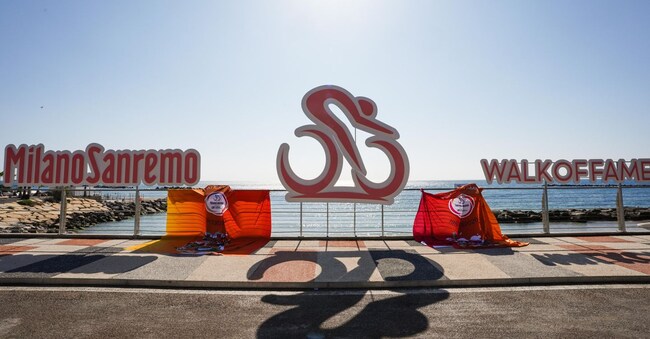
by Dario Ceccarelli

Inaugurazione a Sanremo, sulla pista ciclabile sotto Corso Imperatrice, della Walk of Fame dedicata ai protagonisti delle Classicissime, Sanremo, Italia  (Foto di Massimo Paolone/Lapresse)

5' min read

Translated by AI
Versione italiana

5' min read

Translated by AI
Versione italiana

Sanremo is Sanremo, its unwavering admirers say with a sigh. Despite all the technological and climatic, social and historical changes, and the fast passage from the old protagonists to the new phenomena such as Pogacar and Van Der Poel, the Spring Classic, which is being run this Saturday 21 March starting in Pavia and finishing in Sanremo in via Roma, remains a special, almost magical race, perhaps without even knowing it.

It's amazing how it has retained its appeal, its force of attraction, so much so that when this period arrives those who love cycling feel a tingling in their hearts. As if they feel a signal, a distant call that comes from its own history, its legends, its winners who are never anyone's children, but always champions of great stature, who not by chance arrive first at that finish line after almost 300 kilometres that never end.

Loading...

We should talk about its history, its first edition won in 1907 by Lucien Petit-Breton, Eddy Merckx's seven victories, Costante Girardengo's six, and the unforgettable one, right after the war, by Fausto Coppi who in 1946 inflicted more than 14 minutes on the French Lucien Tesseire while the radio commentator, the mythological Nicolò Carosio, warned listeners that in the interval between the first and second, "dance music would be played...". Not forgetting Michele Dancelli who in 1970, breaking 17 years of foreign domination, triumphed crying after a very long solo run.

Pieces of the history of that booming Italia that led to the successes of Saronni (1983) and Moser (1984), Bugno (1990) and Chiappucci (1992), and Gabriel Colombo (1996). Until the new millennium with Mario Cipollini (2002), Paolo Bettini (2003), Alessandro Petacchi (2005) and Filippo Pozzato (2006). The last victory by an Italian is the one in 2018 by Vincenzo Nibali, our last champion, skilful in taking flight on the Poggio and then breaking away from everyone on the descent before the finish line.

Superfavourites

But this is the past, a bright past that remains in the annals at the moment. The present is less glorious, dominated as it is by foreigners with the exception of Filippo Ganna, who with his two second places (2023 and 2025) is the only one to keep champions such as Van Der Poel, Pogacar, Van Aert and company on their toes. They are the super favourites. With in the foreground the extraordinary duel between Van Der Poel (already twice first) and the new ace of modern cycling, the world champion Tadej Pogacar, who arrives at this appointment with an irresistible desire to break the taboo that has so far prevented him from winning the Classicissima. The Slovenian must really want it, because he has reiterated that he would rather win the Sanremo (and perhaps also the Roubaix, the other classic that has so far eluded him) than conquer the absolute record of six Tour wins (he is now at four).

Here is the pulp of this Sanremo: that we are all waiting to see if this insatiable cannibal with a seemingly human face, will succeed in his goal of conquering a race that so far, for one reason or another, has always eluded him. "I don't like zeros in the palmares," he warns. In five participations, like a wolf approaching its prey, he has come closer and closer (twice third in 2024 and 2025) without, however, managing to make it his own. There are many reasons for this: the first is that the Sanremo route is not ideal for his characteristics. The second, which is not trivial, is that on his way he has found a formidable classics hunter like Mathieu Van Der Poel, a real raptor in one-day races having already won three Tours of Flanders and three Paris-Roubaix. An extraordinary talent, the Dutchman, who has also won eight world championships in professional cross.

Clearly, with this CV, Van Der Poe, 31 years old, grandson of Raymond Poulidor and son of Andrie, a good rider in the 1980s, remains the super favourite. He himself, who prepared last week at the Tirreno Adriatico (2 wins), says he feels in great shape, adding that he is ready for the trio. Words that, in short, announce battle.

Pogacar, the ruler of this era

There is a though, though. And that though is called Pogacar. After what he did last year, after his last crushing victory at the Strade Bianche, the Slovenian seems to have no limits. A Martian capable of any feat. Too superior, too confident. A super-talented assisted by an extraordinary team (the Uae Emirates) and a lieutenant like the Mexican Isaac del Toro, second at the last Giro d'Italia and winner of the last Tirreno-Adriatico. Clearly, psychologically Pogacar also held the entire peloton in check. When Tadej gives the gas, nobody follows him anymore. Almost everyone is now racing for second place when he is there. One of the few who doesn't care is Van Der Poel himself, a true thoroughbred in the monument classics. But his rivalry with Pogacar ends there because in stage races, as far as the classification is concerned, there is no match. The Dutchman may win a few important stages, but he will never challenge the Slovenian on his own ground. The only one who has managed it so far is the Dane Jonas Vingegaard, winner of two Tours, who will participate in the next Giro d'Italia. However, the Dane does not touch the ball in the classics. In short, Pogacar is the absolute ruler of modern cycling.

He cannot yet compare with Eddy Merckx in terms of the number of victories (523, including seven Sanremo), but being only 27 years old he can aspire to eclipse him. Pogacar, in addition to his extraordinary racing skills, has another advantage: he does not suffer from pressure. Eddy Merckx, go and watch the footage, even when he won he often arrived at the finish line distraught. He suffered from rivalry with Gimondi or with Spanish climbers. In contrast, the Slovenian is smooth and smiling, as if he has just come out of the barber shop. With that perfumed smile of someone who, although he has reached the top, is not even tired. That is why Van Der Poel himself, who is also a giant, must be careful. Because he knows that Pogacar is capable of anything. Even to escape before the Poggio or the Cipressa. Of redoing one of those old cycling exploits, now forgotten by hyper-technological cycling.

And the Italians? Little to say. Apart from Filippo Ganna, who in this Sanremo, if convinced, can invent anything, the other Azzurri are on the sidelines. We had an excellent sprinter like Jonathan Milan, who could have made his mark in a sprint finish. But he forfeited for health reasons. So, apart from Ganna, there is little to get your hopes up. Our road cycling is worse off than our football. We are cornered in the sports that were more congenial and popular to us. The others put on a show in the Champions League or the Tour de France, we live on memories hoping that a Sinner will emerge from nowhere to reverse this sad drift.

Copyright reserved ©

Brand connect

Loading...

Newsletter

Notizie e approfondimenti sugli avvenimenti politici, economici e finanziari.

Iscriviti

Tutto mercato WEB