
Daikin, Italy first market in Europe: we will continue to grow
For the Japanese multinational in 2025 sales of 700 million in our country (639 in 2024). Good prospects with heat pumps

"Italy is our first market in Europe and we want to continue to grow". This is how Hiroshi Shimada, the new ceo of Daikin Italy, in office since the beginning of January, outlines the goal in our country of the multinational air conditioner company - active in the Hvac-R sector: heating, ventilation, air conditioning, refrigeration - with headquarters in Osaka (Japan) and 29 billion in global revenues. "In Italy we had sales in 2024 of 639 million euro and we expect to close 2025 at 700 million (the fiscal year closes in March, ndr): this is 13% of the Emea total, in turn 20% of the global total. France, our second largest market in Europe, has a value just below that of Italy. Italy is the most important market on the continent for air conditioning, with a device penetration rate of over 50%, while Germany, for example, is at less than 20%, and has a steady growth trend. We have been here with our products since the 1990s, then in 2002 we acquired our local distributor, who had an annual turnover of 100 million, and from there we started with a physical presence."
Today the company has 13 R&D centres and 18 factories in Europe, 7 of which are in Italy (under the Daikin Applied Europe division): in Cecchina and Ariccia (Rome), Vicenza, Settala (Milan), Pegognana (Mantua), Mazzano (Brescia), Busto Arsizio (Varese), and Ciserano (Bergamo). A network that has been built up over time also through acquisitions of local companies and that - adding the sales offices - employs over 2,300 people. There are also 19 training centres for installers in the area: "We aim to increase the number over the next two years and, above all, improve those that already exist," points out the CEO of Daikin Italy.
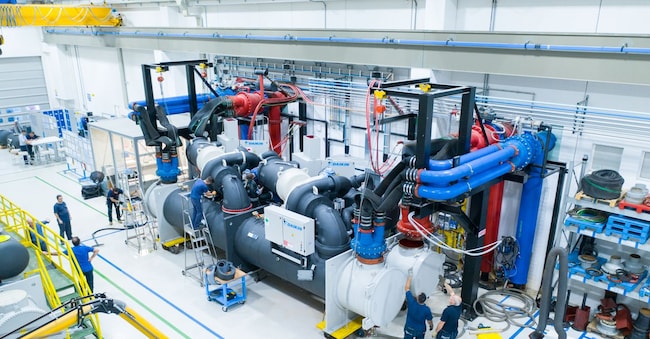
"Italy is traditionally a country of industry related to the production of large hydronic air conditioning devices. Daikin Applied Europe is based right near Rome. The site produces machines with power equivalent to tens of thousands of splits, such as those installed for TikTok's huge data centres in Norway. And there is an R&D centre dedicated precisely to this,' explains Shimada. 'The growth in demand,' he continues, 'has led to the need to expand production capacity over the years. This is why Daikin Applied Europe has continued to invest in Italy: 12 million in 2021, 16 million in 2024, 8 million in 2025 in Settala and Vicenza, while another 19 million is planned for 2026. Here in recent years we have also moved part of our production from Belgium, where we have our European headquarters. Italy is among the top countries on the continent for the manufacture of Hvac products: here we also experiment with new technologies, such as the reuse, once recycled, of refrigerant gases. We are the number one group in the world: we have the responsibility to lead the market in the technical transition'.
'More than 90 per cent of what is produced in Europe is also sold in Europe,' emphasises Shimada. 'This puts us in a favourable position in the Italian regulatory framework, particularly with regard to hyper-amortisation, which rewards made in Europe.
Daikin also produces heat pumps, a technology that aims to replace gas heating and which saw a boom in installations during the Superbonus period and then stopped at lower numbers, but with a trend that always points upwards: "Several years ago we were the ones who started this market in the whole of Europe, selling more than 120 thousand heat pumps to date. Our future goal is to further increase sales, with interesting prospects, especially in the context of the government-supported transition. We positively assess the decree no. 5 of 9 January 2026, which also provides for mandatory quotas of renewables for building heating in renovations: it can push electric and hybrid solutions. On the other hand, we are concerned about the transposition of the Case Green directive. And two issues remain crucial for us: the high purchase cost of the hydronic product category and the cost of energy. For both, we hope for solutions.


