
'Opera quotidiana', Levante's new book: 'Against fear I turn the words of war into poetry'
After five albums and three novels, the singer-songwriter is back with a project balanced between visual arts and writing. A daily diary in which the news clipped from 4,180 newspapers over two years becomes poetic verse alongside paintings, collages, thoughts
3' min read
Key points
3' min read
A journey through words in order not to be afraid. A daily diary where news of wars, epidemics, catastrophes, become poems. And the poems are flanked by paintings, collages, thoughts. This is "Opera quotidiana", the new book by singer-songwriter Claudia Lagona, aka Levante, to be published by Rizzoli on 19 November, a project that stems from a hand-crafted approach to expressing creativity "far from the fierce call of screens and digital".
Magazine titles that become poems
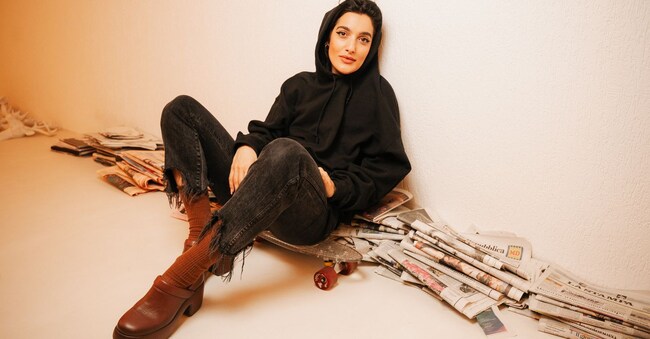
."Opera quotidiana was born out of a feeling of fear that I began to experience in February 2022 when the Russian-Ukrainian conflict broke out, a fear certainly amplified by motherhood since I had become Alma's mother just 13 days before," Levante recounts. That for 730 days she cut out the headlines of 4,180 newspapers and then mixed them up, reassembled them, made them dance like verses and then reassembled them into poems pasted on the sheets of a notebook. Every morning, for two years, he performed a gesture that may now seem anachronistic to some, namely going to the newsstand. "The first times the newsagent was amazed to see a young woman buying so many newspapers,' she says, smiling. 'And even though I buy a newspaper out of habit, for this project I bought many, even more than 10 a day, and different ones: from Sole 24 Ore to Corriere, from Gazzetta dello Sport to Foglio to Avvenire, just to name a few.
Between literature and the visual arts
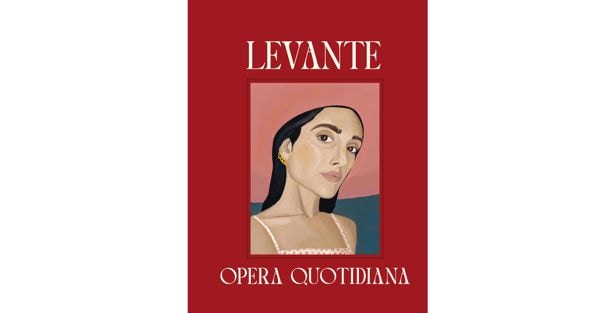
.And then, with painstaking work, 'I tried to transform those words that I read in the newspapers every day into something else, about elsewhere, because the words still sent me back to something poetic despite their tragic source,' Levante emphasises, who has already explored the experience of writing with three novels published by Rizzoli - Se non ti vedo non esisti (2017), Questa è l'ultima volta che ti dimentico (2018) and E questo cuore non mente (2021) - while in her 'guise' as a singer-songwriter she has five highly successful albums to her credit. "In two years, I collected a lot of headlines and I thought this would remain an exercise of mine," she adds, "but when Rizzoli decided to publish it, I proposed to combine the textual work with paintings on canvas. And thus were born images with intense colours, almost pop, evocative portraits of everyday life and love: her parents, her daughter Alma, the first coffee, a hug, the telephone that does not ring, a shirt that recalls Domenico Gnoli, one of the author's favourite painters. The result is a book to read and to look at, a game poised between literature and the visual arts, an invitation to wonder, which through the free gesture of art offers a remedy to silence the background noise of everyday life.
-U16447662135ZGa-600x313@IlSole24Ore-Web.jpeg)
And this return to craftsmanship is a very strong feature of the project, seemingly at odds with Levante's marked digital dimension, which has always been very active on social media, especially Instagram. But with Opera Quotidiana she felt "almost like a shoemaker, if they had turned off the light I would have continued undisturbed because all I needed was scissors, paper, glue and notebooks," says the author, who is convinced that in this hyper-connected time there is "a need to take a time where the connection is between the people in front of you, to regain possession of the present time that is also the time in which you are physically present.
Paper newspapers or news on social media?
And it is precisely the digital dimension where information, news, travels today, and does so much more than it used to, that time of paper newspapers that the singer-songwriter has been exploring for over 700 days. But do today's newspapers communicate effectively through the web and social media? Can they reach that audience of young and very young people who not only don't read paper newspapers, but perhaps don't even know them? 'I am afraid that information, especially through social media, arrives in a partial way,' Levante replies, 'because people are often not intrigued and driven to go beyond the headline. The problem, however, does not concern newspapers and magazines but people's curiosity, the desire to know and to go deeper'. 'We are living in very fast times,' he concludes, 'and my advice is to be able to stop, take your time and flip through a newspaper page instead.


