

From the Chinese case to the tests in the Middle East: the spy balloon war has begun
In 2023, a Beijing-built device was shot down in the stratosphere by the US after it had flown over nuclear bases. Following this, the US military launched a series of tests with the aim of creating a fleet of 300 units, combined with drones carried by air currents. This new high-altitude competition is putting military balances, airspace sovereignty and the security of European industries to the test
by 24Ore NextMed
 Aggiungi Il Sole 24 Ore
ai preferiti su Google
Key points
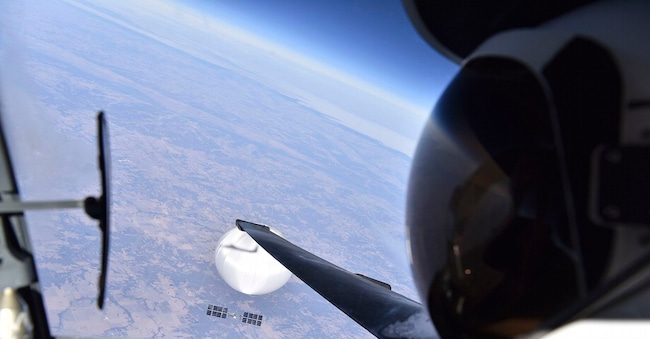
Two hundred or three hundred balloons in the stratosphere at the same time. This is the ambition expressed by General Steven Carpenter, commander of the US Army’s Multi-Domain Command–Europe. And, whatever the outcome, it is the litmus test of an ongoing transformation. Military, financial and diplomatic: the clearest illustration of the political issue dates back to February 2023. A Chinese balloon, which the US Department of Defence described as a surveillance platform, crossed North America at an altitude of around 60,000 feet. Washington ordered its shoot-down on 4 February; Beijing described it as a civilian meteorological aircraft that had strayed off course. The dispute disrupted a high-level diplomatic engagement: Secretary of State Antony Blinken postponed his planned visit to China.
Airspace regulations
The legal principle remains that set out in Article 1 of the 1944 Chicago Convention: every State exercises complete and exclusive sovereignty over the airspace above its own territory. Altitude does not constitute authorisation to overfly, and dependence on wind conditions does not absolve the operator of responsibility. An incident at high altitude therefore requires coordination between technical observation, attribution, civil aviation, military authorities and diplomacy: five stages that do not usually proceed at the same pace.
Drones carried by air currents and US tests
In May 2026, images and reports circulated regarding tests of the Hornet drone, described as being controlled by artificial intelligence, carried by a balloon and released after completing part of its journey by utilising air currents; Subsequently, images of larger, twin-engine aircraft appeared. The atmospheric carrier can spare the drone part of the flight that would otherwise require its own propulsion.
In the United States, experimental activities have a fairly broad institutional base. In June 2024, during the Valiant Shield exercise in the area of Guam and the Northern Mariana Islands, the Multi-Domain Task Force deployed balloons at altitudes exceeding 50,000 feet, equipped with electromagnetic sensors and communications equipment. On 9 May 2026, Multi-Domain Command–Europe conducted trials in Sweden at altitudes between 60,000 and 70,000 feet, with flights lasting approximately twelve hours; in the subsequent exercise, Cold Raptor, launch and control operations from separate locations were tested in Poland.
Clinical trials in the Middle East
Andrew Evans, Head of Strategy and Transformation for Military Intelligence in the US Army, has stated on several occasions that – in support of Central Command in the Middle East – launches involving groups of twenty-four units have also been successfully carried out. If this is indeed the case, Carpenter’s plan to deploy 200–300 balloons simultaneously (designed to deceive defences, relay communications, gather intelligence, carry out electronic attacks or deploy drones) appears to be a realistic objective.

