
Dan Flavin: when light needs to represent nothing else
The Guggenheim in Bilbao is currently exhibiting over twenty works by the American artist who has transformed fluorescent tubes into an art form

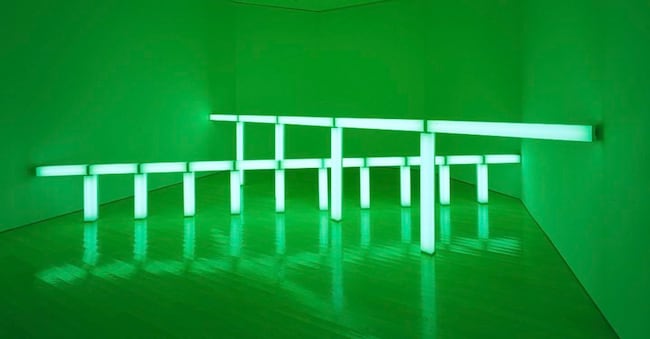
The key to entering the world of Dan Flavin (1933–1996) is a lit lamp. In 1963, the American artist made a choice that was to radically change his work, abandoning traditional painting, the canvas and the painted surface, to turn to an industrially manufactured object: the fluorescent tube. An ordinary material, available in any lighting shop, thus became the starting point for one of the most original bodies of work of the second half of the 20th century.
Light
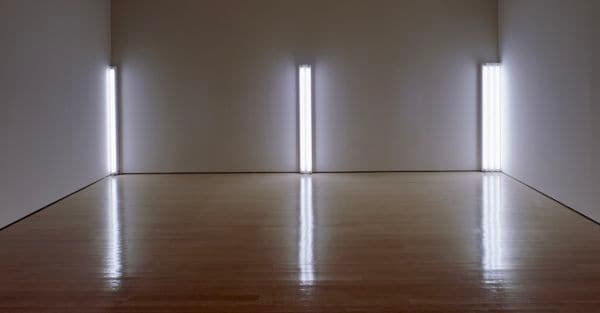
Light, a functional element of everyday life, was transformed by him into plastic form, colour, scale and, above all, an experience of space. It is from this insight that ‘Dan Flavin: A Little Light’, the new exhibition hosted by the Guggenheim Bilbao until 4 April 2027, takes its cue. The exhibition is curated by Lauren Hinkson, curator of the collections at the Solomon R. Guggenheim Museum in New York. Over twenty works are on display, largely drawn from the New York museum’s Panza Collection and supplemented by significant loans from the Dia Art Foundation, tracing a journey spanning three decades, from his early experiments to his large-scale environmental installations. The artist’s first idea was disarming in its simplicity. Flavin took a standard fluorescent tube, retaining its original shape and dimensions, and fixed it to the wall, allowing the light to do the rest. His first work created entirely from this material, the diagonal of personal ecstasy (the diagonal of 25 May, 1963), is a yellow luminous diagonal inclined at forty-five degrees. No brushes, pigments or elaborate composition are required; all that is needed is a light fitting to admire it at its best, a wall and the light that floods the room. In the first gallery in Bilbao, you will find works such as The Nominal Three (to William of Ockham), also from 1963: three vertical lamps emitting natural light, arranged in a progression of one, two and three elements, complete with a dedication to the medieval philosopher William of Ockham. “Reality, in its conception, lies in concrete things, not in universal abstractions,” the scholar maintained, and Flavin seems to translate this conviction into an aesthetic statement: the light is there, visible in its source and in its effects, without needing to represent anything else. Even his earliest works using white light – whether cool or warm – already possess a surprisingly architectural quality.
Angles
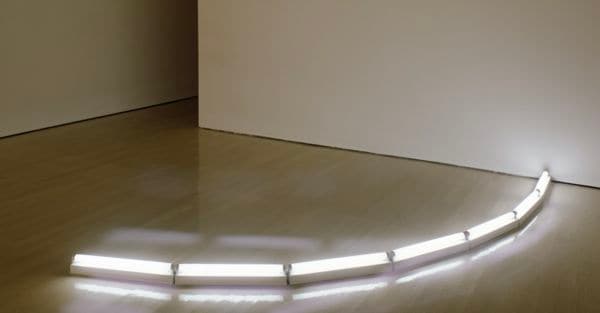
To the viewer’s eye, the corners blur, the walls seem to lose their substance and distances shift, but white is only the beginning, because Flavin works within a rigorous system of possibilities comprising ten colours, four standard lengths and lighting fixtures whose original structure has never been altered. A deliberately limited choice from which an almost inexhaustible variety of combinations arises. It is here that Minimalism encounters something more sensual and perceptual, and it is here that the reduction of elements produces an expansion of experience. Light cannot be confined to the surface, but travels through the air, colours bodies and alters the perception of dimensions. In the mid-1960s came the corners, monuments, barriers and corridors. Flavin began to engage with architecture, making the room an integral part of the work. greens crossing greens (to Piet Mondrian who lacked green) from 1966 – always to be written with a lower-case initial letter, as he insisted – is the artist’s first barrier, in which he arranges green tubes according to a framework of uprights and crossbars that physically blocks the passage. Two years later, in an artificial barrier of blue, red and blue fluorescent light (to Flavin Starbuck Judd), red and blue overlap, creating a shade of purple on the surfaces. The viewer thus enters a chromatic composition that continually alters its appearance depending on the vantage point from which it is observed. Particular attention should also be paid to “monument” on the survival of Mrs Reppin, a 1966 work that carries with it a unique human story. Mrs Reppin was the mother-in-law of the German gallery owner Rudolf Zwirner, whom Flavin met during a stay in Germany. A British citizen, she had been interned by the Allies during the Second World War for refusing to divorce her husband, a German soldier. Flavin dedicated a composition of white and red fluorescent light to her, in which the commemorative dimension takes on a character that is both intimate and unsettling. It is a significant example of how his dedications – often addressed to artists, friends and people he met along the way – introduce a biographical and emotional element into the austerity of the minimalist format. In the 1970s, his exploration broadened further: the light-filled corridors became self-contained spaces, in which colour could be concealed, revealed, perceived from one side and hidden from view on the other. In the 1980s, however, new lamps and new combinations further expanded his repertoire, as demonstrated by the compositions dedicated to Margo and Leo Castelli. The merit of this exhibition, therefore, lies in restoring the coherence of an artistic journey that began with an elementary gesture and succeeded in transforming it into a language.
Dan Flavin: A Little Light, Guggenheim Bilbao, until 4 April 2027

