Food & drink

Danone is focusing on health food: it has acquired the Australian company Made Group

According to press reports, the deal is said to be worth close to 2 billion Australian dollars, equivalent to around 1.4 billion US dollars

by Monica D'Ascenzo

REUTERS/Stephanie Lecocq/File Photo

6' min read

Translated by AI
Versione italiana

6' min read

Translated by AI
Versione italiana

Danone is strengthening its presence in the global market for functional and high-protein foods with the acquisition of Made Group, an Australian company specialising in the production of health drinks and dairy products, which it has acquired from the private equity fund TPG Capital. According to the Australian Financial Review, the deal is reportedly worth close to 2 billion Australian dollars, equivalent to approximately 1.4 billion US dollars. However, the French group did not disclose the financial details of the agreement in the press release issued today.

At the same time, Danone has announced the acquisition of the remaining 49 per cent of the joint venture specialising in fresh dairy products, which it owns jointly with Saputo Dairy Australia. Both transactions are expected to be finalised in the second half of the year, further consolidating the group’s position in the Australian market.

Loading...

The investment forms part of Danone’s growth strategy in the higher value-added segments of the food sector. The group is, in fact, one of the few major international players to have benefited significantly from the expansion in global demand for health-focused and protein-rich products. In particular, the market for high-protein yoghurts has recorded such high growth rates in recent years that it has put pressure on the company’s production capacity.

The transaction also follows the agreement announced at the start of the year regarding the acquisition of Huel, a British brand specialising in meal replacements and backed by a number of high-profile investors and brand ambassadors. The completion of the transaction remains subject to the necessary regulatory approvals.

On the Paris stock exchange, Danone shares have risen by more than 1 per cent, but their year-to-date performance remains down by more than 13 per cent.
The target company

Made Group is one of Australia’s leading players in the wellness drinks sector and owns some of the industry’s best-known brands, including Cocobella coconut water, Rokeby protein shakes, Impressed cold-pressed juices and NutrientWater fortified drinks.

Founded in the early 2000s by a group of entrepreneurs with the aim of offering healthier alternatives to traditional sugary drinks, Made Group has, over time, built up a portfolio of brands strongly focused on wellbeing and functional nutrition. The company’s first brand, NutrientWater, was the first vitamin-enriched water product to be marketed in Australia.

In the years that followed, the group expanded its product range with the launch of Cocobella coconut water in 2010, the expansion of Rokeby Farms into the probiotic yoghurt and protein smoothie segments, and, subsequently, with the Impressed brand of cold-pressed juices.

As regards shareholding, Coca-Cola had acquired a minority stake in the company in 2018. This stake was subsequently sold when TPG Capital came on board; in 2021, TPG Capital acquired 60 per cent of the share capital, supporting the group’s growth until its recent sale to Danone.

Activism in the sector

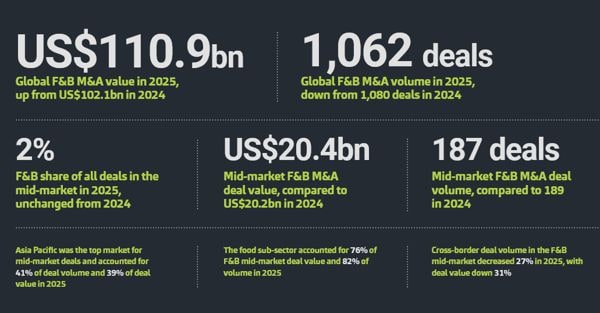
The global Food & Beverage sector is experiencing a resurgence in M&A activity, with players actively returning to the market for extraordinary transactions. The total value of transactions rose by 9% in 2025, reaching $110.9 billion, continuing an upward trend from the $59.4 billion recorded in 2022. The outlook for 2026 and 2027, according to analysts, remains cautiously positive, supported by a more favourable interest rate environment and companies’ need to optimise their portfolios. The convergence of food, health and technology – including new nutritional models and AI-driven supply chains – is also expanding investment opportunities in the sector.

The figures show encouraging signs. In the first quarter of 2026, 60 deals were announced in the Food & Beverage sector, up 5% on the fourth quarter of 2025 and 20% year-on-year compared with the first quarter of 2025. This growth confirms the return of confidence in the sector following the ten-year low recorded in 2025, with a gradual recovery in M&A activity.

In the twelve months ending 31 March 2026, there were 249 transactions, with strategic buyers accounting for the vast majority (79% of the total), driven primarily by objectives of diversification and supply chain optimisation. This trend reflects renewed interest from both strategic buyers and financial investors, with a further acceleration expected in the second half of 2026 and in 2027.

Mid-market transactions

Last year, the mid-market segment of the Food & Beverage sector reached a total value of $20.4 billion, up 1 per cent year-on-year, according to data from a report by Bakertilly International. Although modest, this figure remains broadly in line with the average for the last five years, but falls short of the performance of the global mid-market (across all sectors), where the value of transactions rose by 7% over the same period.

M&A nel food and beverage

Dati relativi al 2025

Fonte: Bakertilly International

In terms of volumes, the sector recorded a slight decline of 1 per cent, in stark contrast to the 4 per cent growth observed in the wider mid-market. The overall picture therefore points to a recovery that remains cautious, with the sector following a more gradual path towards normalisation than the rest of the market, characterised by an improvement in the value of investments but by transaction numbers that remain weak.

Early indications for the first quarter of 2026 suggest, however, that this trend is set to continue, with the mid-market F&B sector maintaining a stable performance and a moderate growth trajectory. The outlook for the rest of the year remains characterised by cautious confidence, against a backdrop that continues to be influenced by geopolitical and economic uncertainties. Despite the complexity of the macroeconomic landscape, market participants are showing sustained interest in the best-positioned Food & Beverage assets, with a preference for targets capable of delivering operational efficiencies and a stable, loyal customer base.

Stock market multiples under pressure

Looking at the trend in stock market fundamentals for the Food & Beverage sector, there is evidence of a gradual normalisation of valuations, with a widespread compression of EV/EBITDA multiples and a return to levels more in line with long-term averages. The picture that emerges from an analysis of the main sub-sectors highlights a growing divergence between defensive categories and more cyclical or growth-oriented sectors, in a context where the market appears to be placing less and less emphasis on themes and increasingly on the sustainable quality of cash flows.

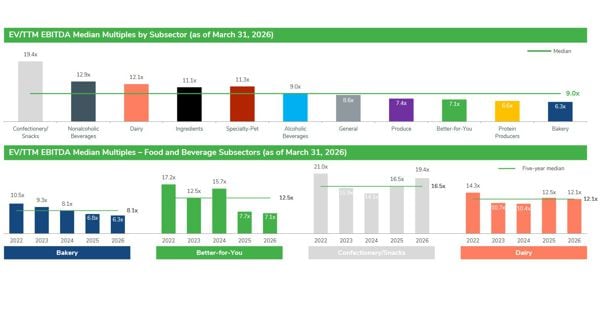
At an aggregate level, according to Kroll’s recent report on the sector, the median multiple for the sector stands at 9 times EV/EBITDA, though there is significant internal variation. At the top of the distribution among the sub-sectors is the Confectionery/Snacks sector, which trades at 19.4 times, confirming its status as the segment with the highest premium thanks to resilient demand, structural pricing power and a defensive profile that continues to be highly valued by investors.

Next come Non-alcoholic Beverages (12.9 times) and the Dairy sector (12.1 times), both of which are characterised by a relatively defensive nature but with more modest growth prospects. Ingredients (11.1 times) and Specialty Pet (11.3 times) also maintain above-average multiples, supported by rising spending in the pet segment, which continues to benefit from favourable structural trends.

The segments that are more mature or subject to more cyclical trends, on the other hand, are below the median. The Alcoholic Beverages sector is in line with the sector average at 9 times, whilst General (8.6 times), Produce (7.4 times) and Better-for-You (7.1 times) show more modest valuations. The figure for the “Better-for-You” segment is particularly significant: although it has been one of the strongest growth stories in recent years, it now shows a marked compression in its multiple, signalling a normalisation of expectations. Even lower are the multiples for Protein Producers (6.6 times) and Bakery (6.3 times), sectors facing greater pressure on margins and a reduced ability to pass on costs.

An analysis of the trend in the data between 2022 and 2026 reveals, according to the study, a general compression of multiples across all sub-segments, with a gradual return to levels below the post-inflation peaks. The most striking example is the Better-for-You segment, which has fallen from around 17.2 times to 7.1 times, whilst the Confectionery/Snacks sector, despite seeing its valuation fall significantly from around 21 times to 12.5 times, retains a significant relative premium compared with the rest of the sector. The Dairy and Bakery segments are also showing a more gradual but structural normalisation, whilst a comparison with five-year historical averages suggests that several segments are currently trading in line with or below their respective medians, signalling a less expansive and more selective market environment.

Copyright reserved ©
Loading...

Brand connect

Loading...

Newsletter

Notizie e approfondimenti sugli avvenimenti politici, economici e finanziari.

Iscriviti