
Dario Fo, the jester who becomes a Nobel Prize winner 100 years after his birth
Big party at the Sistina Theatre in memory of the celebrated playwright who was born on 24 March 1926

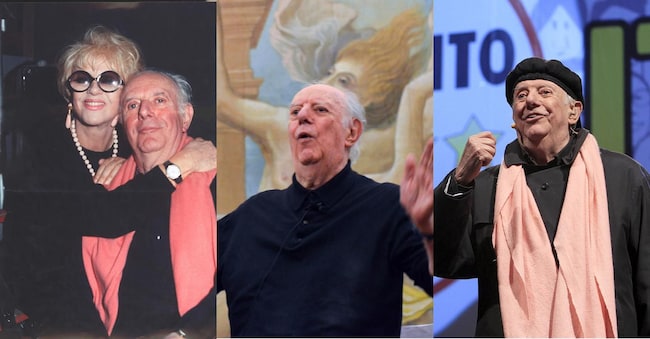
'The rare times when I pray, it is to him that I turn'. This is how Paola Cortellesi opened the evening dedicated to the centenary of Dario Fo's birth (Sangiano, 24 March 1926 - Milan, 13 October 2016), immediately choosing the least celebratory and truest path: that of a living, imperfect, even ironic relationship with the maestro. Not a monument, but a presence that still disquiets and compels.
The invitation to make mistakes
The actress and director recalled the shared work, the invitation to make mistakes, almost an ethical commandment before an artistic one: because in the mistake, for Fo, lurks a form of truth that escapes rhetoric and complacency. It is from this point that memory ceased to be commemoration and returned to theatrical practice.
Theatre as an embodied political gesture
The evening, presented by his granddaughters Mattea and Jaele Fo, was constructed as a choral device that rejected biographical linearity to instead render a constellation of voices, fragments and crossings. Yet a thread held it all together: the idea of theatre as an embodied political gesture, never separable from life. This was captured in the stories, in the sudden deviations and continuous shifts between public and private. These included the recollection of Carlo Petrini, who recalled his meeting with Fo at a very young age and that rare ability to combine art and commitment without ever losing the taste for play, as in a militancy experienced almost as a party. When his son, Jacopo Fo, introduced the Bandabardò, the story took a sideways, almost domestic and for this very reason revealing turn. He revealed the secret of grammelot, that impossible language that his father allegedly invented 'because he did not know English': but the joke already has poetics. It is not lack, it is reinvention. It is not limitation, but openness. And so the radio episode - little Jacopo next to his grandmother, waiting to hear that 'song in a strange language' - has become an original scene: theatre as an act of trust in listening, even before understanding.
Within this movement, the figure of Franca Rame never appears as a mere complement, but as an unavoidable axis. Love and conflict, scene and life, shared writing: everything in Fo seems to happen in the space of that relationship, which is both biographical and political, intimate and public. It is no coincidence that many memories (of Chiara Francini, Alessandro Federico, Anna Foglietta and Gilberta Crispino) insisted precisely on this tension that is never pacified, never reducible to edifying narration. Then there was the moment when history broke through with its almost perfect irony: the Nobel Prize for Literature. Not a solemn announcement, but a piece of news received in the car, while Fo was driving alongside Ambra Angiolini, during an episode of 'Roma/Milano'. The exceptionality that settles into the everyday, without really changing its substance. Even in this, Fo remains true to his nature as a jester: the one who crosses power without ever allowing himself to be defined by it. The reference to Mistero Buffo runs through the evening like an undercurrent. Not so much out of nostalgia as because one of the most radical intuitions of 20th century theatre is condensed there: giving back a voice to those who did not have it, reinventing language, breaking down codes, forcing the relationship between actor and audience. Not representation, but act. Not a form, but a necessity. Then grand finale with the song 'Ma che aspettate a batterarci le mani' (What are you waiting for to clap your hands) dating back to the 1970s, written together with his life and stage companion at a time of strong social and political tensions in Italia. A finale that avoided any emphatic closure and relaunched, rather, the idea of theatre as a collective gesture that still asks to be inhabited. Applause, certainly, but also something more difficult to name - a responsibility, perhaps. A hundred years after his birth, Dario Fo continues to elude any attempt at fixation. He does not belong to memory, but to practice. He does not allow himself to be celebrated without being, once again, staged.
Sistina Theatre, Rome, '100 years Dario Fo'

