Technology in the car

Dashcam, the 70Mai A810 Lite review: what it looks like and how to install it

is an inexpensive but feature-rich 4K dashcam. The 150 euro kit includes a rear camera and 64 GB micro SD. It boasts fast 5 GHz Wi-Fi for downloading videos and, for an extra 50 euros for the 4G module, offers H24 parking sentry mode with remote monitoring from the app.

by Mario Cianflone

5' min read

Translated by AI
Versione italiana

5' min read

Translated by AI
Versione italiana

That dashcams are indispensable is now certain. The small cameras that are installed on the windscreen or under the rear-view mirror are truly a watchful eye on the road, looking ahead, but also behind and inside the passenger compartment. A real sentinel that helps us to settle questions about the right and wrong of a road accident, and to prevent scams by those who try to pretend to come after us. They are also very useful for monitoring possible damage while parking. The approaching summer period and holiday travel inevitably rekindles interest in car cameras.

The most sophisticated dashcam kits are those that also offer the possibility of having a rear view and recording, or even an internal one, so that it is three-way, but a two-way system is really ideal. Until now, these were not particularly affordable, but these days, 70Mai has launched a real game changer. It is called the A810 Lite and offers a number of top-of-the-range features at a particularly affordable price. First of all it records in 4K, secondly it is very affordable, small but not so small that it has an insignificant display. And it is offered on Amazon in a kit that also includes the rear camera and costs 150 euro with a 64 GB micro SD card. Add another 50 euros and you also get the 4G module, which creates a number of interesting features because by permanently connecting to the car's 12-volt network it allows constant monitoring as a sentry function during parking, and this is certainly a plus that very few offer. Remote monitoring takes place via the 4G network with a SIM and a data connectivity plan.

Loading...

The A810 Lite dashcam is remotely controlled with real-time connectivity thanks to an app. It has to be said right away that during our test we particularly appreciated the speed of the Wi-Fi connection, at 5 GHZ, between the smartphone and the dashcam, which means we can download videos that are, moreover, in 4K quickly and quickly whether we need them for security purposes or because we want a souvenir of one of our trips.

Features of the A810 include, as mentioned, 4K resolution at 3280x2160, 5GHz WiFi, dual cameras with GPS, 4G LTE support, HDR, Night Vision, 24/7 Parking, Acceleration Sensor so that recording is activated and not deleted in the event of an accident, as well as loop recording.

With a front view angle of 140 degrees, this means, and we found this on the road, that the dashcam is able to film from the front practically everything that happens in front of the car and, thanks to the comparable performance of the rear lens, also what happens behind us. The videos and photos it produces are of a very high quality indeed, boasting optimised HDR and the possibility of recording with extreme clarity even in the dark. This means being able to recognise cars, number plates and people (with all the limitations of privacy, but in the case of crimes or assaults that may have been committed they can certainly be useful).

One of the features we appreciated the most is the fact that the 70Mai A810 Lite, like many other models of the same brand, does not use a lithium-ion battery, which are always a critical element in an environment such as the car, characterised by very high or very low temperatures, depending on the season when parking. Instead, this dashcam uses a supercapacitor: it replaces conventional batteries by offering greater thermal stability (operation from -40°C to 85°C) and security against leakage, as well as guaranteeing the saving of footage in the event of a sudden power failure.

It is also equipped with useful ADAS functions, even if you don't own a state-of-the-art car. It offers lane change detection, lane departure warning, frontal collision warning and pedestrian and cyclist identification.

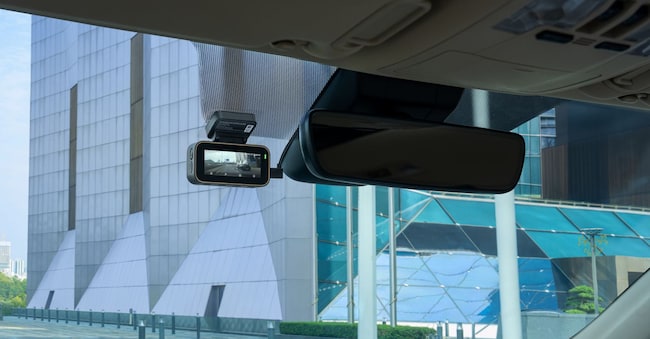
The display is not touch, which means that the camera is controlled with four buttons at the base; it looks archaic, but is actually very convenient. Among other things, the display is more than decent sized (3.28 inches) and such that it does not bother you while driving; moreover, you can decide to activate a screensaver after a few seconds that indicates the speed of the vehicle. A function that is useful because it acts as a display if the camera is placed, as it should be, around the mirror area: at a glance, perhaps while we are looking to see if a vehicle is advancing towards us, we can immediately see at what speed we are proceeding.

Installation

Installation deserves a separate chapter. Let's start by saying that installation is simple, especially if you decide to power it with a USB port, hence with a flying connection. To choose the position it is best to rely on the guide in the instruction manual and the appreciable thing is that two films are supplied in the kits, one of which is a spare, as well as a spare sticker that serves to avoid sticking the camera directly onto the windscreen with adhesive. Basically, you place the film, which then, because it has an electrostatic adhesive, is easily removable, thus avoiding damage to the windscreen if the camera needs to be moved.The camera can also be easily installed using 3M's Dual Lock double sticker (Telepass sticker), which can be easily found on Amazon and allows the camera to be attached and detached using not the windscreen, but perhaps the plastic cover of the car's airbags or rear-view mirror, so that it is even easier to install without having to involve the windscreen.

Connecting the rear camera is child's play because, with a minimum of manual dexterity, it is simply a matter of running a USB-C cable along the front pillar and running it down to the rear window. To do this, there is a very useful plastic lever in the kit with which to gently lift the car's seals. Then you can, with the included double adhesive, stick the small, lightweight rear camera in a suitable area. Here care must be taken not to obstruct the lens with the car's black rear masking.

The 4g permanent connection

Things get a little more complicated, and non-experts would do well to consult an electrician if they want to connect the 4G module, which needs constant current. There are three wires here: ACC, 12V and earth. Theoretically, all you need is a current tap and connect to the internal fuse box, but not all cars have a service with 12 volts permanently on, so you have to find a way to get it from the internal fuse box, and this is a matter for a good technician, also for safety.

It has to be said that 70mai offers a battery to be placed under the seats, made especially for powering the dashcam in case you don't have the possibility to use the wiring permanently. This battery plugs into the cigarette lighter socket; it is obviously a very large and expensive item and is therefore more recommended for higher-ranking and performance models, such as the magnificent Omni with the swivel lens or the T800 that also has the cockpit camera built in, but here we go to other price levels.

All in all, the 70Mai A810 Lite passes the test with flying colours and is forgiven for a somewhat cheap construction with plastics that seem unsophisticated on the surface, but actually contribute to the dashcam's lightness. In addition, the hinged mount allows for easy and immediate adjustment. It is good for all types of cars, even large ones, because it takes up little space, but on compact cars or even a spider it finds its ideal habitat.

Copyright reserved ©
Loading...

Brand connect

Loading...

Newsletter

Notizie e approfondimenti sugli avvenimenti politici, economici e finanziari.

Iscriviti