
Data centres, gas-fired power stations to support development
The focus is on renewables, but for these infrastructures a continuous supply of electricity is needed, and the most efficient combined cycles can guarantee this with low emissions

3' min read
3' min read
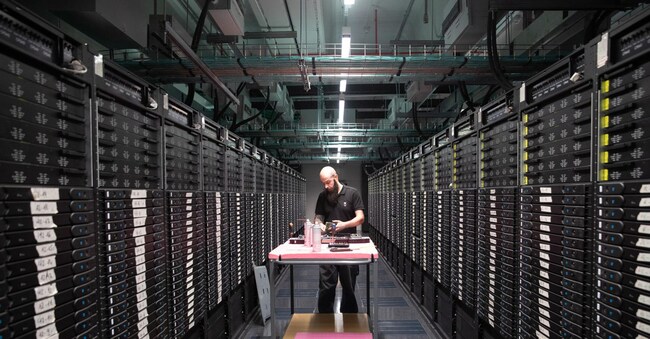
Call it, if you will, the revenge of gas power stations. One of the most mistreated assets in recent years may be experiencing a second youth thanks to the data centre boom, which imposes on networks a seamless need for energy, 24 hours a day, seven days a week. And who can guarantee such a supply, which insiders call 'baseload'? Renewables can do half the work, but the other part of the solution - when the wind turbines stop or the sun disappears - is two ways: gas-fired power stations or nuclear power. Which for Italy, if we want to reason in the short term, boils down to one, high-efficiency combined cycles, of which the country is rich with six new power stations, between present and future, for almost 5 GW, about as wide as Spanish nuclear power. And with the recovery of waste heat from data centres that would significantly lower the final balance of carbon dioxide. Of course, compared to the atom, the differences in terms of emissions remain, but in Italy the roadmap on the Small Modular Reactor, potentially ideal for powering a data centre, projects this solution in the mid-thirties, while fourth-generation nuclear power, without naming names, can only be considered as a start-up and could only see its first fruits in the next decade.
New life for (efficient) combined cycles
.Mind you, what has been said so far does not mean that the role of renewables should be downgraded. On the contrary, they will increasingly be the lynchpin of Italy's energy mix; however, according to TEHA and A2A's study, to power data centres they will have to be integrated with sources capable of guaranteeing continuity and flexibility, prerogatives necessary to make this type of infrastructure work. This would also make it possible to kill two birds with one stone: 70% of Italy's thermal capacity is effectively unused and the remaining 30% is now only called upon to cover peak demand (especially in winter). All this has led to a significant increase in the operating costs of these plants, which for the most part remain standing only at the capacity market mechanism, the remuneration received for the reserve of power and flexibility offered to the system. To give an idea, although today gas still contributes to half of Italy's electricity generation, it is estimated that from over 3,000 hours in 2023 these plants will only work 1,170 hours in 2030, which is essential, however, to avoid blackouts, with potentially very serious consequences, in some areas of the country.
Moreover, Italy can already count on three new combined-cycle plants with high efficiency (over 60%), flexibility, and environmental performance, to which three more will soon be added: a total of six new 5 GW power plants, which in terms of emissions - if coupled with the recovery of data centre thermal waste - would provide more than interesting performance. Assuming to run a data centre 50 per cent with renewables and 50 per cent with such a thermal asset, taking into account waste heat for residential use (for the production of which further emissions are thus avoided), the CO2 produced would be 95 grams/Kwh. Without using district heating and with less efficient combined cycles (50% or 40%) the final balance is 400 and 500 g respectively: a range that speaks volumes about the potential value of data centre circularity.
The American example
.Even the maxi project Stargate, a collaboration between OpenAI, Oracle and Softbank, in Texas, given the urgency of energy supply, is using gas-fired power stations (moreover, with low efficiency). At the same time, it is equally true that many American Big Techs, such as Microsoft or Google have chosen nuclear power, exploiting already existing power stations (the former has signed an agreement with Constellation Energy to purchase 800 MW of nuclear energy from the Three Mile Island plant) or putting new Smr in the pipeline, as has also happened in Great Britain. In Italy, the atom is currently little more than a building site and, according to the report, the most pragmatic choice is to rely on dear old gas, albeit with an efficiency 'facelift', to cover the holes in renewables.


