
Data, knowledge and care: the University at the heart of innovation
The 'Cluster Life Science' model connects the University with hospitals and the Research Centre organised in 5 programmes dedicated to Oncology, Immunology, Cardiology-Pneumology, Gastroenterology and Neurology. An increasingly international University, with students from over 80 countries

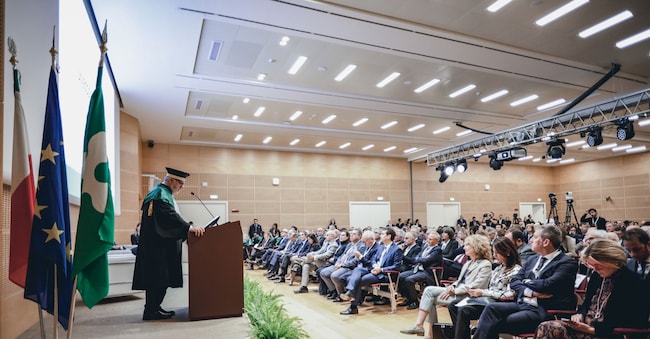
The inauguration of the Academic Year 2025/2026 of Humanitas University was held this morning. Present at the ceremony were the Health Minister Orazio Schillaci, the President of the Lombardy Region Attilio Fontana, the Mayor of Milan Giuseppe Sala and the Mayor of Pieve Emanuele Pierluigi Costanzo. The Lectio Magistralis was given by Michael N. Hall, a Swiss-American molecular biologist, professor at the Biozentrum of the University of Basel and winner of numerous international scientific prizes and awards, including the Balzan Prize 2024 for the discovery of a protein that regulates cell growth and ageing. His studies have concrete implications for modern medicine, in particular on age-related diseases such as cancer, diabetes and cardiovascular disease.
During the ceremony, the Humanitas Clinical Institute's 20 years of Irccs accreditation were commemorated. A milestone in which Humanitas University plays a fundamental role both in terms of preparing future generations of healthcare professionals and researchers, and in terms of responding to the challenges of innovation in the sector, including those of technology and Artificial Intelligence.
The speech by Gianfelice Rocca
"We feel the responsibility to develop innovation in order to change people's quality of life," says Gianfelice Rocca, President of Humanitas, "in a context that has never been as complex as it has been since the last post-war period. We do this starting from the 3000 students of Humanitas University, who are increasingly international, from the 9000 professionals who work in our hospitals, and from the more than 500 people of the Open Faculty who help and support the students on their path. The Irccs in Rozzano is investing heavily in increasingly data-driven research, and the University is an indispensable part of this challenge: by connecting millions of pieces of information, under the guidance of the human intelligence of doctors-researchers and students, we can make a difference for patients. The Irccs represent an enormous competitive advantage and a source of pride for Italy and Europe, as well as the ideal place to train the professionals of the future, with the necessary mentality to lead the evolution of the sector. And for this they must be valued. Let us not forget that we are a healing community thanks to nurses, physiotherapists and technicians who find competitive training for their vocation in our university'.
The Rector of Humanitas University, Luigi Maria Terracciano
"At Humanitas University, we train 'native research' doctors. Our mission is to improve people's health by transforming scientific knowledge into clinical impact. We do this by promoting a research environment integrated with care, driven by real clinical questions and oriented towards concrete solutions. New technologies have been assimilated in our training courses, as demonstrated by the MEDTEC Course in Medicine and Biomedical Engineering with Politecnico di Milano, which this year saw its first graduates; the PRIME Doctorate, again with Politecnico, with a strong vocation for innovation and technology applied to Medicine; or the Master of Science in Data Analysis and Artificial Intelligence in Health Sciences, in collaboration with Università Bocconi'.
Forming the figure of the medical researcher
Among the morning's speeches was that of Anastasia Lalioti, an Oncology registrar and former Medicine and Surgery student at the University, who took part in the Virgilio Programme whose aim is to train the figure of the medical researcher: 'Treatment is not an isolated act, but a continuous process based on improving our understanding of the biological and molecular mechanisms that are responsible for the manifestation of the disease itself. In an increasingly technological world, where Artificial Intelligence, Genetics and Molecular Biology are redefining Medicine, having this dual perspective is no longer a luxury but a necessity. Because only those who know both dimensions - the cell and the person - can truly innovate without forgetting the human being'.
Humanitas, Irccs for 20 years
2025 marks 20 years of Irccs accreditation for the Humanitas Clinical Institute. During the ceremony, Luigi Maria Terracciano shared the pillars of the new Research organisation, which he heads as Scientific Director. The activity in the coming years will be based on four strategic pillars: producing new knowledge through original data; developing clinical trials leading to Translational Research; expanding access to international funding; strengthening partnerships with industry to effectively transfer scientific results towards concrete therapeutic applications. These pillars are integrated in the five Humanitas Research Programmes: Oncology, Immunology, Cardiology-Pneumology, Gastroenterology and Neurology, which coordinate activities between basic, translational and clinical research.
Brand connect


Newsletter Scuola+
La newsletter premium dedicata al mondo della scuola con approfondimenti normativi, analisi e guide operative
Abbonati