
Tariffs, EU-US agreement: historic pact for von der Leyen and Trump. Base tariff at 15 per cent
It is a framework agreement, the details will be worked out later In the tax rate also cars and, according to the EU, medicines. In return the EU will invest 600 billion dollars and buy energy and armaments

4' min read
4' min read
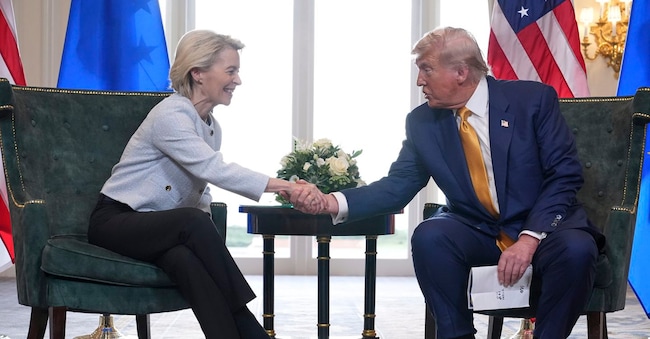
Done deal between the United States and the European Union. Donald Trump and Commission President Ursula von der Leyen, after weeks of tense negotiations, announced an agreement in principle to limit tariffs to 15% on European exports to the US. The new tariffs concern, among other things, cars, which have so far been affected by 27.5 per cent. Trump added that the EU, for its part, has pledged to trigger hundreds of billions of dollars in purchases of US-made goods and new investments.
"It is the greatest agreement of all time," Trump said. "We have succeeded," von der Leyen said, "It is a good deal, a huge deal, which will bring stability" and "clarity to businesses and citizens. She called 15 per cent a 'single tariff rate for the vast majority of EU exports', applied as a 'cap' to, among others, 'autos, semiconductors and pharmaceuticals'. And he explained that reciprocally 'zeroed' tariffs had been agreed on a number of strategic products, such as 'aircraft and components, some chemicals, some generic pharmaceuticals, equipment and semiconductors, some agricultural products, natural resources and essential raw materials', a list that is still evolving. US companies, he added, will have greater access to the EU.
There is no shortage of unknowns to clarify and possible conflicting interpretations. Trump seemed to use a broader meaning of zero barriers, saying that the EU will 'open its countries to zero tariffs'. On pharmaceuticals Trump indicated that it is 'a special sector' would be excluded because the US has to 'produce its own drugs': the White House is preparing global tariffs on the sector of up to 200% within a year and a half. Von der Leyen, on the other hand, asserted that that US global decision would be entirely separate. Another sector in the storm for global tariffs of 50% is steel and aluminium: Trump has said that these tariffs remain unchanged. Von der Leyen rather spoke of cooperation on the 'common external challenge of global overcapacity', a reference to Chinese overproduction, and stated that 'tariffs will be reduced and a quota system will be introduced', favouring some European metals.
Among the quid pro quo put in place by Brussels to secure the deal, Trump claimed $600 billion in extra investment in the US. In addition to purchases of $750 billion of US energy products, which von der Leyen specified would take place over three years.
The protocol guidelines, despite the unknowns, could be enough to reassure Wall Street and the international financial markets when trading reopens today. Breaths of optimism on clearing the trade climate have already driven the US stock markets up recently, with successive records for the S&P 500 and the Nasdaq. The overall 15% tariff to the EU, if higher than the 10% originally hoped for by Brussels and more than triple the previous average tariffs, is half of what Trump threatened in a letter and which would have been triggered at the 1 August deadline if no compromise had been made.


