Trade war

Tariffs, US sting on Canada: 35% from 1 August

The US president has so far pre-announced his tariffs to 23 countries in standard letters, except for a few more customised ones. Such as those to Brazil, for which he has threatened tariffs at 50 per cent for the judicial 'persecution' of former president Jair Bolsonaro

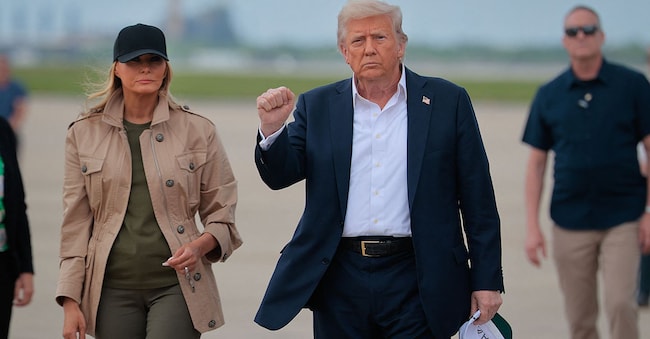
SAN ANTOMIO, TEXAS - 11 LUGLIO: l'11 luglio 2025 a San Antonio, in Texas, il presidente Donald Trump e la first lady Melania Trump arrivano alla base aerea di Lackland prima di dirigersi a Kerrville, in Texas, dove intendono visitare i leader statali e locali, i primi soccorritori e le vittime delle inondazioni improvvise della scorsa settimana.

3' min read

3' min read

Donald Trump threatened 35% tariffs against Canada as of 1 August and announced that he would also announce his decision for the EU shortly, after claiming that 'Europe has been treating us well recently'.

For all other countries, he warned, there would be generalised tariffs of 15% or 20%.

Loading...

In Brussels, anticipation is growing and caution is being preached: 'Compared to yesterday, we remain on our side fully prepared to conclude an agreement in principle with the US. We have no updates to indicate that this will happen imminently,' says a spokesman.

The US president has so far announced his tariffs to 23 countries, in standard letters, except for a few more customised ones. Such as those to Brazil, for which he has threatened tariffs of 50 per cent for the judicial 'persecution' of former president Jair Bolsonaro.

And to Canada, which he blamed for the lack of cooperation in the fight against fentanyl (despite the relatively small amount of traffic from that country) and the retaliation to the initial 25% tariffs.

Dazi, l'annuncio di Trump: "Oggi lettere a Ue e Canada"

But the tycoon pointed out that 'the flow of fentanyl is hardly the only challenge with Canada, which has numerous tariff and non-tariff policies and trade barriers'.

The US has a large trade deficit with Ottawa, largely reflecting oil purchases. However, the 35% tariffs will not apply to goods that comply with the US-Canada-Mexico Free Trade Agreement, for which the current exemption remains.

The latest letters, posted on Truth, sent European stock exchanges and Wall Street into the red.

There was an immediate reaction from Canadian Prime Minister Mark Carney, who remains open to negotiations but promises to hold firm: 'During the current trade negotiations with the United States, the Canadian government has stood firm for our workers and our businesses. We will continue to do so as we work towards the expected 1 August deadline,' he wrote on X.

Carney also replied that 'Canada has made fundamental progress in stopping the scourge of fentanyl in North America' and recalled that 'we are strengthening our trade partnerships around the world', particularly with Europe and the UK.

It is perhaps no coincidence that, just hours before Trump's letter, Carney posted a photo of himself with British Prime Minister Keir Starmer on X, stating that 'in the face of global trade challenges, the world is turning to reliable economic partners like Canada'.

His relations with Trump remain cordial, but Carney has not shied away from criticising the tycoon's trade policy and rebuking his provocative ambition to turn Canada into the 51st US state.

Mexico fared better: tariffs remained at 25%.

So far, the tycoon has only signed agreements with Great Britain and Vietnam, and a framework agreement with China.

The letters seem to reflect Trump's inability to finalise the dozens of trade agreements that he said would be easy to negotiate. And they risk alienating many allies, starting with Asian ones like Japan and South Korea, weakening the anti-China front.

Beijing strongly criticised the tariffs imposed by The Donald on Brazil, Latin America's largest economy: 'Tariffs should not be used as a tool of coercion, intimidation or interference in other countries,' said Chinese Foreign Ministry spokesman Mao Ning.

Meanwhile, Brazil played down the impact of the US tariffs, while the leaders of both nations expressed a cautious willingness to negotiate in the future.

Trump told reporters that he might talk to the Brazilian president later. Luiz Inácio Lula da Silva said he was ready to seek a diplomatic solution, but warned that he would reciprocate on an equal footing if the tariffs take effect on 1 August as promised.

The Brazilian government has predicted that tariffs will have a limited impact on economic growth this year, which is expected to reach 2.5%, as only specific manufacturing sectors will be hard hit.

Copyright reserved ©
Loading...

Brand connect

Loading...

Newsletter

Notizie e approfondimenti sugli avvenimenti politici, economici e finanziari.

Iscriviti