Trade war

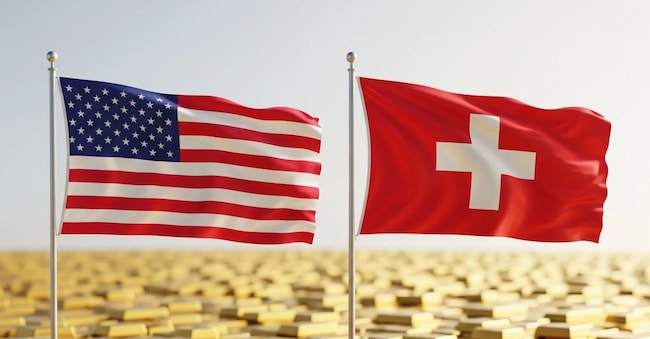
Tariffs, Switzerland negotiates to the bitter end with the US: no retaliation

The Swiss executive wants to continue talks and negotiations with the US, 'going beyond the existing joint declaration of intent and if necessary beyond 7 August'.

by Lino Terlizzi

3' min read

3' min read

After last Friday's drubbing with the US tariffs at 39%, Switzerland remains unchanged.

Negotiate and more negotiation, without retaliation. This is Bern's line.

Loading...

The Federal Council, i.e. the Swiss government, met today, 4 August, and made its position known after the shock from overseas.

The Swiss government wants to continue talks and negotiations with the US, 'going beyond the existing joint declaration of intent and if necessary even after 7 August (when the tariffs come into force, ed.)'. In order to improve the tariffs situation and taking into account US concerns, Berne states that 'Switzerland will enter this new phase with the intention of presenting them with a more attractive offer'.

So counter-offer and not countermeasures, for now. As to what Berne can still offer the Trump administration in order to avoid such high tariffs, there are only a few clues so far, which can mainly be gleaned from the statements made in recent days by the Swiss Minister of Economic Affairs, Guy Parmelin.

The latter mentioned the possible purchase of American liquefied natural gas, although it must be said that Switzerland is not a large country and could therefore not buy as much.

Another button pressed by Parmelin is that of possible greater investment by Swiss groups in the US, and on this front the dimensions could be more significant.

The economics minister mentioned in particular the pharmaceuticals groups, which had already moved in this direction and could perhaps further increase the promised investments; the whole sector, by the way, is in the crosshairs of US President Trump, who is aiming at price cuts for drugs on the American market. Parmelin, however, could now see his role in the talks with the US grow, not least because the other main interlocutor, Karin Keller-Sutter, finance minister and president of the federal government, has been criticised by many for the unhappy outcome of the negotiations so far.

The Swiss government points out that Switzerland is already the sixth largest foreign investor in the USA and the largest in research and development. The 39% tariffs announced by Washington would affect almost 60% of Swiss goods exported to the USA and would put the Confederation in a much worse position than other relevant partners for the United States (the European Union at 15%, the United Kingdom at 10%, Japan at 15%). Switzerland's surplus in the export of goods, Bern reiterates, "is in no way the result of unfair trade practices". The government also points out that Switzerland has unilaterally abolished all tariffs on industrial products and that it does not provide market-distorting subsidies.

What comes out of Berne, in short, is an all-out negotiating line, in the Swiss tradition, but also a kind of heartfelt plea to consider how much Switzerland respects the market.

Will all this be enough to change Trump's mind? Of course, it is very difficult to say. In the meantime, the Confederation also puts its hands out a little in case of further failure in the complicated talks with Washington. The Swiss government points out that Switzerland will continue its efforts to diversify trade relations (in other words: the US is certainly important, but it is not the only one). Furthermore, the government recalls that in order to avoid any redundancies in connection with the new tariffs in Switzerland, it will be possible to use the short-time work allowance. The Confederation is still trying with Trump, but even in Berne it is clear how narrow the path is.

Copyright reserved ©
Loading...

Brand connect

Loading...

Newsletter

Notizie e approfondimenti sugli avvenimenti politici, economici e finanziari.

Iscriviti