Effective from 7 August

Tariffs, Trump confirms tariffs agreed with the EU. Switzerland at 39%, Canada at 35%

The decree signed in the night relaunches the trade war with many partners as of 7 August. Higher tariffs for dozens of countries, from 15% to 41%. But still negotiating in a climate of high tension

5' min read

5' min read

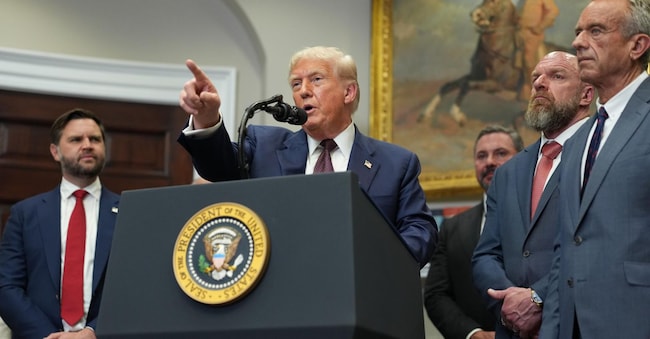
Donald Trump has lifted the curtain on tough new tariffs against dozens of countries around the world with which he intends to reshape the global economy and trade in the name of America First. The US administration's gesture risks new escalations of conflict and instability, but it also leaves open some diplomatic glimmerings, in a heart-stopping game: the 'X-Day' of the actual entry into force of the tariffs slips by a week, from 1 to 7 August.

The White House has decided that instead of triggering from today as it had indicated, they will apply from one minute past midnight next Thursday. Goods loaded before that date on cargo ships and entering US ports by 5 October will also be pardoned, subject to the pre-existing tariffs and not the new ones.

Loading...

The double move shows both Trump's determination to wield the weapon of tariffs in his trade wars and bend allies and rivals to his demands, and the chances of further rounds of negotiations in extremis by countries that have so far failed to reach an agreement with the US to at least try to contain their impact. The new decree, in the sign of the administration's aggressiveness, also prescribes a new measure to combat so-called 'transshipment', i.e. the passage of products from third countries to avoid higher tariffs imposed on the real country of origin: here, on the basis of the US customs assessment, tariffs of 40 per cent are set.

The documentation published by the White House in support of the new measures builds on the hitherto 10% universal tariff and pushes it up to a maximum of 41%. Even higher and more special tariffs against Brazil, of 50 per cent, had however already been decided in a presidential order of the previous day, which added sanctions of 40 per cent in support of the country's right-wing former president Jair Bolsonaro, accused of an attempted coup, to the now confirmed 10 per cent trade levy.

The text of the decree, titled 'Further changes to reciprocal tariffs levels', cites national security reasons for tackling trade deficits and includes in Annex 1 a list of 69 countries and blocs (the European Union) that will be subject to at least 15 per cent, with the exception of Great Britain and the Falklands Islands, which are at 10 per cent. It indicates that in some cases the tariffs in the table are already the result of understandings and that in others negotiations are still ongoing that could change them.

But net of changes, Syria is subject to the highest tariffs, 41 per cent. Other poor countries such as Laos and Myanmar with 40 per cent are also among the hardest hit. In Laos, however, China has moved solar panel plants in recent years to evade tariffs against its own producers. Myanmar's main export is clothing.

Among the major partner countries in the crosshairs, because they are now without an agreement and still engaged in tense negotiations, is Canada. Ottawa is being hit by tariffs of 35%, higher than the current 25% already suffered, even if all goods covered by the North American Free Trade Agreement are exempted. According to some estimates these could amount to up to 94% of exports to the US. The other major North American partner, Mexico, has instead obtained a 90-day postponement of an increase in tariffs from 25% to 30% on goods not covered by the North American treaty with the aim of reaching an agreement.

A close Asian ally Taiwan, itself engaged in intense negotiations, will pay 20 per cent. Although the country has argued that this is a provisional tariff and to count on lowering it during further rounds of negotiations. India was hit with a pre-announced but still high 25 per cent. In Europe, Switzerland receives as much as 39 per cent.

Other major partners had already signed agreements, albeit still in principle, which limited tariffs: the EU, Japan and South Korea are confirmed at 15%, Great Britain at a minimum of 10%. For the EU, a paragraph in the text appears to indicate that the agreed tariffs of 15% will be the new base tariff for goods now taxed below that threshold; for goods already subject to at least 15% there will be no further increase. The goods concerned are defined as Column 1 under the US Harmonised Tariff Schedule, i.e. affected by tariffs reserved for countries with normal trade relations with the US.

With the new presidential order, other countries end up at the 15% threshold: from Bolivia to Ecuador, from Iceland to Nigeria, from Turkey to Venezuela and Afghanistan. The Philippines, Pakistan and Indonesia (which reached an agreement) 19%; Sri Lanka and Vietnam (the latter also with an agreement) will have 20%. South Africa, Tunisia, Algeria, Bosnia and Herzegovina and Libya will have 30 per cent, Iraq 35 per cent.

The tariffs announcement came at the end of days of frantic negotiations, confusion and controversy. Only yesterday morning Mexico agreed on a 90-day extension of the negotiation phase, during which the current tariffs imposed on the country, 25% on fentanyl, 25% on cars and 50% on steel, aluminium and copper, will remain in place. Trump had threatened 30% from the outset, while excluding, as with Canada, products covered by the North American Free Trade Agreement. With Canada, however, the White House cited new disagreements in relations, starting with foreign policy: it attacked Ottawa's stance in favour of recognising a Palestinian state. "It makes an agreement very difficult," Trump said.

Even with India, where Trump has set high tariffs of 25 per cent, tones had already hardened in the hours before the announcement, citing among other things its economic relations with Russia. "As far as I'm concerned, they can go down together with their dead economies," he said referring to the two countries.

The possibility that the new, controversial network of agreements and unilateral interventions will now bring at least more clarity according to analysts remains to be seen. There are many unknowns: China is still an open and separate chapter, moving towards the extension of a temporary truce expiring on 12 August. Tariffs on entire sectors could remain in play, such as steel, aluminium and copper, or be on the way, from pharmaceuticals to semiconductors, at least for those orphaned by agreements.

On the whole, between new tariffs and agreements with sometimes vague details and subject to conflicting interpretations, the only thing that appears unquestionable at the moment is the general rise in tariffs triggered by Trump: according to Yale University's Budget Lab, even before the new manoeuvre his trade measures had already pushed the overall average tariff on the import of goods into the US from 2.4% to 18.4%, the highest since 1933. Aware of inflationary risks from tariffs, Trump has in the last few hours sent letters to 17 pharmaceutical giants to act within 60 days to reduce prices in the US, under penalty of sanctions.

However, the legitimacy of tariffs by presidential decree is at the centre of battles in the US itself: a federal appeals court has started two days of hearings on the validity of the White House's use of a 1970s Economic Emergencies Act, never before used to impose tariffs. The first hearing saw the judges sceptical of the White House's motives. The appeal was filed by a group of small and corporate businesses and a coalition of US states governed by Democrats, who sued Trump for abuse of power.

Copyright reserved ©
Loading...

Brand connect

Loading...

Newsletter

Notizie e approfondimenti sugli avvenimenti politici, economici e finanziari.

Iscriviti