Dining with the Cotarella sisters

'De-coloured wine and synthetic foods are alien to Italian identity'

Compared to their parents, Dominga, Marta and Enrica brought a more systemic and integrated approach and also initiated activities with social utility

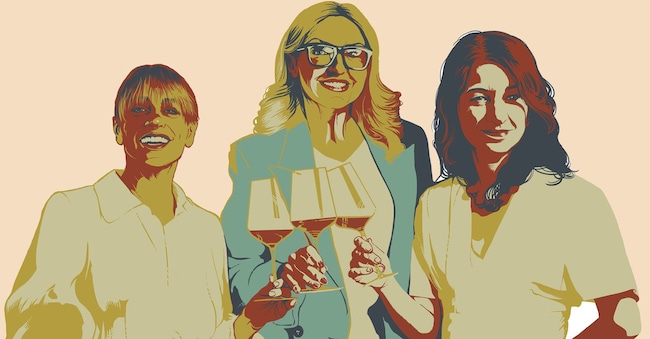
by Paolo Bricco

Illustrazione di Ivan Canu

6' min read

6' min read

"We thought about whether or not to make dealcoholised wine. We decided no. De-coloured wine, synthetic foods and processed foods are all expressions of a technological supremacy that does not belong to the Italian identity, to the deepest spirit of our communities and to the strategic interest of our country'.

Dominga Cotarella is one of the three Cotarella sisters, who - although they are not all sisters - are little by little becoming a brand in Italian wine for the quality of their products, for their activities in training and hospitality and for their presence in the social dimension, which is increasingly contiguous to doing business. The Cotarella sisters are Dominga, daughter of Riccardo and Maria Teresa, and Marta and Enrica, daughters of Renzo and Angela. We are seated around a table whose abundance of food, the colours of sauces and the fragrance of freshly baked bread and focaccia well describes the simple richness of central Italian cuisine, peasant to the bone.

Loading...

In Montecchio, in the province of Terni, on the Cotarella farm, the heat is intense. Outside, the profile of the hills between Umbria and Lazio tends to darken due to the temperature. The landscape is, at once, worked and wild. The summer light is blinding. The July heatwave makes the green and brown of the earth, the plants, the trees, the rows of vines shine.

The cured meats and cheeses - Umbrian prosciutto and capocollo, plus pecorino cheese from Alta Tuscia of various ages - are delicious. And the homemade focaccia is excellent. The classic method Brut Rosé and the 2021 Ferentano Bianco Lazio are perfect. "We consider ourselves three sisters, we slept in the same room throughout our childhood and adolescence, on the farm in Monterubiaglio, five kilometres from Orvieto. The three of us plus grandmother Maria Grazia, wife of grandfather Domenico, the farmer who founded the family business,' explains Enrica. She adds: 'We are a peculiar family. My mother Angela and my aunt Maria Teresa live in neighbouring rooms, they have the same bank account, they have only one car'.

Marta - whose wine of the heart is the champagne of Alexandre Filaine, a small producer in Damery, in the Marne valley - is in charge of administration, planning and control and, in addition, has the summary function of managing director. Dominga, who most appreciates Antinori's Cervaro della Sala, follows the commercial side. Enrica, whose favourite wine is her family's Montiano, takes care of hospitality, communication and image. Marta is a natural Ceo, who without the destiny of wine could be in charge of some international department of one of the Big Four Anglo-American consultancies. Dominga is a generous-hearted Erinni from the Umbrian countryside, with enough energy to one day found a party. Enrica, who is the most delicate and talented of the three, in another life could have been a singer or theatre actress.

The simplicity of the cuisine is equal to its goodness: the panzanella and caprese are good, but the fried vegetables are excellent. And Montiano 2021 is excellent, a one hundred per cent Merlot introduced by the Cotarella family as a top wine that has emerged from the connoisseurs' niche thanks, in part, to the interest of the American wine magazines, which have long been a decisive component of the market. This is peasant Italy. One day - when confronted with the display of titles and lineages by Tuscan wine producers, at the very least either counts or dukes - Gianni Brera said to an intimidated Angelo Gaja: 'Don't worry, we belong to the lineage of the princes of the clod'. And, here, in this part of central Italy so popular and humble, with the Cotarella sisters, the rule of Italian democracy is re-established from the bottom up: it does not matter who you are and where you come from, but if you and your family have a compact energy and an obsessive passion and love for life - despite the feudal structure of Italian society - a rise from little or nothing is possible.

The chickpea salad is remarkable. In the specific case of the Cotarella sisters, their family - starting from the clods of the earth and the rows of the hills - has made its mark on the Italian wine business. They have challenging fathers: Renzo is CEO of Marchesi Antinori Spa, while Riccardo is one of the world's leading wine specialists and president of Assoenologi. 'Our fathers are charismatic and in their own way imposing, but they also provided us with great tools, a remarkable openness to the world, a dose of curiosity not limited only to the reality of wine, and a drive to work and study that gave us clear and precise individual identities,' says Marta. The Cotarella sisters have been adept at not letting themselves be engulfed by such cumbersome fathers. On the contrary, they have happily 'cannibalised' both parents by effectively metabolising the problem of their surnames, when they have turned the normal struggles and physiological complexities that exist in all Italian businesses into a brand - the Cotarella family - based on the principle of the authority of those who are older and the need, for those who are younger, to find space and legitimacy without symbolically murdering their parents or being murdered by them.

The first winery opened, in 1979, was Falesco in Montefiascone, in the province of Viterbo. Since 1979, Renzo and Riccardo Cotarella - in management and consultancy - have indeed become two increasingly influential and influential figures in the industry and, at the same time, have overseen the family business between Umbria and Lazio. In 2015, the three Cotarella sisters took over leadership and, in 2017, carried out a brand repositioning operation, changing the name from Falesco to Famiglia Cotarella. 'My father and uncle,' says Enrica, 'are the ultimate in verticality. They excelled in the knowledge, valorisation and marketing of wine. We have brought a more systemic and integrated approach, with brand and marketing playing a central and positive role in the wine business. And, then, we have staked a lot on the opening of Intrecci, which, with the hospitality academy, trains room staff, and we believe a lot in civil commitment, with the choice of activating the Cotarella foundation in supporting those suffering from eating disorders'.

The spaghetti al pomodoro, brought to the table by the ladies of the kitchen, are no match for those of Fulvio Pierangelini or Massimo Bottura, in the continuum that exists between the country cooking of Italian women and Michelin-starred chefs. The spaghetti goes well with Brunello di Montalcino Le Macioche, produced on the Montalcino estate bought in 2017, to which the sisters have now also added a line of wine in Bolgheri, where the first harvest took place in 2024.

In the core wine business, the first step of repositioning took place when the decision was made, in three years, to reduce the number of bottles from 2 to 1.2 million, concentrating on the company's own vineyards and eliminating grape deliveries from other farmers as much as possible. Today, the group's turnover exceeds 20 million euros, with an Ebitda of 5 million, a 230-hectare estate and financial solidity guaranteed by an equity of 40 million, made possible by the absence of profit distribution since its foundation in 1979.

The point, however, is the versatility of their entrepreneurial actions. Says Marta: 'We realised that there was no school to train wait staff. And the Italian wine business is very much intertwined with hospitality and catering. That is why we decided to open an academy in Castiglione in Teverina, which is working very well. The great restaurateurs and chefs snatch our twenty youngsters out of their hands, even before they finish their training year. It's only natural that our father and uncle always focus on the product and urge us to concentrate on that. They are sacred monsters. But, at the same time, they are very respectful of our entrepreneurial and strategic choices'.

For the second course, in a lunch that could last for abundance and taste until mid-afternoon, here is a great classic of peasant cuisine: roast chicken. And, between Montiano and Brunello, one does not know what to pour into the glass. The complexity of doing business today is to get the numbers with the balance sheet and to express a social utility that gives additional meaning to market results. "We are not doctors,' Dominga notes, 'but in a very humble way we try to work on behalf of boys and girls with problems of anorexia, bulimia and the many forms that eating disorders can take. We facilitated the creation of a listening centre in Orvieto. We support the activities of specialists. We believe in it'.

For dessert, meanwhile, wine biscuits and a series of tarts arrive on the table. And, in the smiling vitality and determined kindness of the three Cotarella sisters, I realise that, truly, the Italian wine business is the economic sector where, more than any other, women take centre stage and, fortunately, are at the heart of things.

Copyright reserved ©
Loading...

Brand connect

Loading...

Newsletter

Notizie e approfondimenti sugli avvenimenti politici, economici e finanziari.

Iscriviti