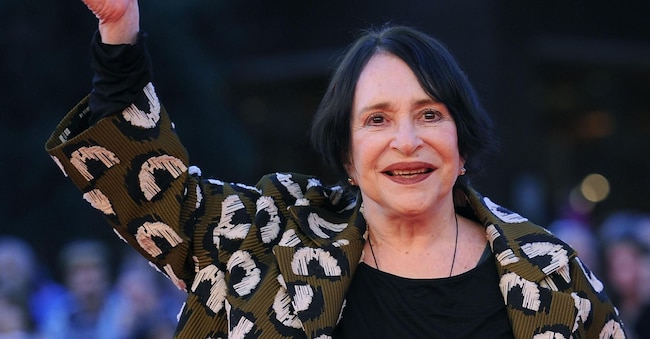
The world of actresses and actors is often made up of memories, anecdotes, techniques and tricks handed down. In short: of oral history.
Thus, every time a great performer passes away, a chapter in the history of theatre and culture also goes away. This is certainly the case for Adriana Asti, who passed away on 31 July, at the age of ninety-four, after having left an indelible mark on Italian theatre.
Loading...
A career spanning the 20th century
Through the constellation of encounters in her career, the whole 20th century could be recounted: Luchino Visconti, Pier Paolo Pasolini, Bernardo Bertolucci, Vittorio De Sica, Tinto Brass. And in her old age this is what Adriana had begun to do - recount an era and an existence - with books and shows: first with the book Recordare e dimenticare, written with the journalist René De Ceccatty (Edizioni Portaparole); then with Un futuro infinito. Piccola autobiografia (Mondadori) and finally with a show, Memorie di Adriana.
Almost as if he was directing his memory in advance.
The Beginning with Giorgio Strehler
Born in 1931 in Milan, she describes herself as a shy child and a rebellious teenager; while still taking her first steps on the city's off stages, Giorgio Strehler notices her, ready to cast her for the already prestigious Piccolo Teatro. Elisabeth of England by Ferdinand Bruckner was her debut in the temple of Milanese theatre, opposite Lilla Brignone: from that moment on, the theatre door opened wide for her, and she would always consider it her home, her safe haven.
Loading...
Luchino Visconti and Rocco and his brothers
It was Brignone, the fearsome primatrix, who acted as a go-between for the second crucial meeting, the one with Luchino Visconti: the director frequented the dressing rooms after the shows, commenting, advising, making notes. And so the young Asti obtained a small part in Rocco e i suoi fratelli (and a kiss on camera with Alain Delon). From then on, a friendship and stable collaboration was born between the director and the actress, and Adriana would remember with nostalgia and gratitude the summers they shared at the villa La Colombaia on Ischia, with a continuous passage of intellectuals, actors and actresses. In 1973, Visconti staged Pinter's Old Times, for an eagerly awaited debut at the Argentina Theatre in Rome, and a scandalous nude scene was planned for Adriana; the future Nobel Prize winner, present in Italy, was horrified by the choice and called the staging a 'porn show'.
The meeting with Pier Paolo Pasolini and Bertolucci
Two more fundamental encounters, among many others: with Pier Paolo Pasolini ("a Midas king who made gold out of everything he touched") Adriana shared the open-air set of Accattone, at the Magliana, among working-class boys and prostitutes. And finally it was the turn of Bernardo Bertolucci, to whom the actress also bonded for a period from a sentimental point of view despite the age difference: 'everyone, Pier Paolo, Moravia, Elsa Morante, Natalia Ginzburg advocated our union. We were surrounded by affection,' she recounts.
Timid and shy in private life
Beautiful, magnetic on stage and in front of the camera, capable of nurturing thought and intelligence through studies and worldly acquaintances, Asti represents an ideal bridge between the great 19th-century Italian scene, with the likes of Eleonora Duse, and contemporary actress-actresses. Despite her reputation as a maverick femme fatale - later fuelled by films such as Tinto Brass's Caligula - Asti appears surprisingly shy and retiring in interviews. To remember her, it may be worth watching an episode of 'Match', the programme conceived by Arnaldo Bagnasco and directed by Alberto Arbasino, aired on RAI 2 in 1977 (now available on RaiPlay). The director pits her against Silvana Pampanini, the sex symbol actress of the 1950s who then disappeared from circulation. Arbasino instigates "the divine" on the question of nudity on stage, but Adriana replies coyly and slyly: she prefers to talk about directing, intellectual friends, theatre, art.
Biographical notes
The stage name of Adelaide Aste, Adriana Asti had made her theatre debut in 1951, acting in Plautus' Miles Gloriosus with the stable company of Bolzano, to achieve her first personal success with a part in Arthur Miller's The Crucible directed by Luchino Visconti. With Visconti came his first success in cinema, with Rocco e i suoi fratelli (1960). In 1961 he participated in Accattone by Pier Paolo Pasolini, the following year in Franco Brusati's Il disordine, in 1964 in Before the Revolution by Bernardo Bertolucci. He then worked with Visconti again in Ludwig (1972), in Luis Buñuel's Fantasma della libertà, and then acted for Mauro Bolognini (Per le antiche scale; L'eredità Ferramonti; Gran bollito).
Addio ad Adriana Asti, volto del cinema d’autore e del teatro di impegno
Photogallery15 foto
As a leading lady she was Felicita, the Flaubertian servant in the adaptation written by Cesare Zavattini for Vittorio De Sica and later realised by Giorgio Ferrara (Un cuore semplice, 1977). In 1999 she starred in David Emmer's Una vita non violenta and in 2001 she participated in the choral film Come si fa un Martini by Kiko Stella. Dubbing Lea Massari and Claudia Cardinale among others, she has also been the face of TV films. Among the most recent films La meglio Gioventù by Marco Tullio Giordana, who entrusted her with the role of the mother of the main characters, the brothers played by Luigi Lo Cascio and Alessio Boni.