
The great philosopher Edgar Morin died in France
Philosopher, sociologist, anthropologist and central figure of the contemporary French intellectual left

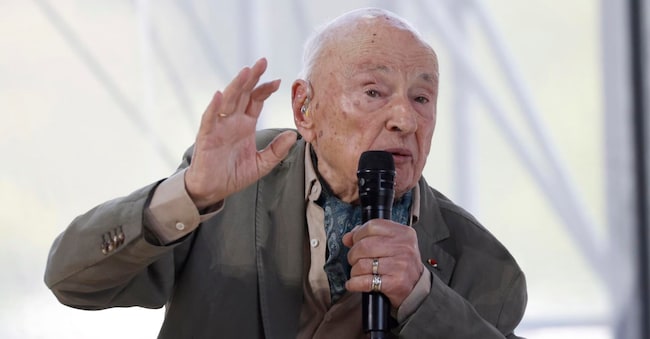
Edgar Morin, philosopher, sociologist, anthropologist and central figure of the contemporary French intellectual left, has died at the age of 104. Author of more than one hundred books translated into some thirty languages, Morin was one of the thinkers best known to the general public, not least for his insistence on the 'pensée complexe', the 'complex thought', a notion also taken up and popularised by French President Emmanuel Macron.
Born on 8 July 1921 in Paris into a Sephardic Jewish family originally from Thessaloniki, Edgar Nahoum, this is his birth name, lost his mother at the age of ten. He studied at the Sorbonne, where he obtained degrees in history and law. After spending time in libertarian circles in favour of the Republican camp in the Spanish Civil War, he joined the French Communist Party in 1942. During the Resistance he assumed the pseudonym Morin, which he would later keep.
He was excluded from the CPF in 1951 for his criticism of the Stalinist line in the leadership. 'It was like a childhood pain, enormous and very brief,' he would later recount. The break with communism came shortly after the publication of his first book, L'An zéro de l'Allemagne, dedicated to the occupation of Germany, in which he had participated in the French army. The detachment from communism was linked to a broader critical posture, which would run through all his work and which found an important stage in Autocritique, published in 1959.
Having joined CNR as a sociologist, Morin soon devoted himself to then innovative topics: cinema, fashion, mass culture, the star phenomenon and the dynamics of the public voice. In La Rumeur d'Orléans, from 1969, he analysed an affair that had struck French public opinion, that of the false rumour that managers of a department store had made women disappear in order to feed a trafficking trade.
After several years in Latin America, he was invited to the Salk Institute in San Diego, California, in 1969. From that experience came Journal de Californie, in which he studied the region as a laboratory of modernity. In the following years he started his major work, La Méthode, a series of six volumes published between 1977 and 2004: La Nature de la nature, La Vie de la vie, La Connaissance de la connaissance, Les Idées, L'Humanité de l'humanité and Éthique.

