
Dead Frank Gehry, designed the Guggenheim Bilbao
He also designed the Walt Disney Concert Hall in Los Angeles

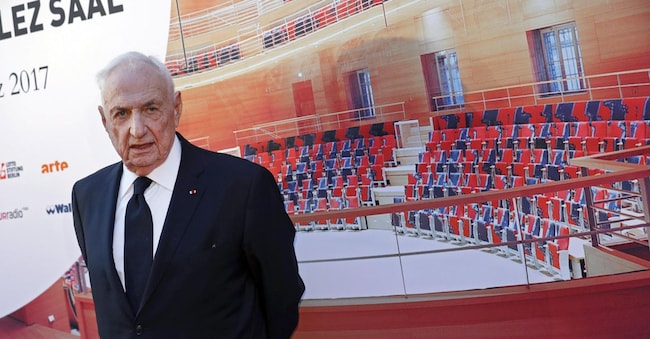
Frank O. Gehry, considered one of the most revolutionary architects of the second half of the twentieth century and one of the greatest interpreters of deconstructivism, died today at the age of 96 at his home in Santa Monica, California, following a brief respiratory illness. The news was confirmed by his staff to the 'New York Times', closing a fundamental chapter in the history of contemporary architecture.
Gehry, born in Toronto on 28 February 1929 as Frank Owen Goldberg and naturalised US citizen, leaves a legacy that goes beyond the built form, crossing technological innovation, artistic creativity and a radical idea of architecture as an emotional and cultural experience.
Career at the top of architecture
During his long career, Gehry has signed some of the most iconic works of world architecture. Among his most famous projects are the Guggenheim Museum in Bilbao (1997), considered one of the greatest masterpieces of the contemporary era, and the Experience Music Project in Seattle (2000). They are joined by the Walt Disney Concert Hall in Los Angeles (2003), the Frederick R. Weisman Art and Teaching Museum in Minneapolis (1993), the Center for the Visual Arts in Toledo (1993), the American Center in Paris (1994), the National-Nederlanden building in Prague, known as the 'Dancing House' or 'Ginger & Fred' (1996), the New World Center in Miami Beach (2010), the Lou Ruvo Center for Brain Health in Las Vegas (2010), the Beekman Tower in New York (2011), the Biomuseum in Panama (2014), the Guggenheim Abu Dhabi (2017) and the Dwight D. Eisenhower Memorial in Washington (2020).
The Pritzker and the Golden Lion were among the prizes awarded
His numerous awards include the Pritzker Prize in 1989 and the Golden Lion for Lifetime Achievement at the Venice Architecture Biennale in 2008. His theoretical and formal research has found fulfilment in a path that has redefined the language of architecture starting from the decomposition of the building into independent volumes, reassembled in an apparently illogical way, but capable of narrating entirely new spatial dynamics. The use of unusual materials - corrugated sheet metal, raw plywood, wire mesh, industrial panels - has become a distinctive feature, as has the use of advanced software, borrowed from the aeronautical industry, which in the 1990s allowed him to model free and complex surfaces, anticipating the digital revolution in architectural design.

