
Dead Jair, the 'Black Arrow' of the great Inter team that won everything
A right winger for Herrera's Nerazzurri, he won four league titles, two European Cups and two Intercontinental Cups. Then Roma and a trophy with Pelé

2' min read
2' min read
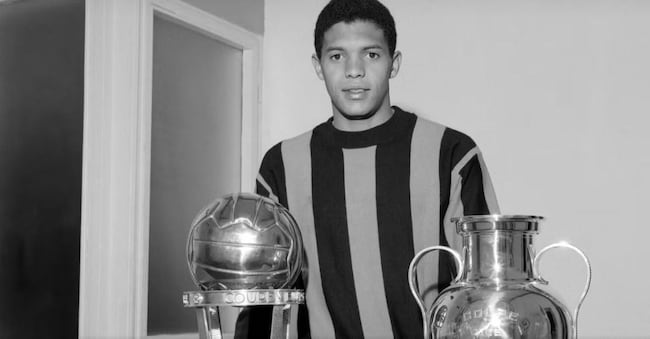
Sudden accelerations, drunken dribbling, a ball brushed into the centre of the box or - when circumstances permitted - a low shot between the posts. On his face always a veil of melancholy for his faraway homeland, on his shoulders the number 7 jersey: all these things put together, in 1960s football, 'made' the right winger, a South American role made iconic by Garrincha, the cursed poet of Pelé's Brazil. But right after the legendary 'Little Bird' came the 'Black Arrow': Jair da Costa, number 7 of Helenio Herrera's Inter with whom, from 1962 to 1967, he had won everything.
A virtuoso with a penchant for scoring goals directly from corners has now died at the age of 84 in Osasco, in the state of São Paulo. The news comes from the Cbf, the Brazilian football federation of which Jair was a symbol. As he was for the great Inter of Angelo Moratti, so much so that the Nerazzurri club now, in an official statement, claims for him 'a place in the eternity of a legendary team'. The numbers say it all: 260 appearances and 69 goals scored in all competitions, four league titles, two Champions Cups - the first in 1964 against Di Stefano's Real Madrid, the second at San Siro in 1965 against Eusebio's Benfica, with Jair scoring the decisive goal - and two Intercontinental Cups won. More than a team, it was a litany of saints that every self-respecting football fan swallowed from memory: Sarti; Burgnich, Facchetti; Bedin, Guarneri, Picchi; Jair, Peirò, Mazzola, Suarez, Corso.
Jair, the idol of another idol of those days - a certain Adriano Celentano who covered the same role in matches with the boys of the clan -, came from afar. He started as a professional in São Paulo's Portuguesa in 1960, and two years later he was part of the Selecao expedition that won the World Cup in Chile, barely making a single appearance because he was 'closed down' by Garrincha. The greatest satisfactions he will take away from Milan. As soon as he arrived, 'he was a cold one, like a good South American, in winter he would hug the radiators', Guarneri would recount. It was captain Facchetti who made him feel at home, taking him under his protective wing. To the delight of all lovers of the beautiful game.
After a spell at Roma and a return to the Nerazzurri, he went to Brazil to win the 1973 São Paulo championship with Pelé's Santos. He would end his career in 1976 wintering in Canada with the Windsor Star. Elderly, retired in Brazil, he remembered the goal against Benfica in the '65 final like this: 'I gave the ball to Mazzola, he exchanged with another team-mate, then I sprinted, slipped, fell, but even so I shot at goal and the ball passed between the legs of goalkeeper Costa. I was fast, a dribbler'. Two adjectives that now, while the rest of us are dying of boredom watching so many matches killed by tactics, we would like to carve in stone. In imperishable memory of a football that no longer exists.


