In Valencia

Colonel Tejero, author of the last coup attempt in Spain, dies

More than 300 members of the Spanish Parliament held hostage for 18 hours
4' min read

Translated by AI
Versione italiana

4' min read

Translated by AI
Versione italiana

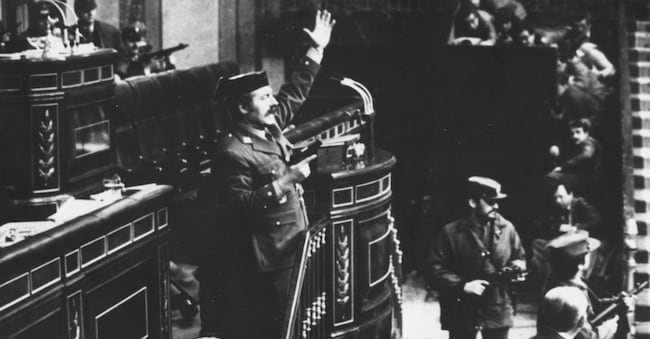
Television footage from the time showed Prime Minister Suarez and Deputy Prime Minister Gutierrez Mellado unperturbed as Colonel Tejero fired shots with his pistol and other rebels fired automatic weapons to silence murmurs of protest. It was 23 February 1981 and Spain witnessed an attempted coup at the hands of a 50-year-old colonel and 200 mutineers from the Guardia Civil, six years after the death of dictator Francisco Franco. The lower house of parliament was stormed and the government seized. Suarez's successor was being decided that day. The intervention of King Juan Carlos thwarted the attempted coup that lasted 18 hours: in a televised speech in the early morning, the king declared his faith in democracy and ordered the repression of the revolt. The deputies left parliament at noon.

Today, 25 February 2026, at the age of 93 (he would have been 94 next 30 April), Colonel Antonio Tejero dies at his home in Valencia. The same day on which the papers relating to the attempted coup d'état were desecreted in Spain.

Loading...

Juan Carlos is no longer king, and Spain has changed a lot: forty-four years ago it was a country trying to emerge from decades of military dictatorship, democracy was still a gamble and Juan Carlos proved to be faithful to it. However, the image of Antonio Tejero with a gun in his hand in the hemicycle remained in the memory and went around the world.

Tejero Molina had entered the General Military Academy in Zaragoza at the age of 19 and served in various posts before becoming commander of the Guardia Civil in Malaga. Even then he showed hostility towards the new democratic order, losing his command after trying to prevent a demonstration of pro-democracy supporters, which cost him a month's arrest.

In 1978 he was among the masterminds of the so-called Operation Calaxia, the first coup attempt against Adolfo Suarez's government and its institutional reforms. The action did not materialise, but Tejero was sentenced to seven months in prison. Once released, he prepared the coup d'état of 23 February, when, leading 200 men, he burst into Congress during the vote for Leopoldo Calvo-Sotelo's inauguration as president of the government. The assault, broadcast live on TV, ended the following morning, after the coup failed with Juan Carlos I ordering the military to return to the barracks.

The War Council in 1982 sentenced to 30 years in prison the military men considered to be the main perpetrators of the attempted coup d'état: with Antonio Tejero, Jaime Milans del Bosh and Alfonso Armada. A total of 12 military and 17 Guardia Civil members were sentenced. Tejero, expelled from the Arma, had served 15 years in prison when he was paroled on 3 December 1996. In 1993, the socialist government of Felipe Gonzalez approved a partial pardon for some of the 30 juvenile defendants involved in the coup, who had not had leadership roles.

During the attempted coup, more than 300 members of the Chamber, as well as the leaders, were held hostage. When it was over, groups of deputies were seen parading exhausted, tired and in tears as Lieutenant Colonel Antonio Tejero Molina handed himself over to his superiors.

The mutinous Guardia Civil members were taken by bus to a military prison on the outskirts of Madrid, while Colonel Tejero was taken to the Guardia Civil's main headquarters in the capital. "Tejero was definitely in charge inside," said Juan Maria Bandres, a left-wing Basque deputy, as friends and journalists gathered around him in celebration. "And that was the worst part. Because he was completely crazy." "This shows the value of having a king," Alfonso Osorio, representative of the right-wing Democratic Coalition, commented instead.

Meanwhile in the squares, during the coup, crowds of young left and right clashed near the Prado Museum.

The ease with which Colonel Tejero recruited two companies of the Guardia Civil and stormed the parliament with complete surprise brought to light hidden complicities and loopholes in the secret service.

Those who supported Colonel Tejero, including a group of army and police malcontents, were convinced that democracy had brought Spain terrorism, regional separatism, crime, pornography and economic decline. The Guardia Civil, which at the time consisted of 64,000 men, had a strong tradition of conservatism and esprit de corps, fuelled by the actions of Basque terrorists who had caused the deaths of many of its members.

To instil a sense of confidence, King Juan Carlos held a meeting with top civil and military leaders at the Zarzuela Palace. He warmly received Suarez, Felipe Gonzalez, leader of the Socialists, Santiago Carrillo, communist leader, and Manuel Fraga Iribarne, leader of the right-wing Democratic Coalition.

In prison, Colonel Tejero became a popular hero of the Spanish extreme right. After hundreds of admirers visited him in a military prison outside Madrid, the authorities decided to transfer him to El Ferrol, in remote Galicia, in the north-western corner of the country, an unfortunate choice because it was evocative: it was the city where Francisco Franco was born. Here, too, the flow of visitors did not cease: admirers, waving Spanish flags, brought chocolates, wine, cigarettes, sausages. Colonel Tejero only accepted a colour television set and refused gifts of non-Spanish origin.

Copyright reserved ©
Loading...

Brand connect

Loading...

Newsletter

Notizie e approfondimenti sugli avvenimenti politici, economici e finanziari.

Iscriviti