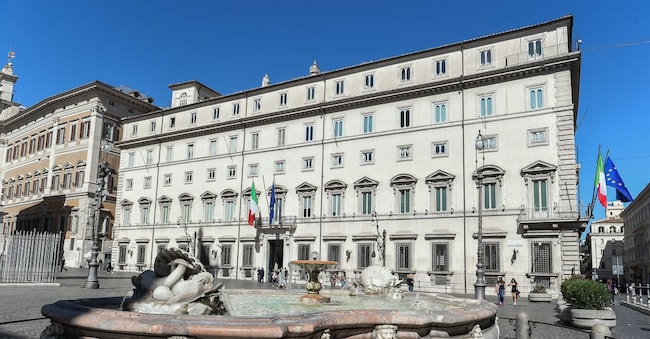
Council of Ministers

Go-ahead for the Labour dl. Meloni: new extension of excise tax cut possibly shorter and for diesel fuel

By the end of the week yes to the House Plan. On the summits of Consob and Antitrust to be appointed "I am quite optimistic," says the premier

by Rome Editorial Staff

 IMAGOECONOMICA

4' min read

Translated by AI
Versione italiana

4' min read

Translated by AI
Versione italiana

Green light from the Council of Ministers to the new Labour Decree launched in view of May Day, Strengthening the role of collective agreements through the concept of 'fair wages', incentives for stabilising contracts for the under-35s and for the recruitment of unemployed women, new rules for work mediated by digital platforms are the pillars of the measure, according to the drafts circulated.

"We think this is the best way to thank the Italians who every day contribute with their work to make our nation great," commented Prime Minister Giorgia Meloni, according to whom "the decree law allocates almost a billion euros for the renewal of some important and effective employment incentives. By the end of this week, the House Plan will be launched, the Prime Minister assured.

Loading...

Meloni: numbers tell us that today more than yesterday Italia is founded on work

The approved decree is 'the building block of a much broader strategy, pursued since the inauguration, which aims to support the creation of more, but also more stable and quality employment'.

"We also see this measure as a starting point for an alliance, a pact with the intermediate bodies, the trade unions and employers' organisations, to which I have referred on many occasions: it is not a vague declaration of principle," the premier explained at the press conference. "It is a concrete choice that must be built measure by measure, obviously with those who are available for this work. The challenge for quality work can only be won if we work as a team, if we all work in the same direction, if we demonstrate this will with facts'.

"New excise cut extension maybe shorter and will help diesel more"

The government is considering 'a further extension' of the excise tax cut, which could be 'shorter than the previous ones' and 'no longer horizontally: diesel has had a more significant increase than petrol' and therefore the cut 'could impact diesel more than petrol, to have a better distributed impact'.

"We are following the negotiating table," he explained, "we are trying to keep fairly close to the progress of the situation, but we have not yet defined the precise timing of the weeks to which the extension of the cut will refer

"Optimistic about Consob and Antitrust summits next week"

"On the summits of Consob and Antitrust I am quite optimistic that next week we will have both". So said Prime Minister Giorgia Meloni at a press conference at Palazzo Chigi after the Prime Minister's meeting.

Female employment and Zes

In detail, the measure introduces, for the whole of 2026, contribution exemptions of up to 100 per cent for open-ended hirings: up to EUR 650 per month, rising to EUR 800 for women residing in the regions of the Single Zones for Southern Italy, with a maximum duration of 24 months. An expenditure limit of EUR 26.5 million is envisaged for the year 2026, EUR 63.7 million for the year 2027, and EUR 51.3 million for 2028. Similar measures are envisaged for the under-35s, with the youth bonus and the Zes bonus: total exemption from the payment of total social security contributions by private employers, with the exclusion of those due to Inail, up to 'a maximum amount equal to €500 on a monthly basis for each worker' (up to €650 if within the Zes). For this purpose, EUR 109.7 million are allocated for the year 2026, EUR 252.4 million for the year 2027 and EUR 135.4 million for the year 2028, plus a further EUR 26 million for the year 2026, EUR 60.0 million for the year 2027 and EUR 34.0 million for the year 2028 for the Zes.

Space is given to the stabilisation of fixed-term contracts, with incentives to transform short contracts into open-ended contracts, especially for young people in their first stable employment, again with a contribution allowance of up to EUR 500 per month.

Wage front

The draft does not introduce a legal minimum, but strengthens the principle of the 'fair wage' linked to the most representative national collective agreements, which also become a mandatory reference for access to incentives. There is also a strengthening of transparency, with the obligation to indicate the contract applied and the salary in job offers and in compulsory communications. There is also a boost to renewals, with an automatic adjustment to 30% of inflation (Ipca) in the case of contracts not renewed for 12 months. The rule has changed several times, in an earlier draft the adjustment was to 60%, however, it does not apply to contracts that have already expired: in this case the measure applies from 1 January 2027.

A central chapter concerns work through digital platforms: a presumption of subordination in the presence of algorithmic control is introduced and information obligations on task allocation, remuneration and evaluation are strengthened. Platforms will also have to keep performance data and make them available to the authorities.

Digital Caporalism

The decree also intervenes on the fight against digital caporalisation, with sanctions for the illicit use of accounts and exploitative practices. In this regard, the following constitute indications of illicit remuneration below the minimums laid down in national contracts, 'disproportionate rhythms, times of availability or workloads', and 'use of other people's identities, documents or accounts in an organised manner'. For riders, there are obligations of identification 'with SPID, CIE or CNS or with an account issued by the same platform to a single tax code'. The transfer of one's account and the use of accounts by a person other than the account holder is punishable by an administrative sanction of between EUR 600 and EUR 1,200. Other measures include the extension of the isopension until 2029.

The Premier: with minimum wage rights at risk as in Puglia

"As we have always argued, in the case of the introduction of a minimum hourly wage we would risk constructing not an additional guarantee parameter but, paradoxically, a substitute parameter for an overall amount that today's contracts clearly represent and construct, risking a downward revision of workers' rights," Meloni noted. 'Clearly this is not a thesis that only we support, all the major trade unions have also supported it for a long time,' he added. And I must also say that our doubts were not completely out of the air if you take as a parameter what happened in Apulia, where the regional government decided to apply the measure of the minimum hourly wage in the tender for concierge services in the regional offices: the result was that the workers were paid a lower wage, so we start from another premise

Copyright reserved ©
Loading...

Brand connect

Loading...

Newsletter

Notizie e approfondimenti sugli avvenimenti politici, economici e finanziari.

Iscriviti