
Deep drilling for critical minerals
Excavations will target materials for chips and batteries. But the ecosystem of the oceans is at risk

4' min read
Key points
4' min read
The world is hunting for nickel, copper, manganese, cobalt and rare earths to produce chips and develop green technologies, from batteries to solar panels. The ocean floor, especially in the abyssal plains at depths of 4-5 thousand metres, is littered with these metals, contained in trillions of nuggets discovered by oceanographers as early as the late 19th century. These are polymetallic nodules, which are generally the size of a large potato. The total amount of nodules on the seabed has been estimated at 500 billion tonnes. The growth of nodules is one of the slowest geological phenomena: it takes many millions of years to grow about one centimetre. Their abundance can vary widely, but in some cases they cover more than 70% of the seabed. A density of economic interest has been discovered in three areas in particular: in the north-central Pacific Ocean, the Peru Basin and the Indian Ocean. The most explored and promising deposits are located in the Clarion-Clipperton area, in international waters between Mexico and Hawaii.
Trump's sights
.It is precisely on this area that Donald Trump has set his sights: at the end of April, the US president ordered the acceleration of licensing of deepwater metal mining projects in an attempt to boost a nascent industry and wrest control of critical minerals away from China. The executive order signed in late April is the latest move in Trump's strategy to expand US access to critical minerals, following agreements with countries such as Ukraine and Congo to gain access to their mineral resources. The most immediate beneficiary of Trump's executive order will be The Metals Company, a Vancouver-based, Nasdaq-listed company that has long been fighting for permission to mine in deep water: its share price has nearly doubled in the past month.
New rules by the end of the year
However, this move represents an open challenge to the Jamaica-based International Seabed Authority (Isa), whose 170 members include the EU, China and Brazil, but not the US. The Isa's secretary general, Leticia Carvalho, has responded sharply: the US has no authority to issue licences in international waters. China has already warned against any unilateral action on the seabed, whose resources 'are considered common heritage of mankind'. The EU insists that the rules of the United Nations Convention on the Law of the Sea are binding even for countries that have not signed it, such as the United States. So far the Isa has refused to allow commercial mining and has only issued 31 exploration contracts, even though it has been working for ten years on a regulation for the mining exploitation of the seabed and Carvalho assures that it will be finalised within the year. If the Secretary General is right, we would be on the eve of an era of exploitation of the seabed according to agreed rules.
Risk to marine ecosystems
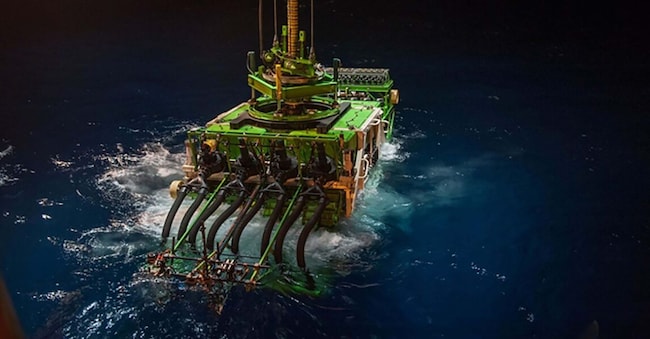
.Marine biologists, however, have already warned of the possible risks of these activities. To extract mineral treasures from the depths, in fact, it is necessary to enter with heavy machinery into ecosystems about which we still know very little. It involves dredging the ocean floor, completely in the dark and with 500 times more pressure than at the surface, by lowering tubes connected to remote-controlled bulldozers from large ships, which would roll along the seabed sucking up nodules, to pump them to the surface. It is not hard to imagine the effect on the marine fauna and flora, a myriad of species some of which we do not even know about. Scraping the ocean floor could destroy colonies of octopuses, sponges and other species living in deep waters, causing similar damage to trawling. Mining would also produce sediment plumes, which could be toxic. Noise and light pollution could compromise entire deep-sea communities that have adapted to the lack of light. Douglas McCauley, a marine biologist at the University of California, describes the ocean depths as 'one of the least resilient ecosystems on the planet'. Other experts counter that mining on the ocean floor would certainly be less polluting and cause less damage than mining on the surface.
New discoveries on black oxygen
.The latest development in scientific research is that metals scattered on the ocean floor would produce so-called 'black oxygen' through an electric current capable of splitting the hydrogen and oxygen atoms contained in seawater: scientists led by Andrew Sweetman, of the Scottish Association for Marine Science, have in fact discovered the presence of oxygen during exploration at a depth of over 4,000 metres in the Clarion-Clipperton Zone. A surprising discovery, because at those depths oxygen should not be there. "Through this discovery, we have generated a lot of unanswered questions and raised a lot of questions about how to deal with these nodules, which are basically batteries contained in a rock," cautioned Sweetman. The oceans produce about half of our oxygen, through organisms that, like on land, use photosynthesis. But at these depths, the lack of light rules out the possibility of a photosynthetic origin of the oxygen detected by the team. Hence the explanation that black oxygen is produced by the nodules through the electrolysis of seawater. This discovery challenges the established theory that all oxygen is generated by photosynthesis, raising new questions about how life in the oceans originated.

