Defence and space are driving venture capital: 16 new unicorns by 2026
Rising global spending in the sector is driving investment: in the first half of 2026, the sector raised $22.6 billion

Key points
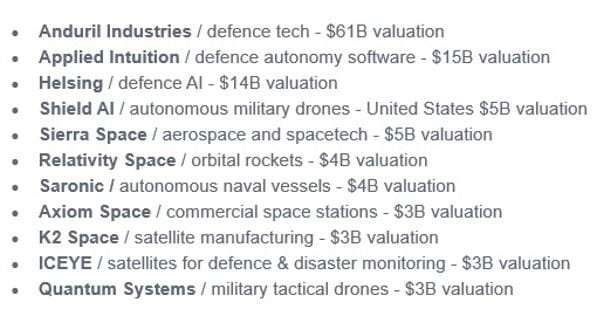
The new global arms race and the surge in investment in strategic technologies are also reshaping the priorities of venture capital. After years in which many funds shunned the sector for reputational and sustainability reasons, defence, aerospace and the space economy are undergoing a major reassessment, fuelled by rising military spending by Western governments, the spread of artificial intelligence and the growing importance of dual-use technologies, which can be deployed in both civilian and military contexts. According to an analysis carried out by BestBrokers based on data from Crunchbase, supplemented with information from PitchBook and other specialist sources, $22.6 billion was invested in companies operating in the defence, aerospace and space economy sectors in the first six months of 2026. During the same period, 16 start-ups achieved ‘unicorn’ status, exceeding a private valuation of $1 billion, for a combined value of close to $23 billion.
Space economy leads the way
The aerospace and space economy sector remains the main driver of growth. In the first six months of the year, nine new unicorns emerged, with an aggregate valuation of 12 billion dollars, accounting for 7.4 per cent of all new unicorns created globally during the same period. The defence sector is also seeing a sharp rise in investor interest. In fact, seven start-ups surpassed the $1 billion threshold during the half-year, accounting for a further 5.8% of the total number of new unicorns worldwide.
The United States dominates the market
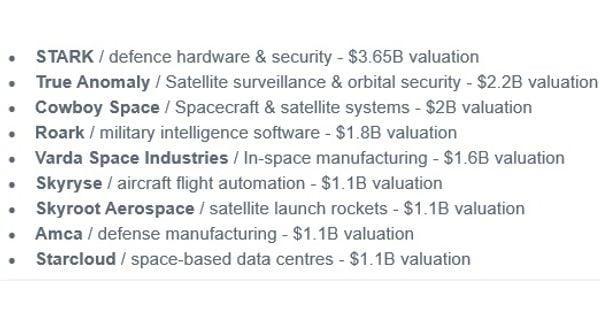
From a geographical perspective, the United States continues to be the key ecosystem for this sector, accounting for 9 of the 16 new unicorns – almost 60 per cent of the total. Among the highest-valued companies are Cowboy Space Corporation, which specialises in satellite infrastructure, and True Anomaly, active in space security, both valued at $2 billion. In the defence sector, Amca (Advanced Manufacturing Company of America), an advanced manufacturing firm valued at $1.1 billion, also stands out, alongside military drone developer Performance Drone Works and military technology firm Defence Unicorns, both valued at $1 billion.
Europe is stepping up its efforts in AI, drones and Earth observation
Europe, for its part, is consolidating its presence in the sector with five new unicorns in the first six months of 2026. Specifically, in the United Kingdom, two new billion-dollar companies have emerged: Roark Aerospace, which specialises in autonomous technologies for defence and airspace management, became a unicorn in January 2026 following a $313 million funding round that brought its valuation to $1.8 billion; In March, it was the turn of Uforce, a developer of autonomous systems based on drones and robots for land, sea and air operations, which raised $50 million in its first round of external funding, reaching a valuation of $1 billion.
In Germany, Stark – a developer of autonomous attack drones powered by artificial intelligence – stands out, having recently raised 500 million euros in one of Europe’s largest funding rounds dedicated to defence technologies. The funding round was backed by investors including Sequoia, Founders Fund and the NATO Innovation Fund, bringing the company’s valuation to $3.65 billion.