Towards the Council of Ministers

Defence: from military cyber specialists to drones, the first phase of the Crosetto reform gets underway

A draft bill aimed at strengthening national operational capacity is due to be examined by the government

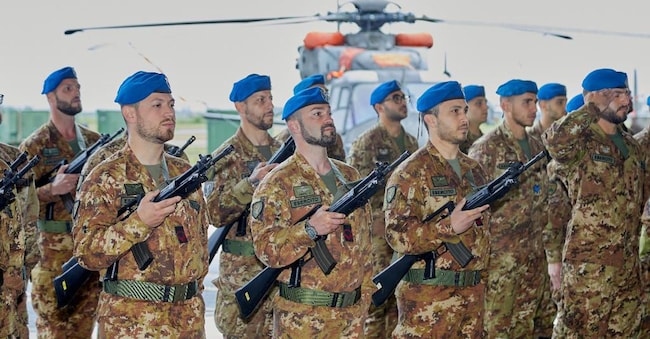
Approda sul tavolo del Consiglio dei ministri una riorganizzazione della Difesa Imagoeconomica

4' min read

Translated by AI
Versione italiana

4' min read

Translated by AI
Versione italiana

Cyberspace is officially being incorporated into the standard framework of defence policy. This is the key new development in the measure due to be tabled before the Council of Ministers on Tuesday 4 August. At the heart of the draft bill, which *Il Sole 24 Ore* has seen, is the provision for a cyberspace of national interest for the defence and military security of the state. This move demonstrates just how prominent a role cybersecurity currently plays amongst security threats.

This space comprises the entirety of IT infrastructure, including hardware, software, capacity, data, and physical and electromagnetic connections. It also includes OT cyber-physical systems, comprising process actuators, sensors, industrial control systems (ICS) installed on military vehicles and platforms, mobile devices with network connectivity, as well as the interconnection points, digital representations, and the physical, logical and cognitive relationships established between them. In all these areas, the Ministry of Defence works to fulfil its institutional duties, including beyond national borders.

Loading...

The measure, comprising 15 articles, marks the first stage of a comprehensive reorganisation of the Ministry of Defence. For the second stage, the new voluntary reserve for the Italia , outlined by Minister Guido Crosetto, will have to wait for the time being. The necessary resources must first be identified.

The Chief of the Defence Staff formally assumes command and control of cyber operations. And that’s not all: the role of Military Cyber Specialist (with the corresponding qualification) is being introduced.

Without prejudice to the remit of the National Cybersecurity Agency, the Ministry of Defence thereby assumes responsibility for the organisation, professional training and deployment of joint cyber personnel.

But the changes are not limited to the cyber sphere. With regard to funding, Article 12 of the draft bill provides for the establishment of a Fund for Investment in Military Scientific and Technological Research (FIRTSM) within the Ministry of Defence, with an initial allocation of €10 million per year from 2026. The criteria for accessing the fund will be set out in a decree issued by the Minister of Defence, after consultation with the National Director of Armaments, to be adopted within eighteen months of the measure coming into force.

Some of the changes have organisational implications. Following an amendment to the Military Code, the post of Deputy Chief of the Defence Staff has been established. Reporting to the Chief of the Defence Staff, the Deputy Chief of the Defence Staff is appointed by decree of the President of the Republic, following a decision by the Council of Ministers, on the proposal of the Minister of Defence, after consultation with the Chief of the Defence Staff, from among officers holding the rank of General of the Army, Admiral of the Fleet or Air Chief Marshal on permanent active service. He is entitled to a special pensionable allowance.

Under the provision, the Chiefs’ Committee becomes the highest advisory body to the Minister of Defence. It comprises the Chief of the Defence Staff, the Commander of the Joint Forces Operational Command, the Chiefs of Staff of the Armed Forces, the Commander-General of the Carabinieri, the Secretary-General for Defence and the National Director of Armaments. The function of this body is to put forward proposals which the Chief of the Defence Staff in turn submits to the Minister of Defence.

The Joint Forces Training Centre for Combat and Countering Hybrid Threats has been established. Headed by a Major General or an officer of equivalent rank from the Armed Forces on permanent service, it reports directly to the Chief of the Defence Staff.

A joint-services high-level committee has been set up to assess major generals and equivalent ranks. For the Italian Army, Navy and Air Force, this committee comprises ten members. Its members include, amongst others, the Chief of the Defence Staff and the Chiefs of Staff of the Armed Forces. The number of members rises to 12 for the Carabinieri.

The measure also introduces new provisions regarding drones. The document uses the term ‘military unmanned aerial systems’. These are remotely controlled or autonomous aircraft, deployed for institutional purposes by the Armed Forces and the Carabinieri for activities related to military duties. It is made clear that the Armed Forces and the Carabinieri are responsible for the deployment of these systems and, in the case of operational activities – whether on national territory or abroad – relating to emergencies, crises or armed conflict, they must follow the rules laid down by the authority designated for that purpose.

As part of the process of rationalising the use of public property, the Ministry of Defence may identify state-owned properties retained for the Ministry’s institutional purposes that are suitable for exchange for goods, services or works with local authorities, publicly owned companies and private entities. The exchange procedures are carried out by the Ministry of Defence, in consultation with the State Property Agency.

Regarding the measure providing for the voluntary reserve, however, we must wait. The reason for what is effectively a two-stage process lies entirely in the issue of resources, which are currently in short supply, pending the final decision due in September on whether or not the country will exit the EU infringement procedure. The issue is inextricably linked to the request to invoke the national safeguard clause, which allows for flexibility not only in military and security spending but also in the energy sector. The Minister for the Economy, Giancarlo Giorgetti, who will first appear before the committees on Tuesday and then in the Chamber on Wednesday, is expected to explain the mechanism to Parliament, seeking authorisation to submit Italy’s request to Brussels.

Copyright reserved ©
Loading...

Brand connect

Loading...

Newsletter

Notizie e approfondimenti sugli avvenimenti politici, economici e finanziari.

Iscriviti