
Defence: Italia can now equip its F-35 fighter jets with its own missiles, not just US ones
On 26 June, the US Department of Defence, on behalf of the Navy, awarded a contract worth $74.2 million to Lockheed Martin. One of the aims of the agreement is to provide for the adoption of ‘sovereign’ weapons in the Block 4 modernisation and upgrade programme for the UK and Italian F-35s.

Key points
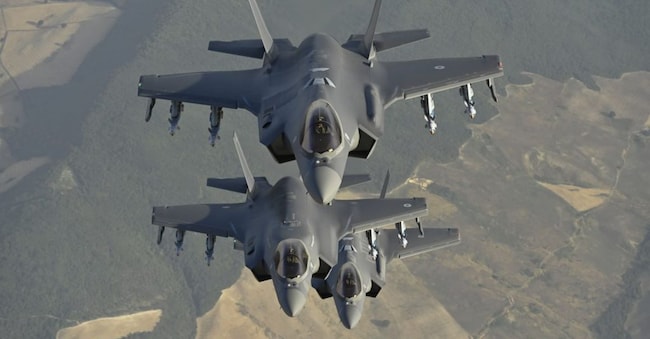
A step towards an F-35 fighter that is a little less ‘US-centric’ and a little more Italian (than it already is). On 26 June, the US Department of Defence, on behalf of the US Navy, awarded a contract worth $74.2 million to Lockheed Martin. One of the aims of the agreement is to provide for the adoption of ‘sovereign’ weapons in the Block 4 modernisation and upgrade programme for the UK and Italian F-35s.
The F-35’s Block 4 modernisation programme, which has suffered massive delays to date, introduces significant hardware and software upgrades necessary to enable the aircraft’s on-board computer to ‘communicate’ with non-US weapons.
Essentially, the agreement of 26 June allows Rome and London, as members of the North Atlantic Treaty Organisation, to integrate nationally selected munitions onto their F-35s, thereby increasing operational flexibility compared with exclusive reliance on US-produced weaponry. For the United Kingdom, the Block 4 roadmap provides for the integration of the MBDA SPEAR 3 missile – a small cruise missile 2 metres long and weighing 100 kilos – and the Meteor, a long-range air-to-air missile designed to intercept targets beyond the pilot’s line of sight. Block 4 introduces greater processing power, expanded memory capacity, improved electronic warfare capabilities, upgraded sensors and enhanced networking capabilities, making the aircraft effective against advanced air defence systems.
Guidance from the US Department of War
‘Lockheed Martin Corp., Lockheed Martin Aeronautics Co., based in Fort Worth, Texas – as stated on the Department of Defence’s website, in the section on contracts dated 26 June relating to the US Navy – has been awarded a finalisation amendment (P00134) on a ‘cost-plus-incentive’ basis worth $74,220,041 relating to a previously awarded contract (N0001919C0010). This amendment finalises four contract items aimed at providing the United Kingdom and Italia with the integration of specific weapon systems, through a functional review of the system until the completion of development tests on the F-35A and F-35B aircraft, in support of the ongoing development of the F-35 Block Four’s critical combat capabilities for the Joint Strike Fighter programme. Furthermore – the statement continues – this action also includes the partner-shared scope relating to a tactical data recorder for the F-35A, F-35B and F-35C. The work will be carried out at Samlesbury in the United Kingdom (51 per cent), Fort Worth, Texas (24 per cent), Orlando, Florida (10 per cent), El Segundo, California (5 per cent), in Baltimore, Maryland (5 per cent), in Nashua, New Hampshire (1 per cent), at various locations within the continental United States (2 per cent), at various locations outside the continental United States (2 per cent), with completion scheduled for December 2032. Funding for research, development, testing and evaluation (Air Force) for the 2026 financial year, amounting to $500,000; funds for research, development, testing and evaluation (Navy) for the 2026 financial year amounting to $500,000; and funds from the Department of Defence’s non-US partners totalling $187,336,521 will be committed upon award, none of which will expire at the end of the current financial year. This contract was not put out to tender. The contracting authority is the Naval Air Systems Command at Patuxent River, Maryland’.
F-35 technology is largely US-based
The agreement marks a new development. “It is a sign that, despite the personal controversies at the top of the American political leadership, the defence establishments continue to cooperate – indeed, precisely with a view to rebalancing transatlantic relations and the respective burdens, with greater autonomy for the European allies,” notes Alessandro Marrone, head of the “Defence, Security and Space” programme at the IAI (Institute of International Affairs).


